
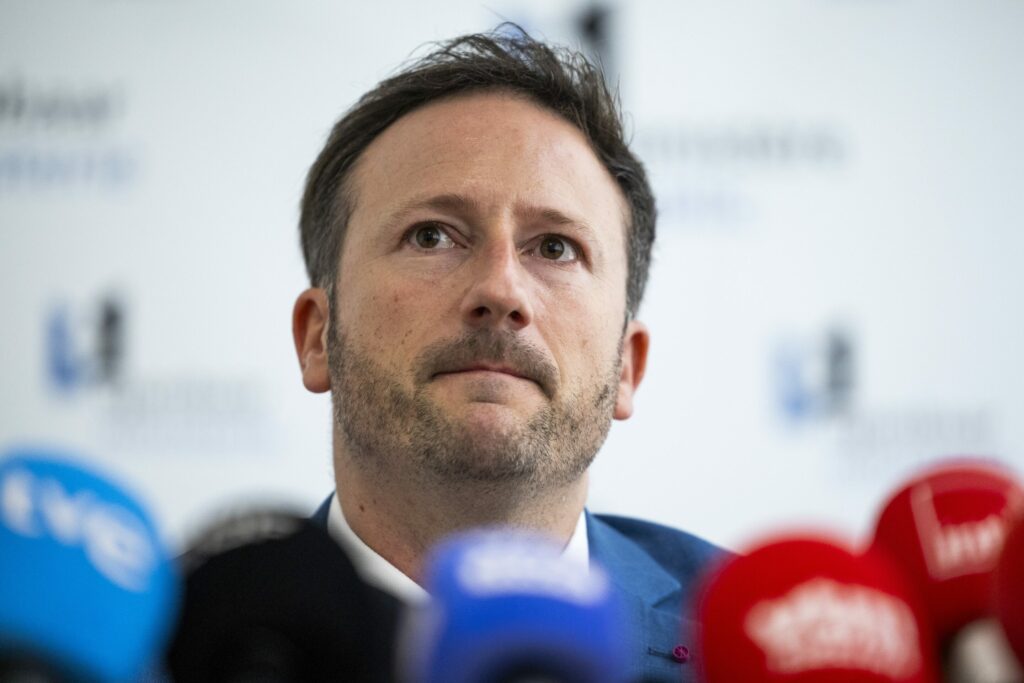
Brussels chief prosecutor Julien Moinil has warned that shootings linked to the capital’s drug trade remain a persistent threat, after six more incidents were reported over four days.
Speaking at a press conference on Friday, Moinil said he felt he was repeating himself. He noted that prosecutors had held a similar briefing a year and a half ago about the same problem, which he said still endangers society.
He said the shootings tend to come in waves, but that the underlying issue, drug trafficking, is constant.
"Any citizen can get shot. This is not going to calm down," warned Moinil, the King's Prosecutor of Brussels on Friday.
The press conference followed a fresh spate of violence between Friday evening and Monday evening, including an attack in which a police station was shot at. Moinil said Brussels recorded 102 shootings in 2025 and has already seen 69 in 2026.
He said he had warned last year that any innocent bystander could be struck by a stray bullet, and that this had since proved true.
In April, an innocent civilian in Saint-Josse-ten-Noode, a father, was left paralysed for life in a shooting, he said. At the end of July, a 20-year-old man was also shot in the torso.
Moinil said every shooting is being investigated and prosecuted, and that several suspects have already been arrested and weapons seized in recent days.
However, he said the justice system cannot tackle the problem alone, especially without the resources it is legally supposed to have. His office is still not fully staffed, despite repeated requests, with the Brussels federal judicial police also short of 80 detectives.
Moinil also raised concerns about prisons, saying arrested leaders of drug gangs are still able to continue their operations from inside their cells and order contract killings.
He said he had already called for signal jammers to block mobile phone communications for such detainees, and asked why this had still not been done.
French minors
Brussels police and prosecutors are increasingly dealing with French minors being recruited to take part in the city’s drug trade, with dozens arrested in recent weeks and months.
According to Brussels Public Prosecutor Julien Moinil, the full scale of the phenomenon is still unclear. The young people involved come from several parts of France, including the north of the country, Lille, Valenciennes and Marseille.
He said they are often recruited through social media, although investigators have also identified links between Brussels-based and French drug gangs. Moinil has ordered a detailed analysis to establish exactly how many minors are involved and where they come from.
The findings are expected soon, but the issue is already creating serious difficulties for the Brussels justice system.
“These are easy targets for drug gangs, and they are easy to replace,” Moinil said. He added that Brussels is already facing a youth care crisis, with more than 150 minors waiting for a place in a secure institution.
As a result, French minors arrested in Brussels often have to be released because there is no room to hold them. Moinil said those young people should ideally be taken in closer to home, through the French youth care or justice systems.
Authorities say they are trying to tackle the problem in the meantime. Police in the Brussels-Midi zone, which covers Anderlecht, Saint-Gilles and Forest, recently arrested a man who was renting out a flat where six minors were sleeping on mattresses.
The cybercrime unit is also investigating the issue, as many of the teenagers are believed to be recruited online.
Prime Minister Bart De Wever (N-VA) is also convening a meeting of the Intelligence and Security Coordination Committee (CCRS) this Friday from 14:00 to discuss shootings and drug trafficking, Le Soir reports.
