
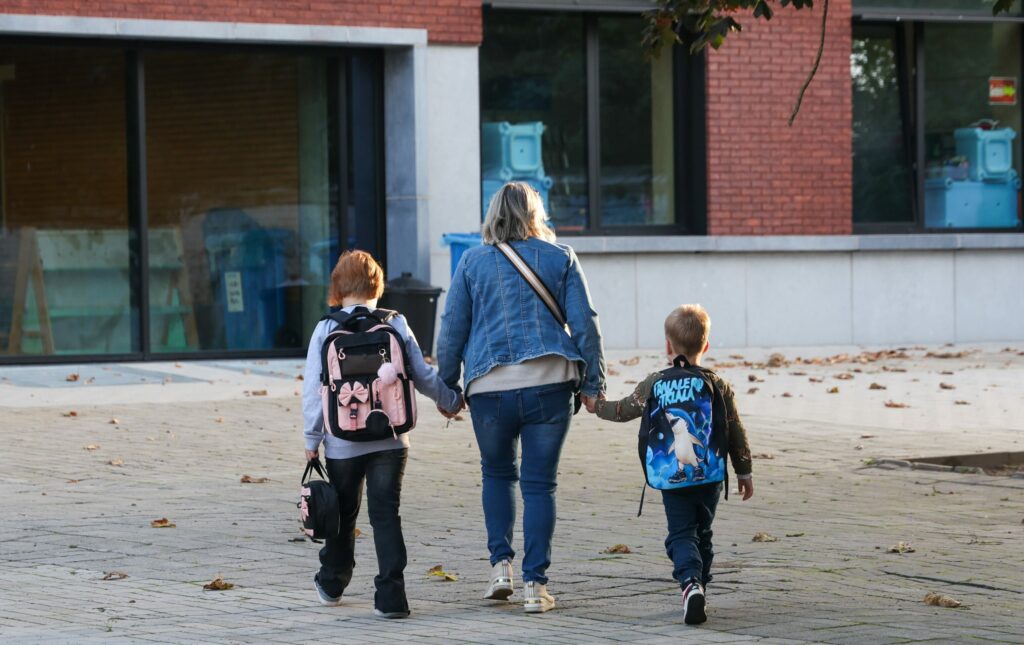
More than 1 million children and young people in the Flemish education system are returning to school today, Tuesday 1 September.
The Dutch-speaking education system will undergo a series of far-reaching changes, as Flemish Education Minister Zuhal Demir (N-VA) set a wide-ranging reform package in motion.
Nearly 3,800 pupils in their first year of secondary education (ages 12-13) will receive three extra hours of Dutch per week, on top of the standard timetable. The extra lessons are compulsory for pupils who did not meet the minimum Dutch language targets at the end of primary school. The primary school class council will decide which pupils are eligible when the certificate is awarded.
In primary education (ages 6 to 12), the phased introduction of revised minimum targets – which replace the 1997 attainment targets – is also set to begin. The common thread is a stronger focus on knowledge, and the targets are becoming much more specific.
Related News
- New penal code, fewer homeless shelters, back to school: What changes in Belgium on 1 September?
- First year of school changes brain fundamentally, research finds
- Is a shop-free Sunday good for our health?
In the 2026–2027 school year, the revised targets for Dutch, mathematics, and science and technology will become compulsory for nursery pupils and for pupils in the first, second and third year of primary education (ages 6 to 9). The remaining subject areas and higher year groups will follow in stages up to 2029–2030.
Additionally, 30 primary schools have been selected as ‘inspiration schools’. Each will receive €70,000 to recruit additional staff and will take on a leading role in the implementation of the knowledge-based minimum objectives.
Each inspiration school will share its expertise with around ten other schools within learning networks. Demir is allocating €2 million to the project.
As much as possible, school days must be effective teaching days: optional holidays will be abolished, staff training days will be restricted, and lessons may no longer be suspended in school buildings following elections.
The first and last days of term will be full teaching days, and in secondary education the maximum number of assessment days will be reduced.
Where lessons cannot take place, pedagogically meaningful childcare will become the norm. Demir points out that Flemish schools provide 11% fewer teaching hours than the OECD average. There will be no changes to the school holidays to bring them in line with Belgium's French-speaking system.
Furthermore, 20 pilot schools will launch. In these, mainstream and special needs schools will collaborate with learning support staff and Centres for Pupil Guidance (CLB) to test how pupils with additional support needs can be better supported. The pilot projects are voluntary.
By the end of the legislative term, there should be 50 such projects; €5.2 million has been earmarked for the first academic year.
One planned reform will not go ahead: the greater flexibility regarding religious education subjects. The Council of State ruled that the organisational flexibility the Flemish Government sought to introduce via a decree went too far.
Following that advice, Demir said it would be unreasonable to impose yet another new framework on schools.
According to the most recent figures from Statistics Flanders, Flemish primary and secondary education had over 1.2 million pupils in the 2025–2026 school year. Pre-primary education (mainstream and special needs) had approximately 256,900 pupils, and primary education (mainstream and special needs) had 456,400 pupils. In secondary education (mainstream and special), there were 501,900 pupils.
