
The idea that the mainstream media is biased against the right seems like common sense to many, and conflict with the press has almost become a part of the contemporary idea of what it means to be conservative.
While some historians in the United States argue that conservatives invented the notion of a liberal media bias, AJ Bauer, a former journalist and assistant-professor at the University of Alabama, traces the idea of a biased press instead to left-wing critiques of concentrated media ownership in the hands of the wealthy.
"In the 30s and 40s, there was this widespread consensus that the media was biased in favour of the right," Bauer told the Brussels Times. "How do we get from that to where we are now, where people believe that the media are biased against the right?"
To answer this question, Bauer visited Brussels to speak at the VUB as part of his tour of several European universities to promote his new book "Making the Liberal Media: How Conservatives Built a Movement Against the Press" at the end of October.
The event was co-organised by ECHO and DESIRE, two research groups at the VUB.
[caption id="" align="alignnone" width="800"] Professor AJ Bauer. Credit: DESIRE research centre at the VUB[/caption]
Based on archival research and historical analysis, Bauer outlines three major historical steps.
He starts with the roots of left-wing press critique in the US in the 1930s and 40s, to the right-ward shift as anti-communists appropriated these arguments in the 40s and 50s, and finally to the 1960s, when the idea of a biased media became a movement-making force in conservatism and a central part of its political identity.
The belief that there was a structural conservative media bias "was popularised by progressives and liberals during the New Deal era. Franklin Roosevelt was fond of claiming that 85% of the newspapers were against him in the New Deal," Bauer said.
At the seminar, Bauer drew on historical events like the second Red Scare in the 40s and 50s that marginalised progressive critics, pointed out how conservative groups used the Fairness Doctrine to get airtime for their political views during the 1950s and 60s.
He identified a famous speech by American Vice President Spiro Agnew in 1969 denouncing the media for their coverage of Richard Nixon as a moment that made this kind of critique mainstream. By the 60s and 70s, according to Bauer, criticism of the media became a way for conservatives to see themselves as a political community under attack from cultural elites and the press.
Beyond bias
Bauer makes more than a historical argument. For him, bias is the wrong framework to evaluate media altogether, as it presupposes a standard of objectivity that cannot be reached.
"Objectivity is kind of a horizon that you orient yourself towards, but you never ultimately achieve," he said. "Bias is a euphemistic way to say we disagree."
But what would this change in perspective mean from journalism? For Bauer, it means shifting away from evaluating news from the point of view of 'bias' and 'impartiality,' and reimagining what journalism is and what journalists do.
"It requires changing our imagination of the public and what we see ourselves as journalists doing. So rather than just informing the public, it's movement building. You can think about journalists as movement builders," Bauer said at the event.
"How do you cobble together constituencies through a story that you may write that may appeal to multiple different subconstituencies in order to cultivate a shared common sense oriented towards change?"
Media bias in Europe
Experts believe that there are parallels to be drawn with right-wing political thought in Europe as well.
"You find this criticism of the media as being dominated by a progressive elite across far-right parties in Europe," Professor Benjamin De Cleen, the academic coordinator of the Journalism and Media in Europe Master's at the VUB, told the Brussels Times.
"Even though the national contexts are very different, certain tropes related to this are very similar, sometimes copied from the US, but often also just homegrown," he said.
This partially arises because of the diminished dominance of mainstream media, he said, with a contemporary right-wing news culture emerging online, advancing the narrative that they are necessary to tell the public the truth.
In Belgium, a yearly report, called Onpartijdigheid van de VRT Nieuwsberichtgeving, examines impartiality in the VRT news coverage. The news archive in Antwerp has recorded all 19:00 news broadcasts for public and commercial broadcasters in Flanders since 2003.
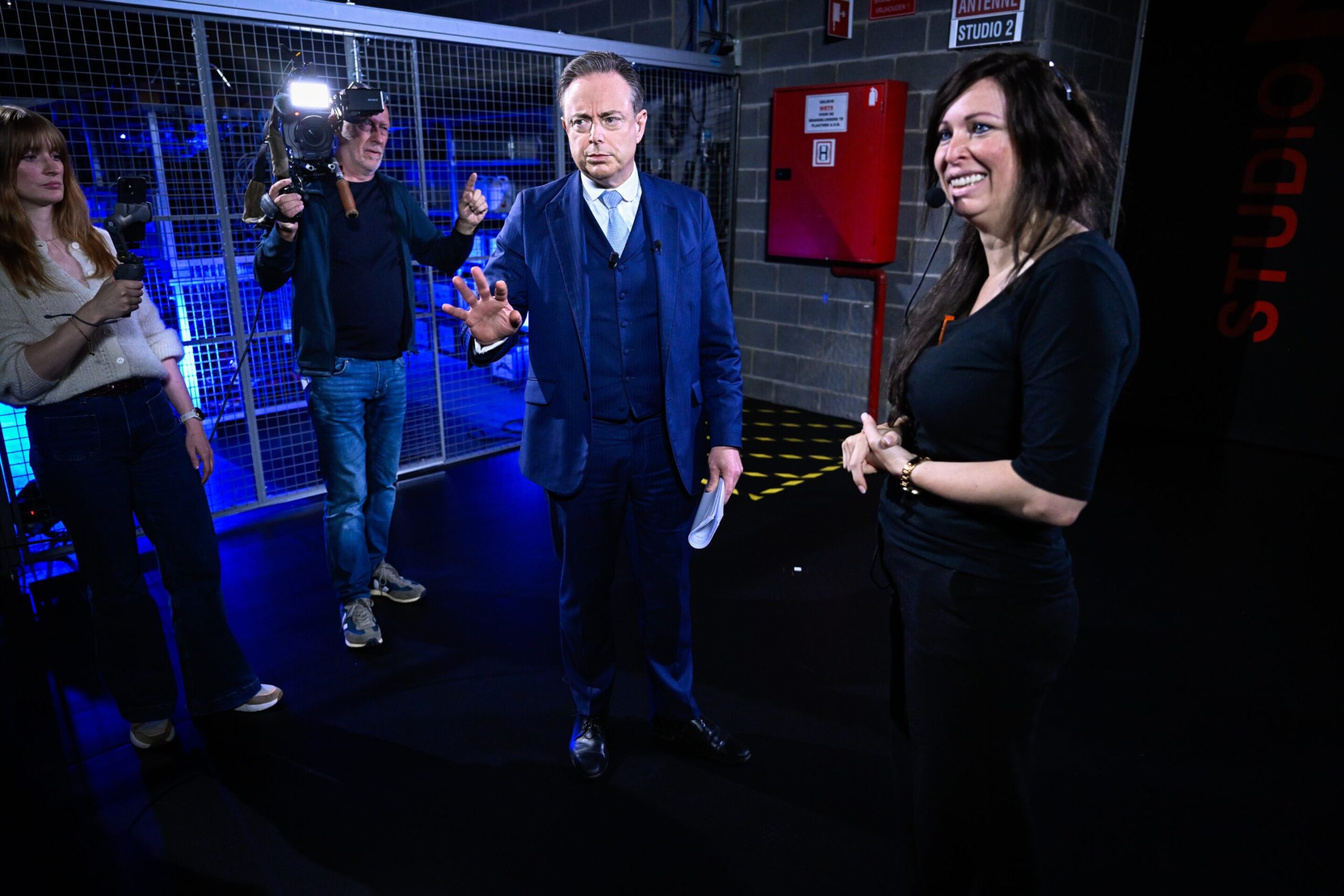
N-VA leader Bart De Wever pictured at the VTM television studio in Vilvoorde, Tuesday 28 May 2024. Credit: Belga/Laurie Dieffembacq
Every year, they measure the speaking time of politicians on these programmes, and present that report to the Flemish parliament, as part of the research.
"One of our main conclusions over the years is that the news follows a power logic. So people with power get the microphone," Peter Van Aelst, a Professor at the University of Antwerp and vice-dean in the Faculty of Social Sciences who is part of the group carrying out this research, told The Brussels Times.
His own research has found little evidence that there is something like a left-wing bias in the media, he said, and based on his own talks with journalists and editors, he believes that they are highly sensitive to questions regarding bias.
Nevertheless, measuring impartiality is not as simple as it seems. According to Van Alest, the critique of the Flemish far-right Vlaams Belang is "somewhat fair," as they receive only a fraction of the rightwing N-VA's air-time, despite only narrowly losing the election.
Importantly, however, N-VA then went on to become the biggest party in the both the federal and Flemish governments, with the country's Prime Minister being N-VA's party leader, Bart De Wever. Vlaams Belang, meanwhile, is not part of any government.
For Vlaams Belang, speaking time should be proportionate to the number of votes recieved, and being biased means not meeting that benchmark.
"We are also struggling with doing impartiality research. What is the benchmark? When is the story completely neutral or impartial?" Van Aelst asked. "If you have some ideas for us as researchers, I'm very open to them."
