
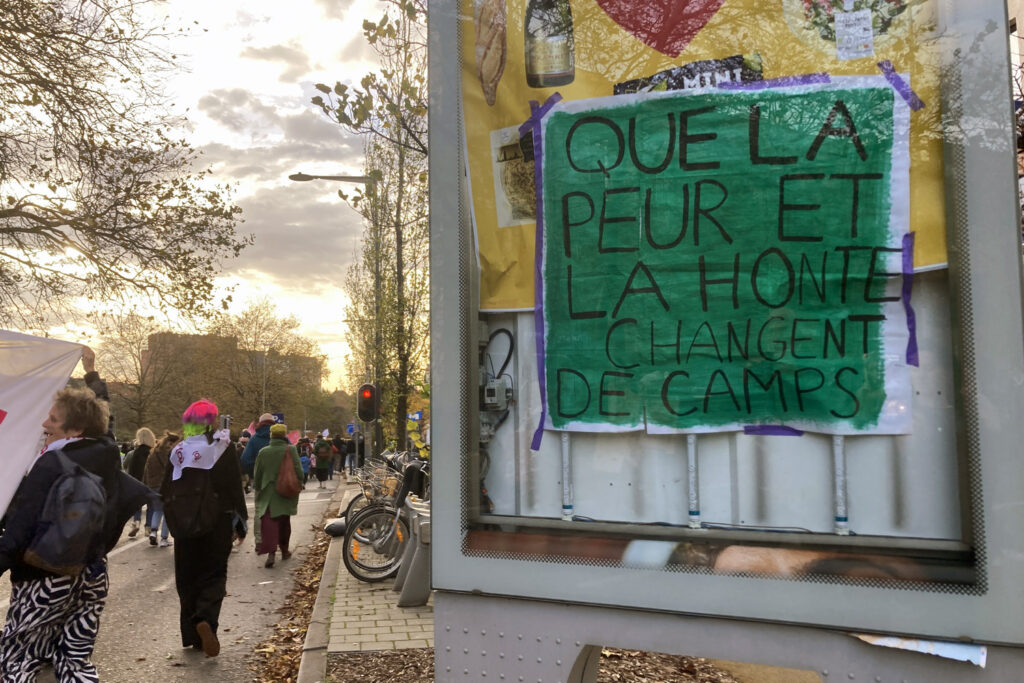
As the International Day for the Elimination of Violence against Women approaches on 25 November, feminist groups in Belgium are warning that cuts to funding for charities and campaign organisations are undermining efforts to tackle gender-based violence.
Women and gender minorities continue to face physical, sexual, economic and psychological abuse. A European survey carried out in 2021 and 2022 found that 42.5% of women in Wallonia, 33.7% in Brussels and 24.7% in Flanders had experienced violence by an intimate partner.
Feminist organisations Soralia and Sofélia say the scale of the problem means gender-based violence must be treated as a public policy priority. They argue that lasting and substantial funding is needed for charities and collectives working to combat such abuse.
Related News
- 'My dad is an ex-Jihadist': The first date stories you can't make up
- How fear of homophobia changes the way queer people move through Brussels
- Women in Brussels 'filmed without their knowledge' by men wearing Meta smart glasses
Instead, the two groups say the voluntary sector is being weakened. Despite the existence of public policies aimed at tackling gender-based violence, they say front-line organisations are losing grants and, in some cases, being forced to stop their work altogether.
The Feminist Platform Against Violence Against Women, known as PFVFF, has lost two grants in the space of a year. As a result, it has had to suspend its monitoring of femicides through the StopFéminicide project.
The loss of funding also cast doubt on whether the national demonstration organised through the Mirabal platform, coordinated by PFVFF, could go ahead.
The march has ultimately been maintained and is due to begin on Sunday 29 November at 14:00 from Place de l’Albertine in Brussels.
Calls for stronger action against sexist and sexual violence are now being made against the backdrop of budget cuts. Soralia and Sofélia say withdrawing funding from the sector amounts to a new form of violence, this time institutional.
They say many organisations, particularly smaller ones, are struggling to survive without adequate subsidies, while others have lost much of their staff because they no longer have the resources to keep them on. As a result, they are being asked to respond to growing social needs while making up for state failings with ever more limited means.
The 29 November demonstration will also be used by the sector to defend the right to protest. Aline Dirkx, PFVFF’s coordinator, said there was currently a rollback of rights, including the right to demonstrate.
She said an increasing number of measures were putting social and fundamental rights at risk, including the right to raise one’s voice in disagreement.
Soralia and Sofélia say they share that view. They argue that civil society’s ability to organise is being hindered not only by economic measures, but also in the streets by what they describe as a police institution mired in violence.
