
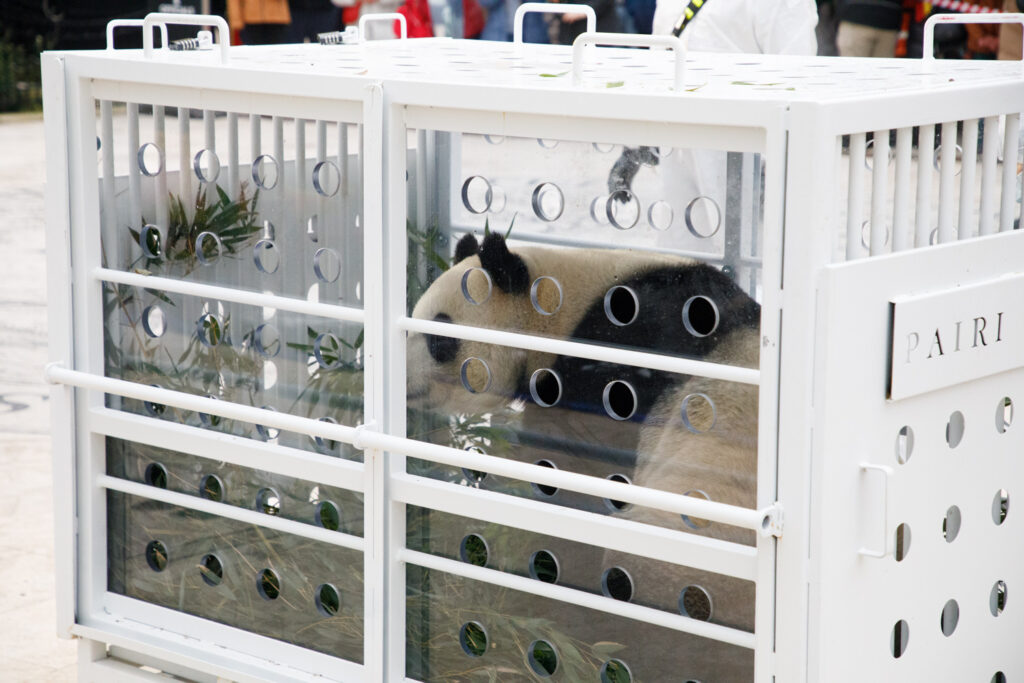
Ran Ran, a nine-year-old female giant panda from China, arrived at Brussels Airport on Saturday before being transferred to Pairi Daiza animal park in Cambron-Casteau, the park said.
She landed at 12:30 in Zaventem and was then taken to the park in Brugelette, in Hainaut province.
Born on 31 May 2017, Ran Ran had been living at the Shenshuping base in Wolong, part of the China Conservation and Research Centre for the Giant Panda in Sichuan province.
Related News
- 'No political bargaining chip': Belgium urged to extend 12-week abortion limit
- What Belgium's sewage reveals about the country's drug habits
- Three unwritten rules: How to become a true Belgian
According to Pairi Daiza, her name suggests gentleness and tenderness, as well as growth and flourishing.
The panda weighs about 110kg. Her Chinese keepers describe her as calm and gentle, saying she likes spending time alone, prefers a peaceful environment and is especially fond of tender young bamboo shoots.
Pairi Daiza said its teams worked closely with their Chinese counterparts to prepare both her journey and her enclosure, taking account of her needs and habits.
Ran Ran will now undergo a 90-day quarantine. During that period, visitors will still be able to see her in her cave, although she will have to wait before being allowed into her outdoor garden.
Giant pandas have played a special role at Pairi Daiza for the past 12 years. The park said the arrival of Hao Hao and Xing Hui, followed by the births and first steps of their three cubs, became an important part of its history.
The park’s panda story began in 2013, when Pairi Daiza and its Chinese partners signed a 15-year co-operation agreement focused on giant panda conservation, scientific research and public awareness.
The first two pandas, Hao Hao and Xing Hui, arrived at Pairi Daiza in February 2014. A few weeks later, their habitat was officially inaugurated in the presence of Chinese President Xi Jinping and his wife, Peng Liyuan, as well as the Belgian royal couple.
Their first cub, Tian Bao, was born on 2 June 2016. The family grew again on 8 August 2019 with the birth of twins Bao Di and Bao Mei.
On 10 December 2024, the three young pandas born at Pairi Daiza returned to China in line with the commitments of the conservation programme.
Their mother, Hao Hao, also returned to China to receive specialised medical care and continues to be looked after by her Chinese keepers.
Xing Hui, the father of the three cubs, still lives at Pairi Daiza, where Ran Ran is due to join him soon.
The co-operation forms part of wider Chinese efforts over several decades to protect the species and its natural habitat.
Thanks in part to conservation measures in the wild, the population of wild giant pandas has risen from about 1,100 in the 1980s to nearly 1,900 today.
Pairi Daiza said Ran Ran’s arrival marks the continuation of the project. It was made possible by an additional agreement signed on 16 September 2026 between the Chinese and Belgian partners, in a year that also marks the 55th anniversary of diplomatic relations between China and Belgium.
