
As more than half of Belgians (54%) are in favour of extending the country’s current legal 12-week abortion limit to 18 weeks, over a dozen organisations are urging the federal government to relax the strict measure.
In Belgium, abortion is currently permitted up to 12 weeks after conception. After that, a termination may only take place for medical reasons. There is also a legally mandated six-day waiting period between the initial consultation and the procedure.
“In our centres, we see every day that abortion care is not a black-and-white issue,” said Carine Vrancken, director at LUNA. “There is no ‘type’ of woman or couple who have an abortion: we see people of every religion, every political persuasion and from all walks of life.”
“Abortion is not a matter of the political left or right, but touches on something very fundamental,” she said. “People want to make informed decisions about their lives, parenthood and their future.”
'Not particularly concerned'
According to an independent survey commissioned by the LUNA Abortion Centres non-profit, 54% of Belgians want more flexible rules – with the majority of them advocating a limit of 18 weeks or more.
In the survey, participants were presented with fictional scenarios in which a woman had an unwanted pregnancy, such as following rape or a lack of desire to have children. Participants could respond with ‘yes’, ‘no’ or ‘I’m not sure’. Those who were undecided were not counted among either the supporters or the opponents.
Importantly, the majority of respondents stated they were not particularly concerned with the issue.
On a scale of 0 to 10, the acceptability of abortion scores highly, with an average of 7.6 – 41% even gave a score of 9 or 10. The overwhelming majority (90%) believe that a pregnant person should be able to decide for themselves about an unwanted pregnancy.
Additionally, 76% believe that abortion legislation should be based on recommendations from scientific experts rather than on political convictions.
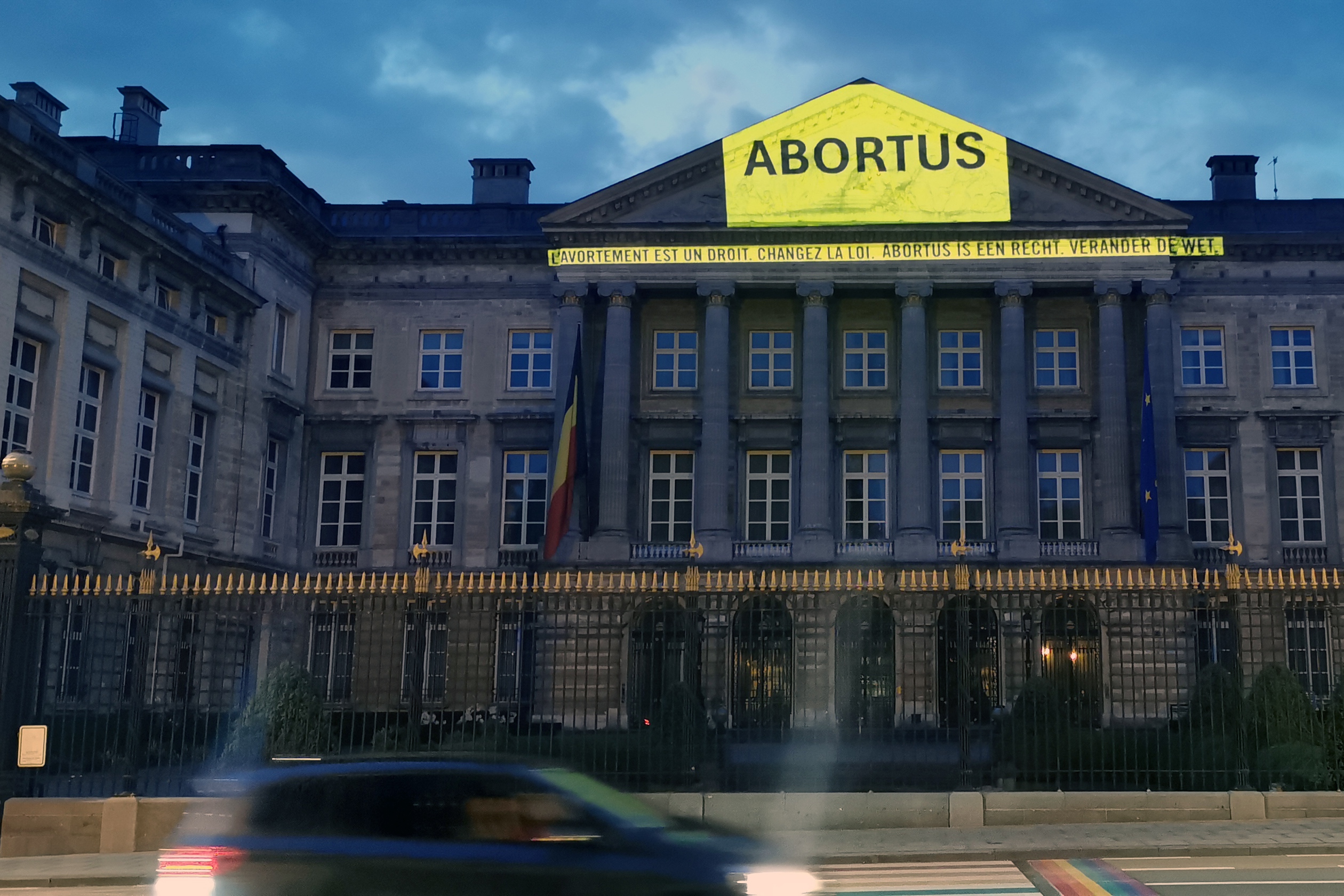
Human rights group Amnesty International holds an action to stress abortion rights, projecting their message on the building of the Chamber in Brussels on Tuesday 10 June 2025. Credit: Belga/Mateusz Kukulka
“Those who wish to retain the 12-week limit do not reject every abortion carried out after that point,” said researcher Lies Maurissen. “What someone wants the law to stipulate and what someone considers acceptable in a specific case are two different matters.”
Opinions on the waiting period are also nuanced; 53% believe the law should impose a waiting period, 30% do not, and 17% are unsure.
Of those who want a statutory waiting period, 35% favour the current six days, 36% believe the healthcare provider and the pregnant person should determine the duration, 12% favour a longer waiting period, and 10% favour a shorter one.
Differences also emerged within the population regarding the question of who should be able to decide on the termination of an unwanted pregnancy. Women and those aged 65 and over most frequently cited the pregnant person (93%).
Men and those aged 18 to 34, on the other hand, were more likely to name the partner or the doctor: around a quarter of them did so.
Interestingly, the survey found that the older the respondents were, the less frequently they mentioned the woman’s partner or doctor.
'A shame'
On Tuesday, following the publication of the survey, 16 organisations called on the federal government to extend the abortion limit to 18 weeks in an open letter published on Tuesday.
They stressed that the abortion debate should be guided by science and not used as “political bargaining chip.”
Recent figures show that in some 400 women in Belgium a year (more than one per day) go to the Netherlands for an abortion, where the procedure is permitted up to 22 weeks (since last menstrual period) in abortion centres.
Before the summer, Belgium’s federal government started looking into extending the country's legal abortion limit from 12 to 14 weeks after conception – ignoring the advice of an expert report that suggested 18 weeks.
By proposing to allow termination of pregnancy up to 14 weeks after conception, the government went against the 2023 consensus among experts commissioned by the federal government itself to examine abortion term limits.
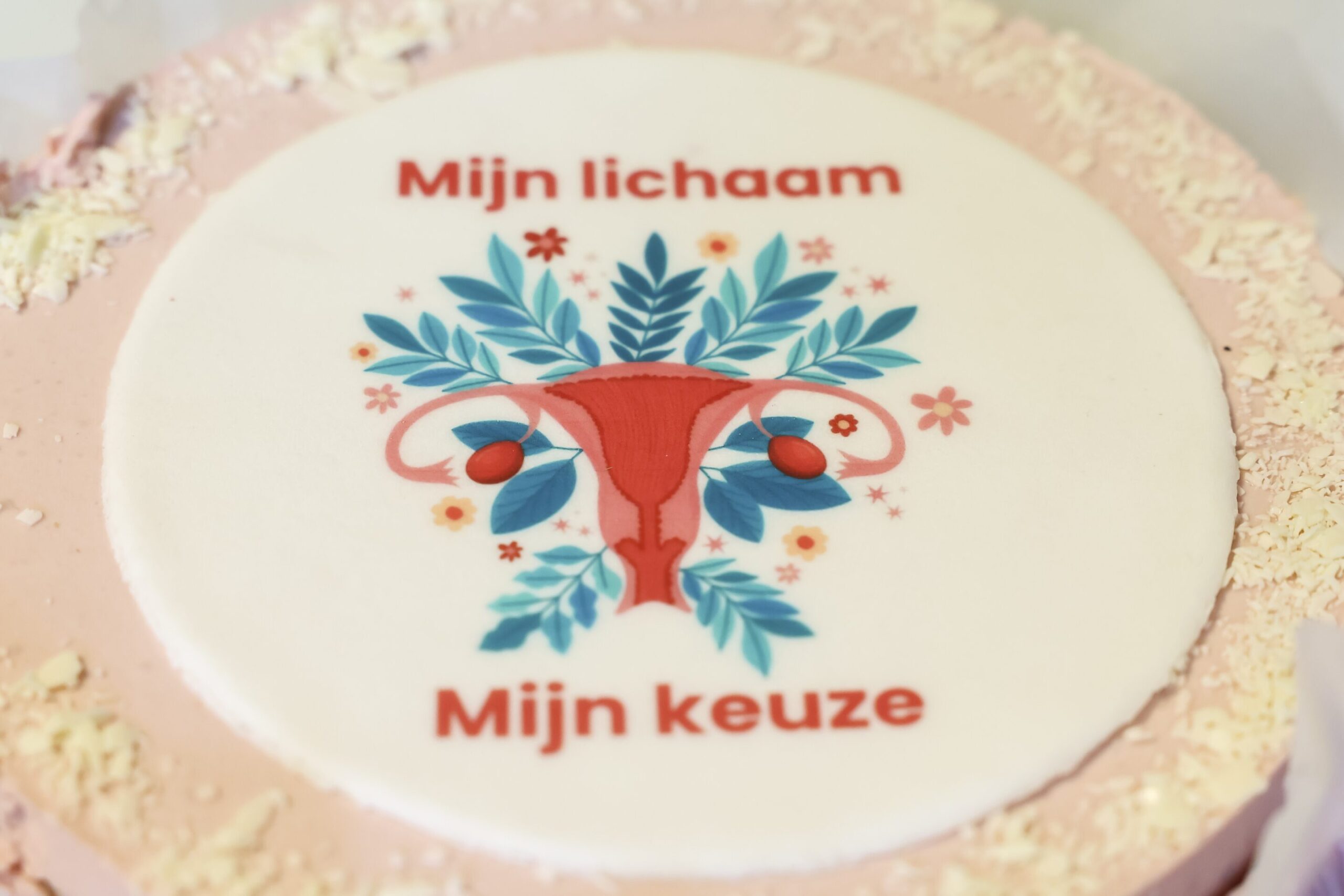
A cake with special decoration showing a woman's reproductive organs in a floral design, and the slogan 'Mijn lichaam, mijn keuze' (My body, my choice). Credit: Belga/David Pintens
At the time, Dr Anne Verougstraete (VUB), one of the pioneers among Belgian abortion doctors and former head of the VUB-Dilemma abortion clinic, told The Brussels Times that this decision was “a shame.”
"By extending the legal limit to 14 weeks, we would only be able to help 22% of the women in Belgium who currently travel to the Netherlands for an abortion," she said. "If we were to extend it to 18 weeks, that figure would rise to 74%."
Verougstraete was appointed by her university, VUB, as one of the experts to draw up the scientific advice report in 2023, under the previous federal government. Having worked on the report for 18 months, she regretted that CD&V (the Flemish Christian Democrats) did not take their recommendation.
"We agreed on a minimum limit of 18 weeks after conception, and we wanted to do away with the mandatory waiting period. But even before the report was published, CD&V made it clear they would not go beyond 14 weeks," said Verougstraete.
Less strict on specific scenarios
Therefore, the open letter calls on politicians to base their policy on scientific recommendations and to take into account the circumstances in which people have to make decisions about that pregnancy.
“As soon as people are presented with specific situations, such as a pregnancy resulting from rape, difficult living conditions or a desire to have no more children, their judgement proves to be less strict,” the organisations said.
While 90% indicated that they trusted doctors and healthcare providers as a reliable source of information on abortion, only 4% said the same of politicians as a reliable source.
Therefore, the organisations criticised the fact that the abortion limit “was not determined by the experts, but was set during the coalition negotiations,” they wrote. “This means that a political compromise risks being the deciding factor in a decision that has direct consequences for access to abortion care.”
For Justice Minister Annelies Verlinden (CD&V), the 14-week proposal is the only way to bridge the ideological divides between conservatives and progressives in the government.
The debate on relaxing Belgium's abortion laws has been going on since the previous federal government took office in October 2020 – and even before that, when it briefly looked as if discussions on a possible extension would block the coalition's formation.
