
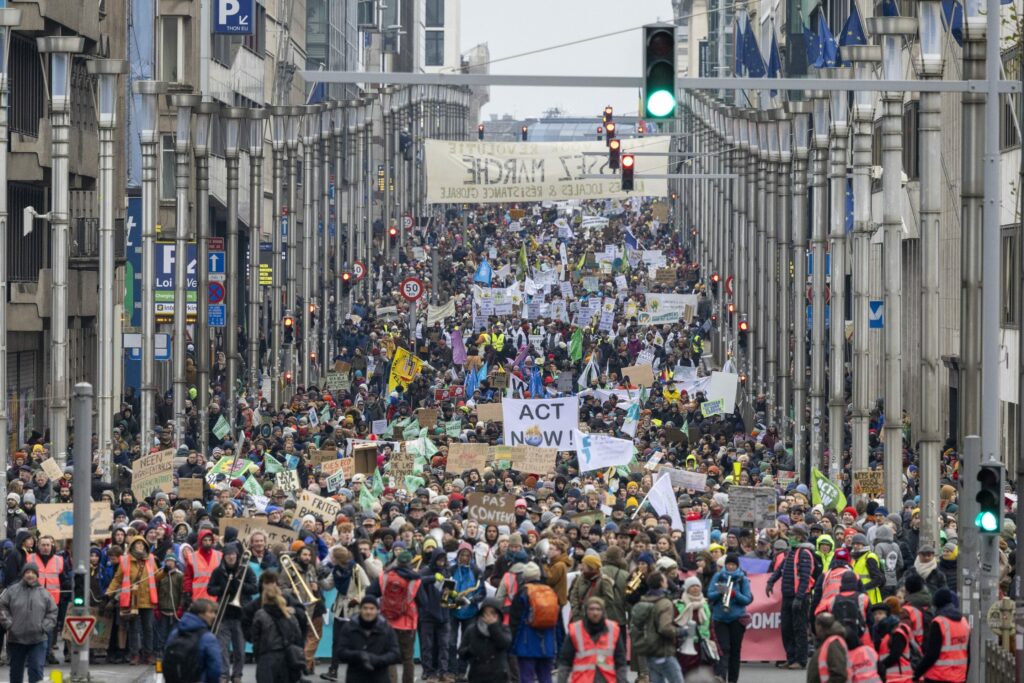
Climate activists are marching in Brussels this Sunday to push for the government to redirect €15 billion of public funds from fossil fuel subsidies to green investments.
The Climate Coalition, an umbrella organisation that unites more than 100 NGOs and has organised the march, expects tens of thousands of people to join. The day will include speeches from Climate Coalition.
The climate march is being organised in the run-up to global climate change conference COP30, which this year takes place in Brazil.
Activists will gather at noon near Brussels-North station, marching from Boulevard Roi Albert II along Boulevard du Jardin Botanique to Boulevard Bischoffsheim and Boulevard du Régent, turning at Rue Belliard and arriving at the Cinquantenaire Park.
Travel disruptions?
Traffic is expected to be disrupted in northern and central Brussels. Several roads along the route will be closed around Brussels-North station and Cinquantenaire Park. These include Rue Royale, Rue de la Loi and the Boulevard Roi Albert II, Several bus and tram lines may be affected.
Road closures are expected around Brussels-North station, Boulevard Roi Albert II and the Cinquantenaire area. Several bus and tram lines may be affected.
The SNCB will be putting on extra trains to and from Brussels on Sunday for passengers taking part in the climate march.
A total of three extra trains will run to Brussels North. They will depart from Ghent-Sint-Pieters (11:21), Antwerp Central (11:06) and Liège-Guillemins (11:06). The trains will also make an extra stop at Mechelen (11:26) and Leuven (11:37) stations.
In addition, the SNCB will increase the capacity of S-trains in and around the capital. According to the SNCB, people taking the train to the march are advised to buy a Weekend Ticket. This is half the price of a standard ticket during the week.

Route and checkpoints of the Climate march 2025. Credit: Climate Coalition
Push against fossil subsidies
Demonstrators are calling for the publicly-funded subsidies of fossil fuel companies to be re-invested into green jobs, reliable public transport, affordable housing, and energy renovation of homes.
Belgium has committed to the binding EU climate target to cut net greenhouse-gas emissions by at least 55% by 2030 compared to 1990 levels. However, according to the Climate Coalition, about €15 billion of public funds are spent on subsidies to fossil fuel companies.
In 2022, Belgium spent €13.3 billion in direct subsidies; about 2.4% to 2.5% of GDP, according to the Ministry of the Environment. Indirect subsidies, which also include VAT exemptions on plane tickets and the tax treatment of company cars, added another €3.4 billion according to their figures.
In June, the European Commission also urged Belgium to phase out its over-dependence on fossil fuel subsidies in its annual socio-economic recommendations for Member States, suggesting this could help reduce budget deficits.
The march is expected to be large, with several key figures expected to join.
Belgium's Archbishop Luc Terlinden and Bishop Lode Aerts of Bruges said they will join the Climate March this Sunday after an ecumenical prayer service in the Beguinage Church in Brussels, the Belgian Bishops' Conference announced on Thursday.
