

At midday on a Saturday, the number of people stopping by the Galerie Bortier to grab a bite to eat, get work done, or browse through old books, is beginning to swell.
The shopping arcade - which is nestled within a block of houses at the foot of Mont des Arts - has been a refuge for bookworms, collectors, and dreamers for over 175 years. Designed by architect Jean-Pierre Cluysenaar, the creator of the Royal Saint-Hubert Galleries, its magnificent interior is reminiscent of old Parisian galeries.
On 22 November 2024, the historic arcade reopened its doors with an entirely new concept: a food hall merging the worlds of culture and gastronomy.
Despite a petition against the transformation that collected 13,000 signatures, three restaurants opened, along with a butcher and a fishmonger, plus a beer counter and literary cafe. These new businesses fitted in alongside the longstanding bookshop, antiquarian, and rare book specialist.
One year on since this controversial metamorphosis from sleepy covered passage for book lovers to busy food hall, The Brussels Times paid a visit to the arcade to see what the arcade's booksellers think of the changes.
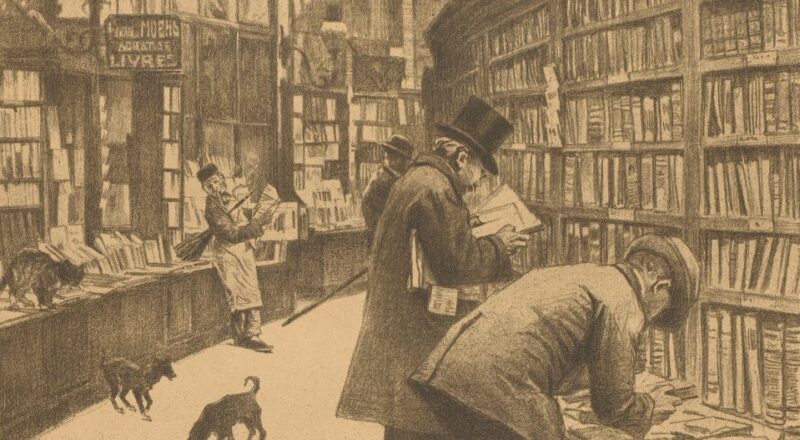
Galerie Bortier drawn by Francois Gailliard in 1919.
'There are businesses that are doing well'
Before its reopening, Nicolas Van Cutsem, who opened his antique shop within the arcade nine years ago, had been cautiously optimistic: "My general feeling is one of curiosity. It could fail, it could work."
Exactly one year later, we sat across from soft-spoken rare book dealer Pierre Coumans in the shop he has run since 2007 - likely one of the only places in Brussels where one can still hold a 16th-century book in hand. Asked whether the reopening had been a success, he answered, “There are businesses that are doing well,” citing the literary cafe, Kawa Club, in particular.
He also noted that although Kawa Club had been thriving in the large space opposite his shop, the café had to move its sales counter to a space at the gallery’s entrance - the one vacated by the butcher Dierendonck after they withdrew from the project less than a year in.
Kawa Club’s relocation stems from a law dating back to the 1970s, which prohibits that particular space from being used for commercial activities; anything that happens there must be strictly cultural. Customers may still bring their drinks into the literary café area, but Kawa Club has reportedly had to hide its former counter behind a curtain and conduct all sales a few metres away.

The Kawa Club literary cafe. Credit: Sabine Zednik-Hammonds
Public inquiry rekindles the debate
In August 2025, a public inquiry into the changes made to the arcade’s architecture was launched by Brussels NGO Inter-Environment, bringing previous concerns about the transformation to light again.
According to the organisation concerned with issues at the intersection of urban, social and environmental matters, the enquiry was launched with the goal of regularising certain “planning violations” made to the listed 19th century building, as well as “the blatant transformation of secondhand bookstores into restaurants and bars (HORECA), a function that should only be secondary.”
On 23 September, a consultation committee meeting took place, during which business owners in the arcade were given the opportunity to express their concerns.
Thierry Goor, the serial Brussels foodhall entrepreneur behind Wolf and Fox who has led the project in the Galerie Bortier told The Brussels Times that “the consultation proved us right on all points.” According to him, “Inter-Environnement raises problems but never comes with solutions.”
The Galerie Bortier presents many challenges for Goor. Unlike his previous ventures, Galerie Bortier is a transient, breezy passageway, making temperatures difficult to manage and outdoor seating less desirable. Also, as it is a listed monument the architecture requires special attention. “We can’t just do as we please,” he explained.

The Galerie Bortier as it is today. Credit: Sabine Zednik-Hammonds
Adapting to 'the smell of beef and fish'
Coumans, who said he wished to “stay out of it all”, did not attend the consultation committee meeting, but his neighbour Fanny Genicot, who runs the eponymous secondhand bookshop, did. “I took the floor and said that this is not what had been planned,” she recalled.
Although Genicot hasn’t felt any noticeable increase in business since the gallery’s transformation, she has noticed a rise in the number of tourists. Many don’t know how to behave in a store like hers. She claims that some out-of-towners mistake the books on display in the gallery’s passageway for freebies and walk away with them, while others spill coffee in her store.
When it comes to the arcade’s new form, “lots of people love the concept”, said Genicot - though perhaps not her clientele. Among them, “maybe one or two out of a hundred think it's great," she joked. At the start, her new neighbours took a bit of getting used to. “Caught between the smell of beef and fish, I sometimes felt a little nauseous,” she admitted with a laugh.
Fifteen years ago, Genicot took over the bookstore her father opened in 1991, after years of helping out here and there. She hopes to pass on what she calls the métier de plaisir (a job you love) to one of her daughters someday. As she spoke, her mother Arlette assisted customers enquiring about out-of-print books, or anything on the topic of Albania.

Fanny Genicot and her mother Arlette sitting in Librairie Genicot. Credit: Sabine Zednik-Hammonds
Breathing life into the arcade?
There also appears to have been some confusion among the booksellers over the nature of the food offering within the arcade. While they initially believed that only small-scale catering would take place in the gallery, that notion was quickly dispelled when they noticed cooker hoods being carried in.
Besides the shopkeepers, Martine Dufrenne, who lives in one of the nine apartments above the gallery, is “not at all pleased” with the changes of the past year and says she wants the arcade to go back to what it was before. Her bedroom is located just next door to the upstairs seating area of the gallery’s new pasta restaurant, and she claims this has led to lots of noise problems.
Still, most people appear to have accepted the changes and do not wish to turn back the clock. Coumans admits that any mention of completely shutting down the food stalls and returning the arcade to its original state “really scares" him.
After all, he explained, for 13 years there was nothing in his part of the gallery. While the stretch leading up to Librairie Genicot thrived, the rest of the gallery was lined with vacant storefronts, causing many people to turn back before ever reaching Coumans's door.
In Goor’s view, if he hadn’t initiated this transformation “the gallery would be empty.” For Coumans, the fact that Goor’s project has breathed some life into the gallery can therefore only be positive. “The Italian restaurant is very tasty. So are the cheeses,” he smiled. It’s safe to say that it will be difficult to ever make everybody happy.
