
"Always pay a compliment if you can with sincerity. Always thank when complimented, whether you believe it or not. Treat people who do humble jobs with respect and courtesy. Smile generously whenever it isn't weird. Tease those who can take it, including, hopefully, yourself. Offer to help without expecting a quid pro quo. It'll come from somewhere. Don't fear people - most are of goodwill. You'll suss out the others quick enough. Be kind to children, animals, the disadvantaged. Always. Look people in the eyes. Lie only to protect feelings."
These are not New Year's resolutions, but rather ten life-rules written by 81-year-old Brussels resident Hugh Dow on 27 December – one of the posts he has been publishing daily on Facebook for the last ten years.
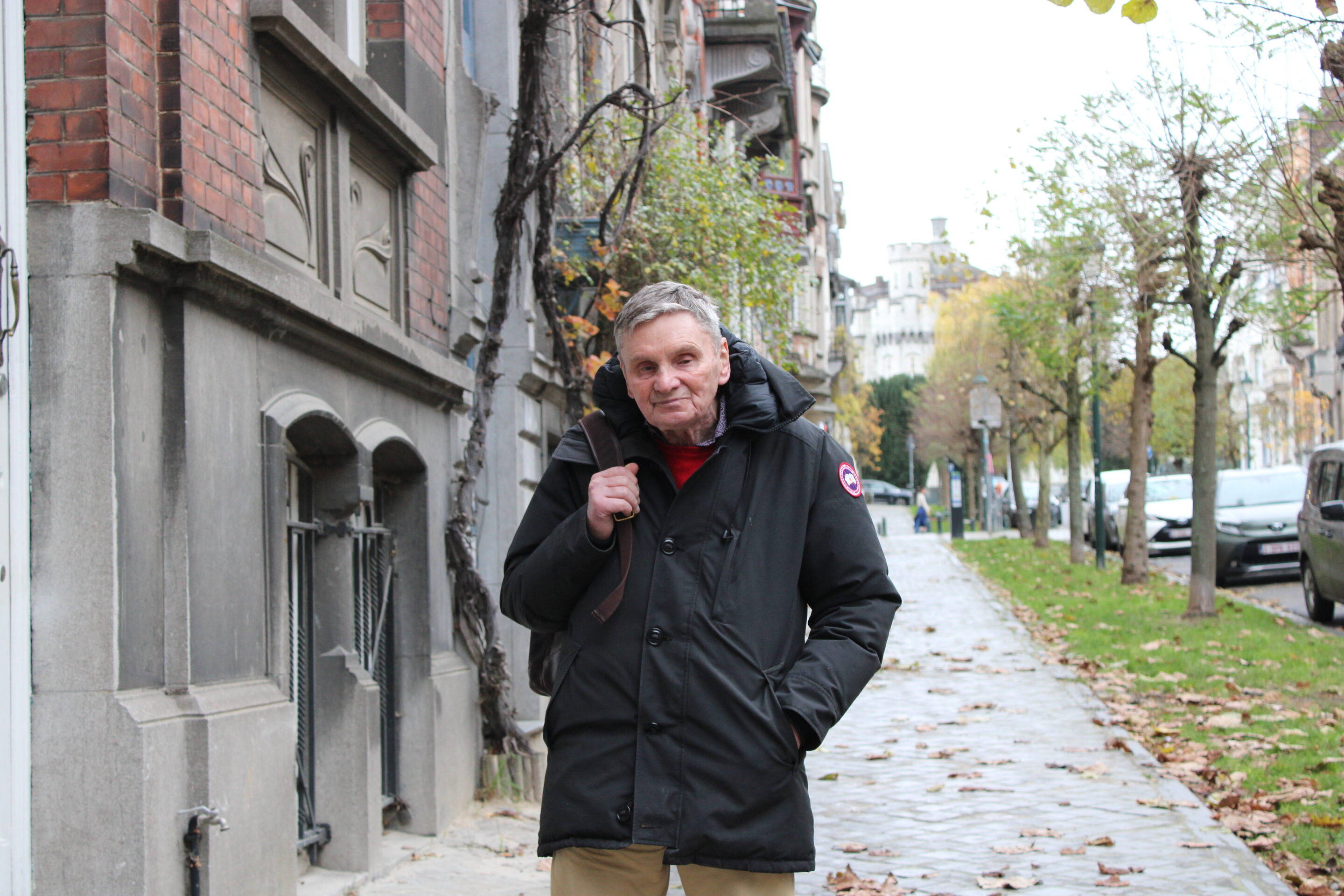
You wouldn't know that Hugh Dow is 81 years old. Dressed in a crimson jumper on a chilly December morning, he's as dapper as he is sprightly and is still regularly directing plays on Brussels' amateur theatre scene. But despite his effervescent positivity, he was told in his early 70s that he only had 12 to 18 months left to live.
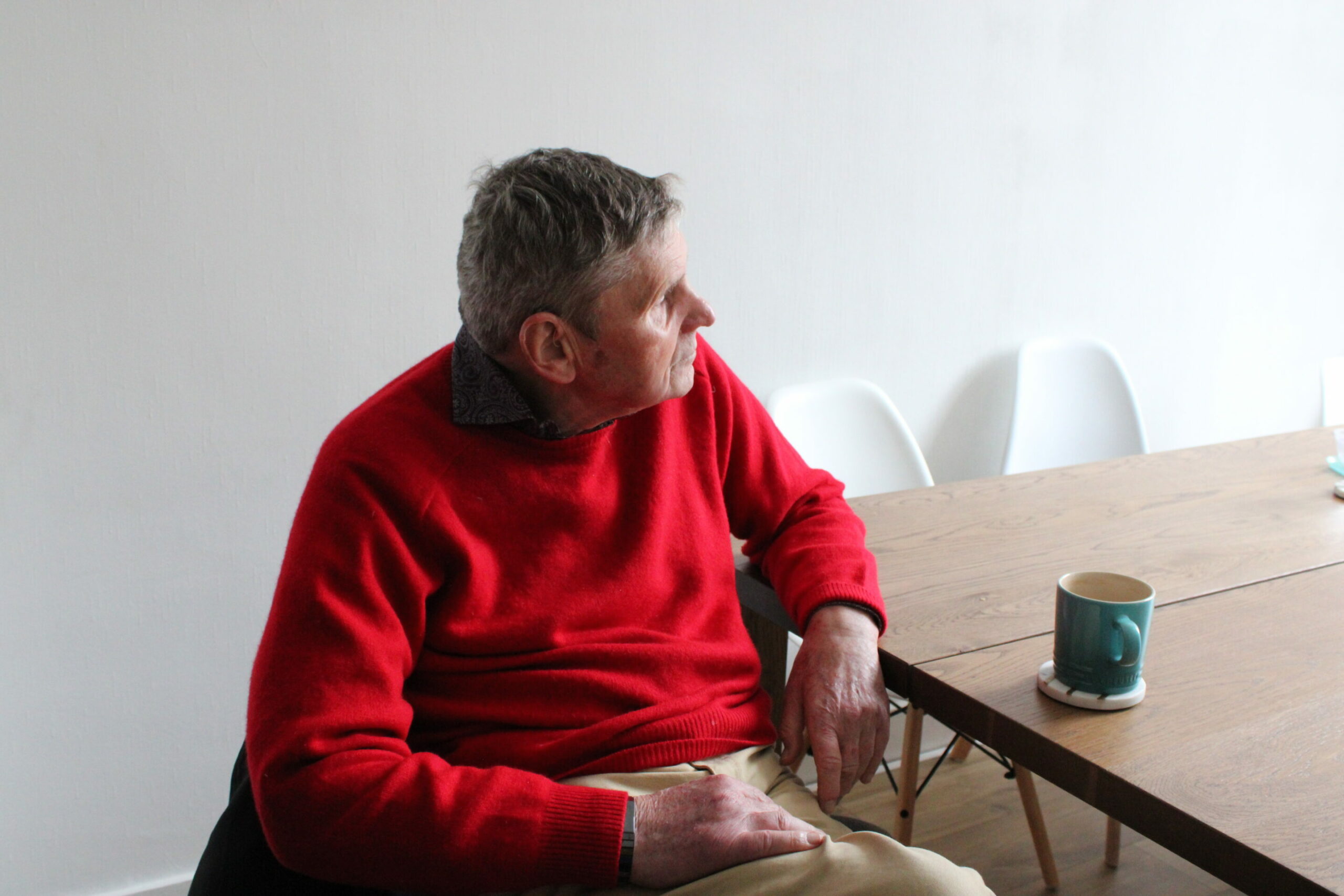
Credit: Isabella Vivian / The Brussels Times
Hailing from Scotland, Hugh has lived in Brussels for over 50 years; a true veteran of the city. He does not consider himself an expat – rather, a proud Belgian citizen.
"I just see myself as a citizen of this city, and I'm quite happy here. I like it. I like its comparative safety, its good eating, its cinema and the fact that you can shoot off to Amsterdam or Paris at a moment's notice."
Would he ever go back to live in Scotland? "Unthinkable."
He does, however, enjoy popping back for holidays and keeps a pair of tartan trews (Scottish trousers worn on special occasions) close to hand. "I occasionally wear them and look mildly ridiculous with a Dolce & Gabbana velvet jacket and a green bow tie. I wore them for my 80th and felt very dandy indeed."
Belgium, the sexless marriage
As a city, Hugh says Brussels gets unfair press. He came for a job with Price Waterhouse in 1973, but stayed for the restaurants, transport, architecture, cinemas, and Belgians' respect, politeness and tolerance. "Nations are constructs. Somebody drew a line on a map at some stage. I like the fact that you don't have to worry about it too much here."
Belgium's international reputation for handling particularly fractious negotiations is thanks to the fact that its citizens do so much of it themselves, he says, as the country is a fusion of two different tribes.
"Somebody said it's like a sexless marriage – and it is. They don't necessarily get on, but they treat each other with a certain deference and step aside as they walk up the stairs. And it's enough. You can't change history. The country is formed."
But he does wish that Wallonia would sort out the "stupidity" of not teaching Dutch properly in its schools, to enable people to get jobs in the north of the country.
Swank in the spotlights
Something else that has kept Hugh here is his love of theatre. Before Brussels, he had only ever acted at his Dickensian Scottish boys' boarding school, where beatings were commonplace.
He remembers playing the messenger in 'Romeo and Juliet' – an unpopular choice of play among his male peers who were forced to play women, "but that's what Shakespeare intended."
Eyes gleaming with nostalgia, he says he also remembers having to play a violent thug once. "I walked around with a big spanner in my hand and terrified everyone. I greased my hair back and wore black leather. It was cathartic. Any incipient violence that I had was got rid of by pretending to be violent."
But he believes he is more of a performer than an actor. "I like to think I'm a cunning swank, like all of us in the theatre. We want to be in the lights, we want to show off. Otherwise, we wouldn't do it. There's something about stepping outside yourself and being someone else, good or bad, that is so satisfying."
Since retiring – or, "leaving business", he says, as he sees retiring as just another stage in his life – he has continued to act and direct with even more gusto.
Most recently, he directed the Irish Theatre Group's 'The Fifth Step', previously a West End hit. In May this year, he's looking forward to leading a 40-minute version of 'Othello' and potentially the powerful, one-woman 'Prima Facie' in the autumn, although negotiations are ongoing.
"If I haven't got a couple of ideas bubbling up, I get frustrated and almost 'idea lonely'."
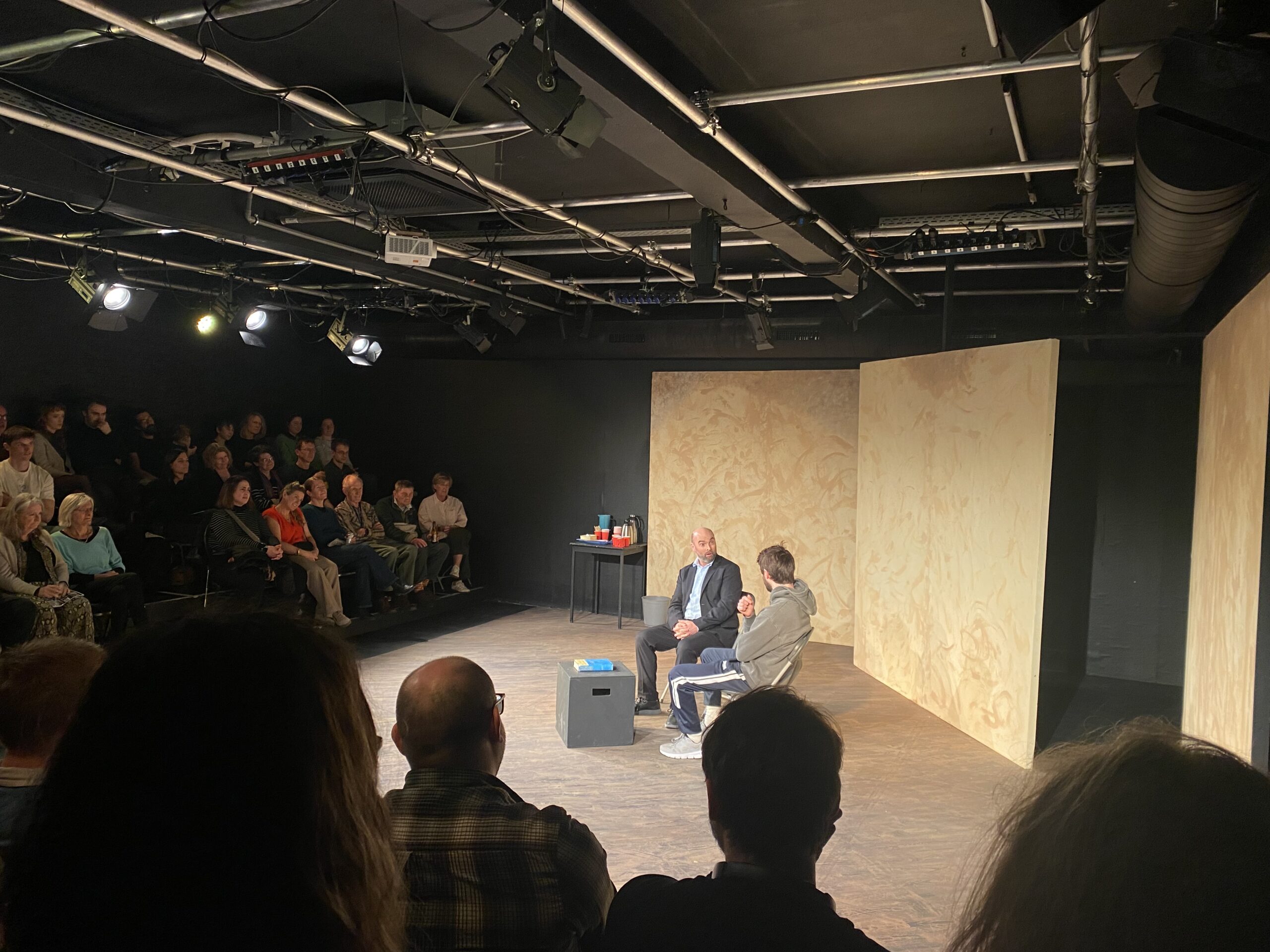
Hugh Dow and his wife Jackie watching his show 'The Fifth Step' in Brussels' Warehouse Theatre. Credit: Isabella Vivian / The Brussels Times
Part of him wonders how long he can keep up the act, and if he's got another decade in him – "which is why I'm an old man in a hurry."
He also wonders if people will start thinking he's getting too old for it. "Ageism is interesting because almost everybody is ageist at some stage, and almost everybody is subject to ageism at the other end, except the unfortunate ones who don't live long enough to be subjected to it. I'm trying to see how good old age can be, and how good I can make it."
Months left to live
Life in Brussels wasn't always plain sailing, though.
At the height of his career, managing the biggest training company in the Benelux, Hugh suddenly became very ill. He was diagnosed with terminal oesophageal cancer and given 12 to 18 months.
He even organised an end-of-life party in the Warehouse Studio Theatre in Schaerbeek, with champagne and poetry readings. He describes the event as "a bit odd", almost as if he were present at his own funeral.
He had a tumour on his throat and could barely speak. "Your voice is so much part of what you are, but when you start to lose it, you wonder, do I exist anymore?"
Throughout the party, he sat in the corner and people would come up to him, looking at him sympathetically. "And I f***ing loved it," he whispers under his breath, earnest and deadpan.
But in a remarkable and somewhat comic turn of events, he went on to make a full recovery. A feat recorded in just 3% of patients – not odds he would have chosen. "Everyone thought I was going to die, but I failed them."
Looking back, he wonders if his positive mindset cured him. He was enjoying the adrenaline-fuelled challenge of trying to sell his business for his family, and "the endorphins flying around like nobody's business" from the attention he was getting.
"I loved the feeling that I couldn't do anything wrong right now. Nobody's going to condemn me for anything, and that just felt fun. And I think I saved my life."
How to get happy
Ever since, Hugh has endeavoured to make every day count. "What happened is an immense privilege. Most people can't say that they've been told they're going to snuff it and then they don't."
So, he says, it then becomes a question of exploiting that unique experience to get the best out of life. He doesn't believe in an afterlife and is convinced this one is all we have, so it saddens him when people "chuck it away."
He notices that many people manufacture their own misery, and admits he was "as bad as anyone." Between an unhappy childhood and a tricky first marriage, he says he was a "self-pitying git", but has since found a zest for life and even wrote a book on it: 'How To Get Happy'.
"There are things to celebrate, but nobody celebrates them. They worry about Brexit or the fact that Brussels has no government. But you’ve got to stop worrying so much and be happy. Positive thinking is so powerful," he says.
"The first thing is to realise that it's a choice. Filter the people out of your life that are making you unhappy. Look for the good in things and in people."
Related News
- Brussels through the eyes of EU workers: A loved but feared city
- The Spanish tourists who came to Brussels and never left
- Think you can party hard? Brussels' senior citizens will put you to shame
Surrounding yourself with the right people is also key. For Hugh, that's his "un-neurotic" wife, Jackie, whom he met through running club Hash House Harriers and married in 1987.
"I love it when, at a family gathering, she arrives and she's just making everybody smile and everybody feels better when she's around. She's a good woman."
His brother, meanwhile, was the most influential person in his life. They'd discuss their problems, but also had great fun. He says his brother made him more equable, and made him see the futility of petty sibling squabbles.
"He died three years ago of cancer, and there's not a day I don't think about him. But I'm not prepared to let him spoil my life.”
Life lessons from an 'old man in a hurry'
Imparting some final words of wisdom, Hugh says being confident is crucial. "If you try, you'll discover you have talents you didn't even know you had. So don't be afraid."
And in true thespian fashion, he quotes Shakespeare's 'Measure for Measure': "Our doubts are traitors, And make us lose the good we oft might win, By fearing to attempt."
Coupled with confidence, he adds that mixing with the right people helps.
"If you keep throwing down dice, eventually a double six will come up. But if you don't put yourself about, that won't happen. Now I'm not a very good networker, because if people bore me, I can't hide it. I get on quite well with 50% of humanity, and it's nothing to do with race, colour, creed; it's to do with whether they're boring or not," he says.
"And the more you talk to people, the more you find people who are like you. It's the same thing in finding a partner for life. If you don't move around and talk to loads of people, you won't find the perfect person."
And finally, "know what you're good at, and pay somebody else to do what you're not good at, because you're always going to be crap at it."
Hugh Dow is a regular contributor to The Brussels Times Magazine, writing about cemeteries and trams.
