
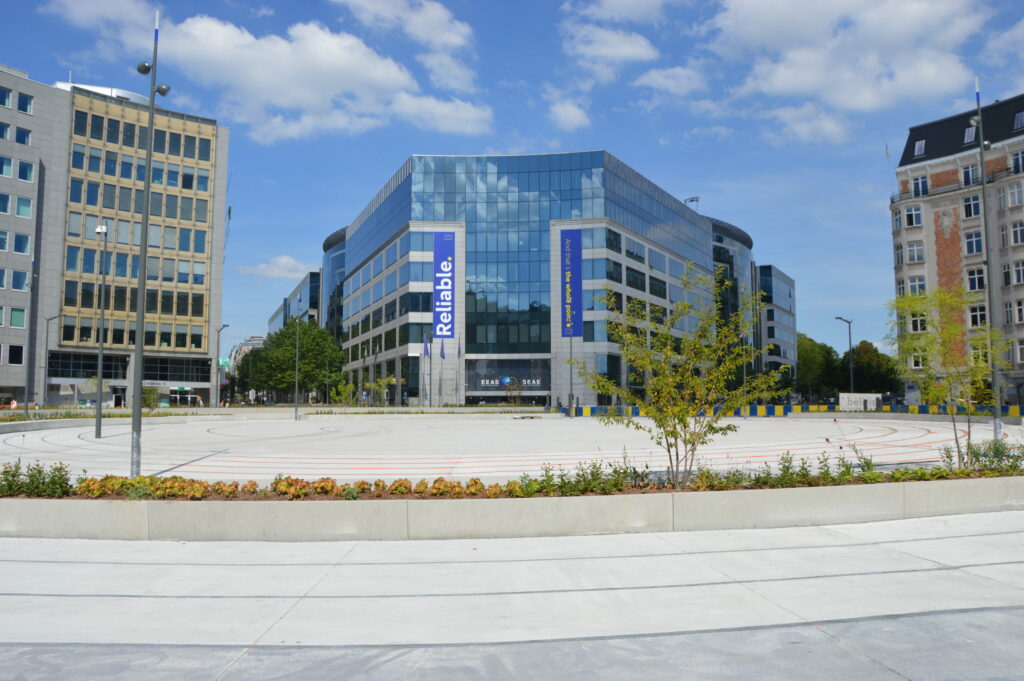
As the long-awaited facelift of the Schuman Square roundabout nears completion, the results are underwhelming for all involved – including the architect himself.
From the start, the project has drawn criticism, particularly following the decision to axe plans for a canopy that would have provided shade and an agora for people to sit down and have lunch.
"The people themselves were meant to become the centrepiece," Francis De Wolf, the Belgian architect who is leading the project, told The Brussels Times. "The roof would have reflected the diversity of the people of Europe."
He and his team at Brut had the idea of centring a large reflective roof that would mirror the people standing underneath it, which he says "would have distinguished Schuman from an ordinary public space".
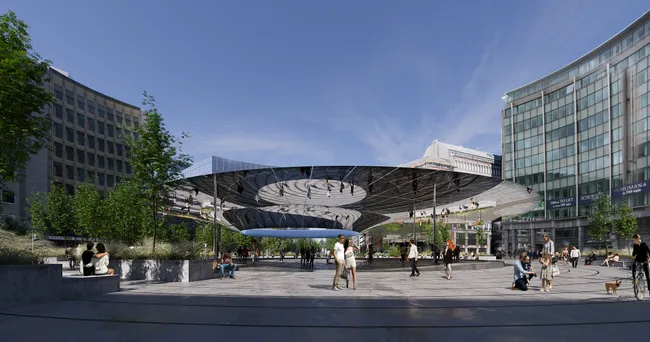
What Schuman Square would have looked like with the planned canopy. Credit: Cobe/Brut
But hopes of building a canopy are next to zero for the moment – though De Wolf insists that his team "repeatedly offered to study alternative solutions after doubts emerged over the canopy's feasibility".
'Frying pan'
Criticism of the project intensified during recent spell of exceptionally hot weather, when photos of the square circulated widely on social media, with users comparing the expanse of paving to a frying pan.
"In a situation like that, with the heatwave, it becomes extra apparent," De Wolf says. "It's an uninhabitable place."
Because of Schuman’s location, De Wolf thinks that the results of the makeover will have far-reaching consequences.
"It will be used as a symbol for the failure of the city, the failure of the nation and, to a certain point, the failure of Europe," says De Wolf.
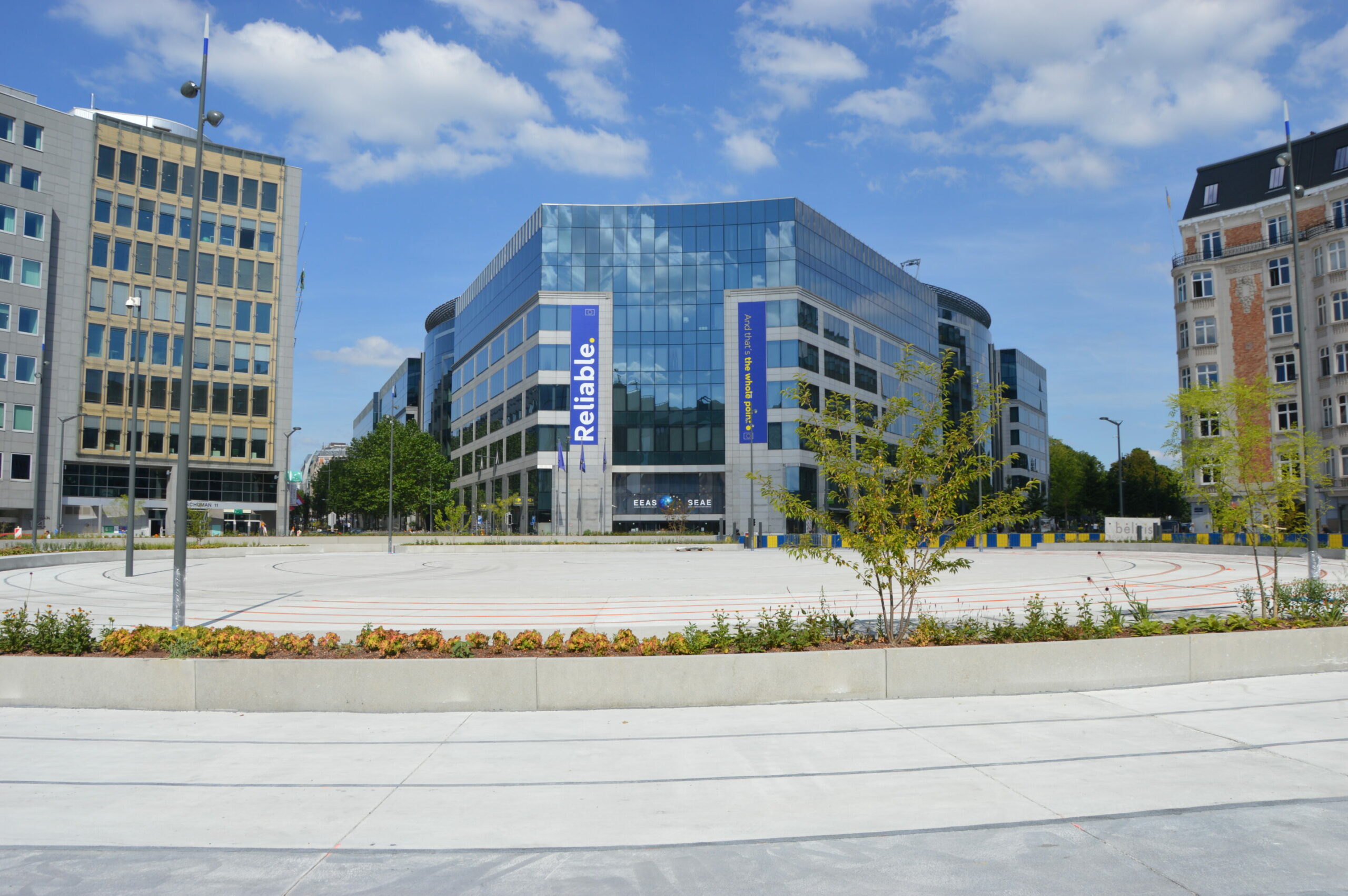
Schuman Square pictured on 29 June 2026. Credit: The Brussels Times/Anas El Baye
Political entanglements
Last summer, project developer Beliris, under the authority of Interior and Home Affairs Minister Bernard Quintin (MR), decided to proceed without the canopy after costs rose beyond the original budget of €30 million, leaving an additional €12 million funding gap.
Under the agreement between the Brussels Region and Beliris, that extra funding would have had to be provided by the Region. At that time, Brussels was operating in caretaker capacity as negotiations had stalled on the formation of a new government. Ministers unsuccessfully appealed to the European Commission for financial support.
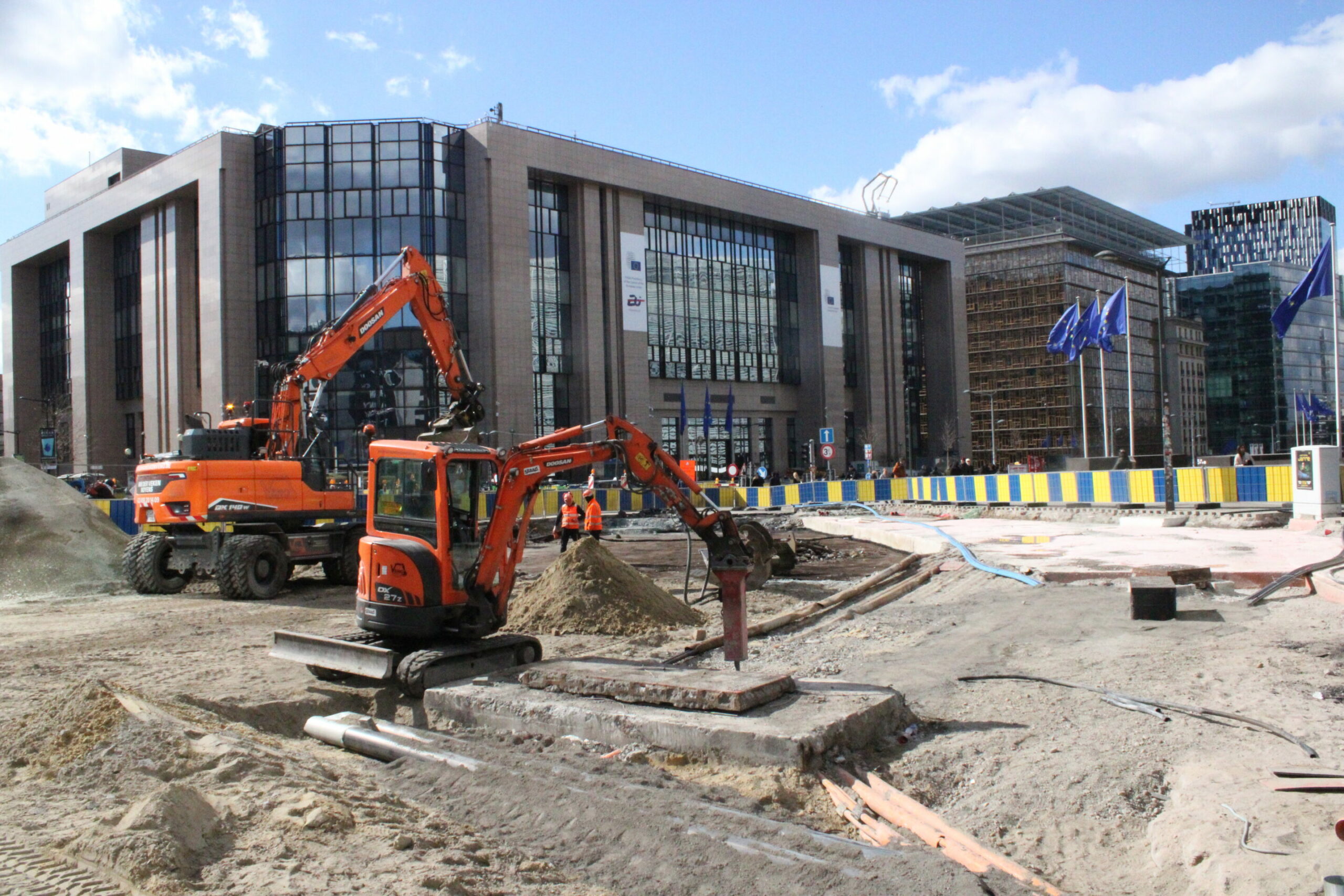
The project received €17.4 million from the EU’s Covid recovery fund, out of a total initial budget of around €30 million. Credit: The Brussels Times
The dispute over the missing canopy exposes two competing political narratives over who bears responsibility for its failure.
Former Brussels Mobility Minister Pascal Smet (Vooruit) told Bruzz funds initially earmarked for the structure were redirected to cover cost overruns elsewhere in the redevelopment.
The cabinet of Mobility Minister Elke Van den Brandt (Groen) told us that soaring construction costs following the Covid-19 pandemic and Russia's invasion of Ukraine forced the Region to prioritise completing the first phase of the project.
"The project is not yet finished for it to be judged", François Decamps, the cabinet’s spokesperson, explained. "The results do not satisfy us either. But this is the end of the first half, not the end of the match."
According to Decamps, the revamp was always conceived into two phases: first, transforming the traffic roundabout into a pedestrian-oriented square, then deciding on the canopy or an alternative intervention. "You can not encrust a canopy on an unfinished base," Decamps said.
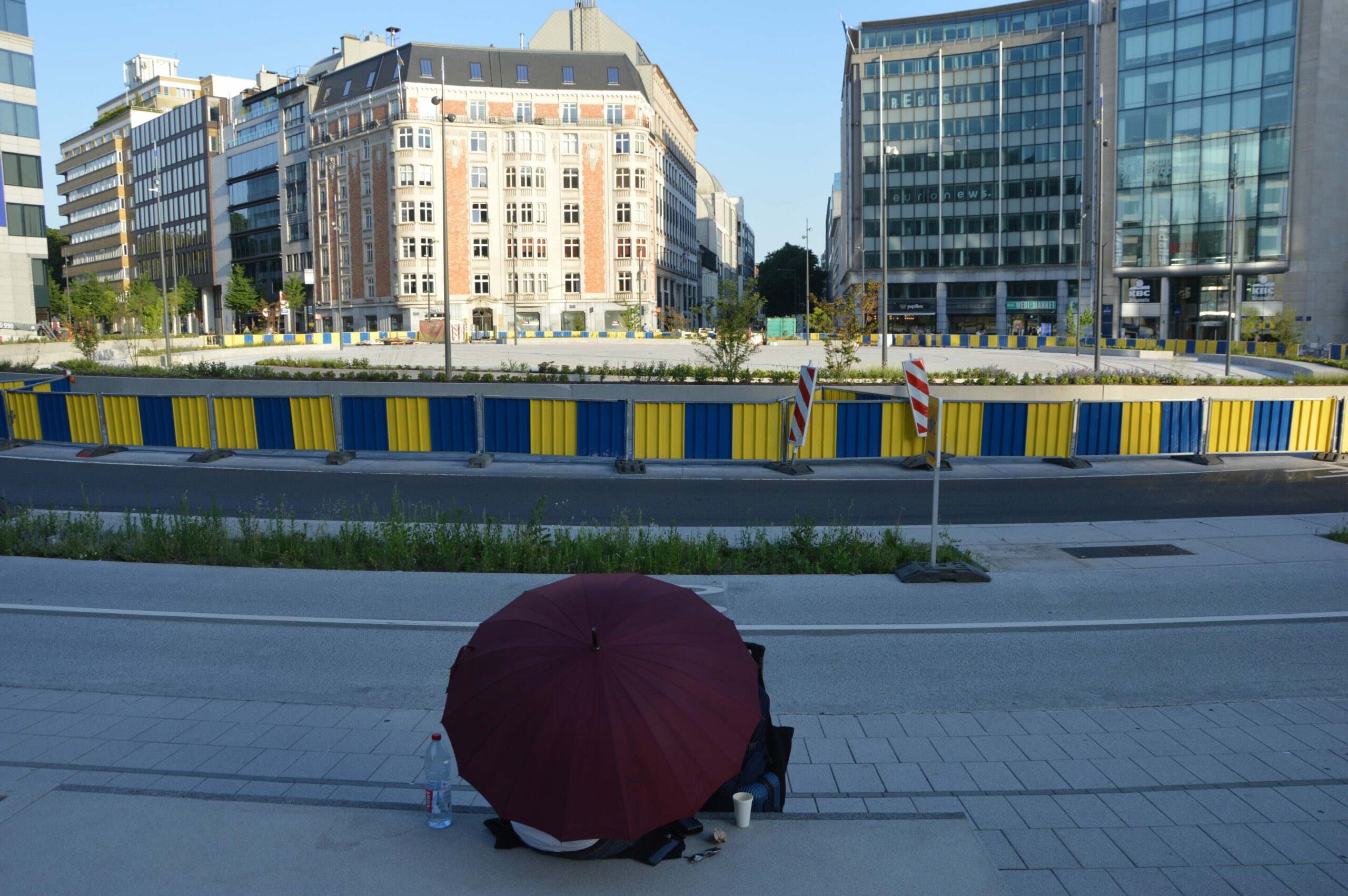
A man sitting down with his umbrella next to the square. Credit: The Brussels Times/Anas El Baye
The urgency surrounding the current works, Decamps explains, was dictated by the deadlines attached to the EU recovery fund. He told us that funding is given in parts: "Some instalments have already been paid, but the full balance has not yet been disbursed."
To retain the funding, the first phase of construction had to be completed by September. This forced contractors to finish the paved public space "before any final decision on the canopy could be taken".
According to Decamps, the costs of both the square itself and the canopy increased substantially, while the Brussels Government, operating in a caretaker capacity after the June 2024 elections, was legally unable to commit additional funding.
The cabinet says the available regional budget was therefore used to complete the mobility works required to secure European funding, leaving the canopy's future to be decided by the new government.
"We completely understand why people react the way they do," the Cabinet said. "Today, you have an entirely concrete square. We recognise that."
"We want an attractive, vibrant public square that lives up to the image Brussels wants to project," the cabinet concluded.
A symbol of Europe's capital
Brussels Commissioner for liaison between the Region and the EU, Alain Hutchinson (PS), who stepped down this week after 12 years, told the Brussels Times that Schuman has always been more than just another infrastructure project.
"It is an area filmed by television crews from around the world," he said. "It deserved to be redeveloped with dignity. The canopy was really the centrepiece. Without it, it is a let-down", he explains.
The debate, he says, is often reduced to arguments over costs, when the real issue is the image projected by Europe's capital. "People don't know the political story," he said. "They simply see the final result."
'Public spaces shouldn't be neglected'
Brussels residents are far from impressed by the results of the makeover. Angès Esquirol, 60, a painting conservator at the nearby Art and History Museum in Cinquantenaire Park, crosses Schuman roundabout regularly.
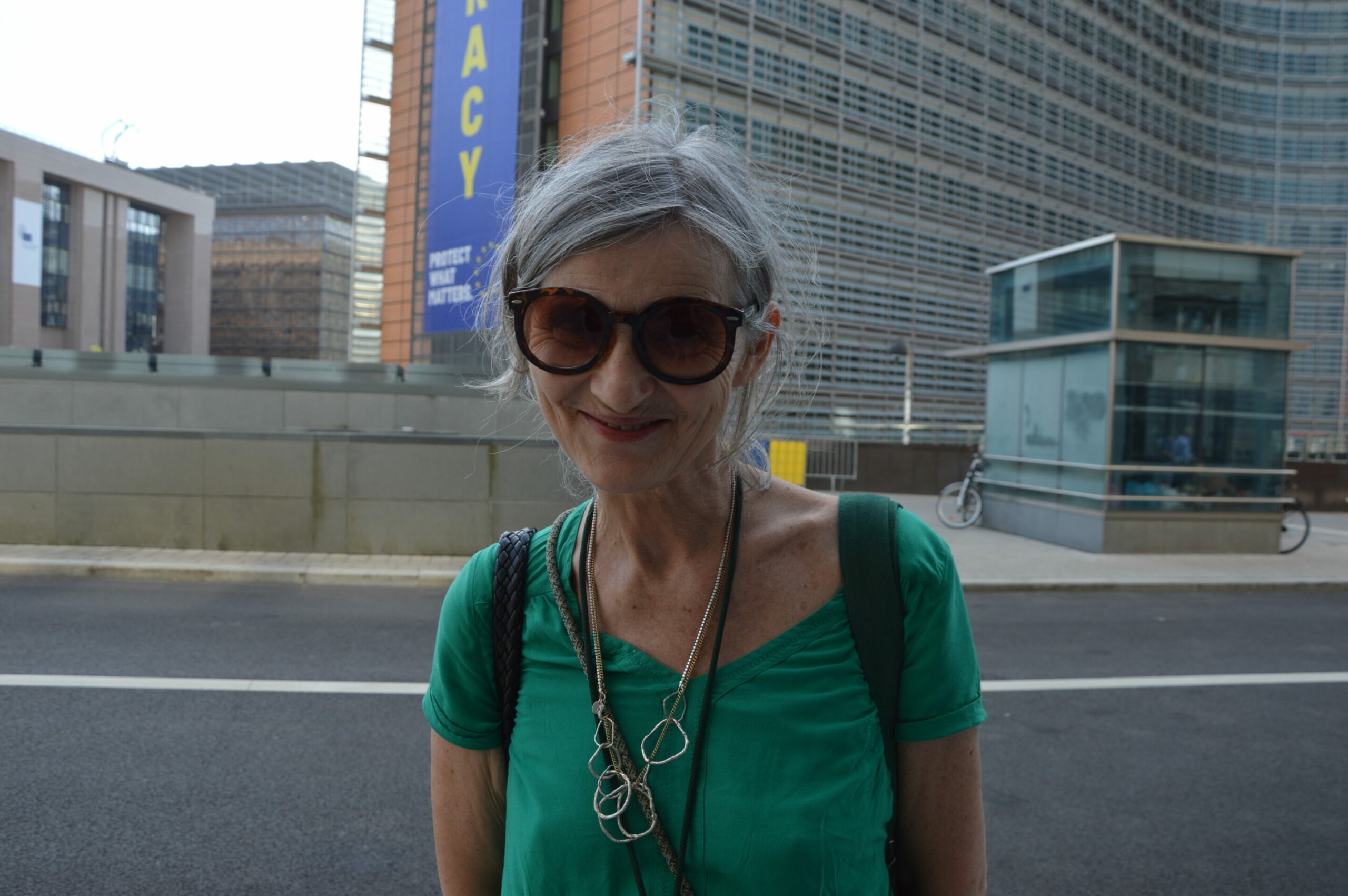
Agnès Esquirol. Credit: The Brussels Times/ Anas El Baye
She told The Brussels Times she was perplexed about what the new square has to offer. "I really do not understand the project," she said. "Public spaces are important. They shouldn't be neglected".
Esquirol believes the current square lacks the basics that encourage people to stop rather than simply walk through it. "There are no benches, no fountain, nowhere to sit."
She is baffled that in scorching heat, one could think of "an original architectural gesture, that simply provides shade".
Standing a few hundred metres away, Fabio, a 26-year-old bartender working in a Portuguese restaurant overlooking the square, shared a similar view.
"I am disappointed," he said. Like many workers in the neighbourhood, he had expected a canopy to become the defining feature of the square. "If there had been the cover, I'd probably spend more time there.
What is this place going to serve? Are people going to sit there? What are they going to do? For people walking, it's okay. But by car it's a problem."
Mohamed, who was passing by Brussels and looking at the promised 3D project on a board, simply shrugged. He looked across the square and wondered if this was yet to be built.
"Is this what it is supposed to look like? They still have quite a lot to do."
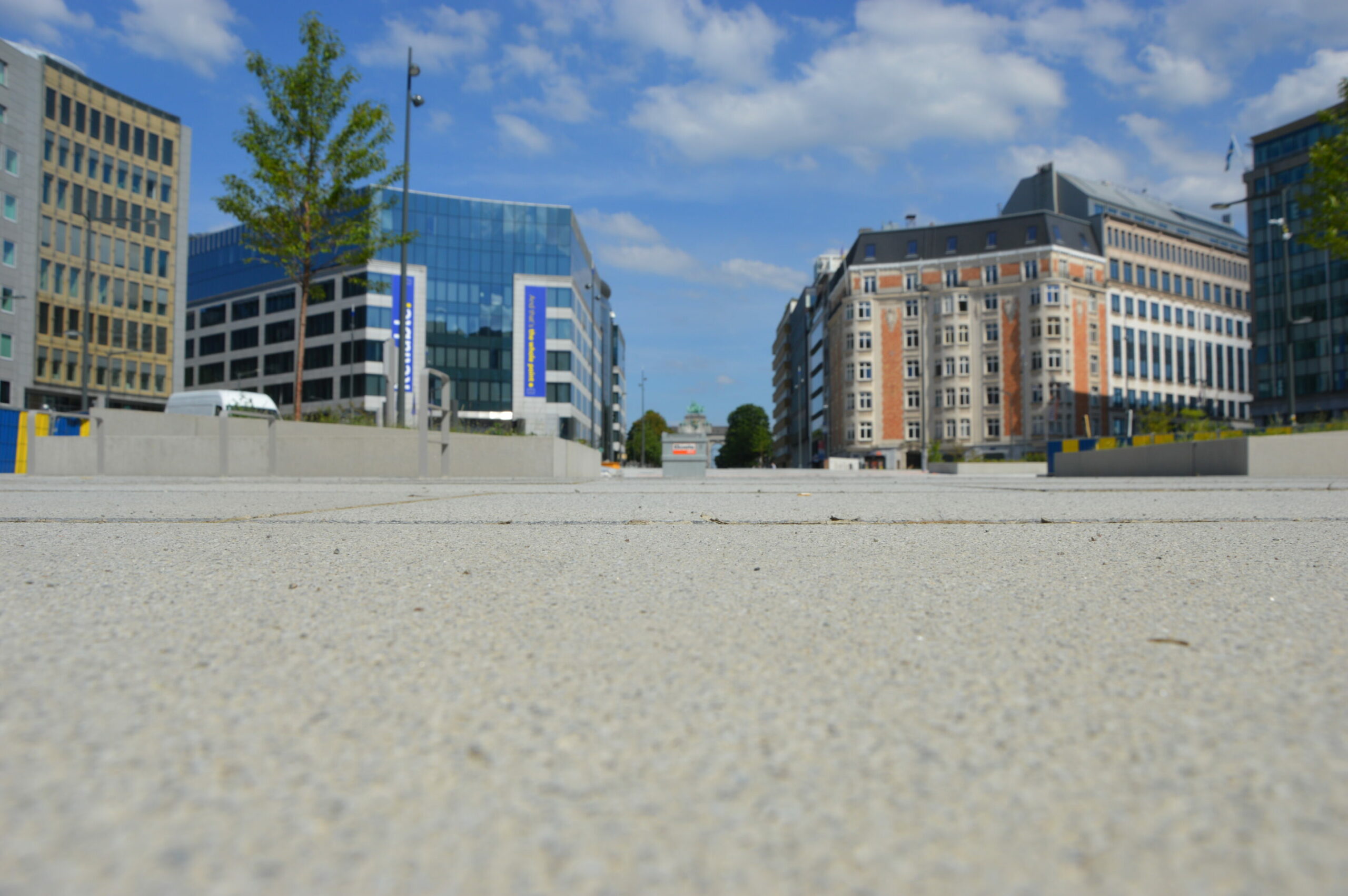
Schuman Square pictured on 29 June 2026. Credit: The Brussels Times/ Anas El Baye
