
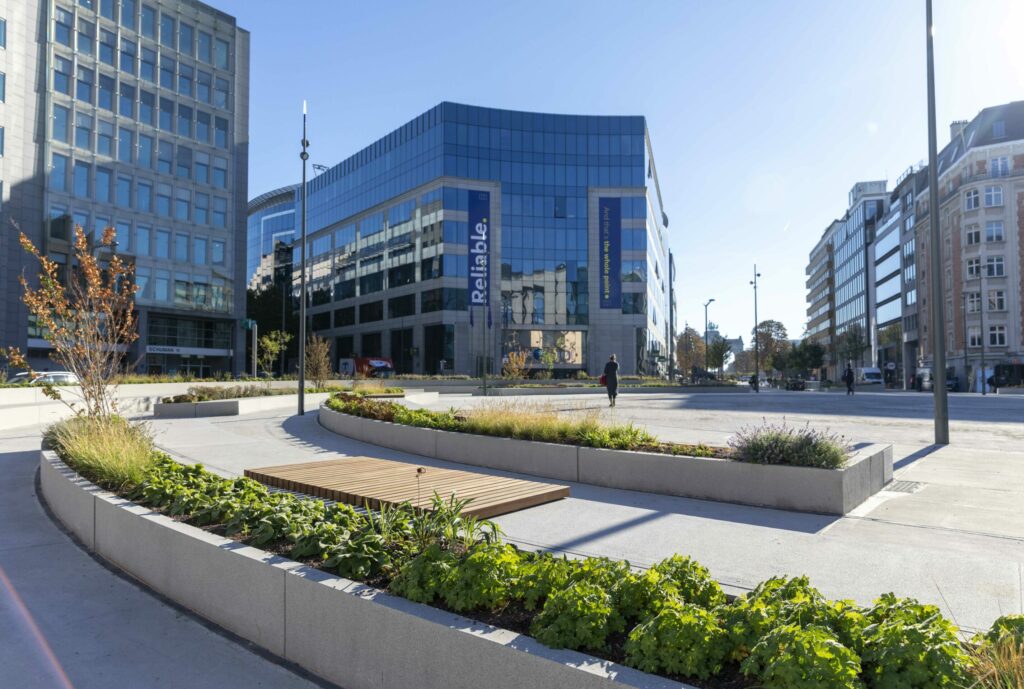
Brussels' Schuman Square revamp is complete. This week, it was quietly inaugurated after a €29 million makeover, but the axed canopy meant to define the space had left the square lacking charm and passers-by far from charmed.
Beliris, the federal agency overseeing the works, confirmed in a statement to The Brussels Times on Tuesday that, on its end, the roundabout works were declared finished. In summer 2025, the Brussels-Capital Region abandoned the canopy because of soaring costs.
Despite heavy criticism from locals, the former Brussels Commissioner Alain Hutchinson and even the project's own architect, Beliris called the current facelift "a success," congratulating the transformation and pointing to wider pedestrian areas, new cycling infrastructure, and reduced car traffic.
The Region is now considering smaller installations to improve the square. It has yet to announce what these might look like or when a decision will be made.
A flop?
During summer heat, the vast paved surface drew criticism for its lack of shade and greenery. "Frying pan", "hellscape", "sans l'ombre d'une ombre" are amongst the few titles international media outlets have used to decry the newly revamped roundabout.
Greenery is nowhere to be seen – something Beliris acknowledged in its response to The Brussels Times.
They pointed out the underground railway station, metro station, and Rue de la Loi tunnel beneath the square. At its centre, there is only around 35 centimetres of available depth, while the surface can support a maximum load of 500 kg/m².
These constraints make planting large trees directly into the ground impossible in the central area. Instead, vegetation has been placed in planters designed to accommodate the limited depth and weight restrictions. Across the wider project area, 49 trees have been planted, alongside more than 1,100 m² of greenery.
Beliris confirmed the underground restrictions were known from the outset and had been taken into account during the design phase.
Now, the Brussels Region is examining whether lighter installations could make the centre more inviting. A Brussels MP launched a proposal suggesting surrounding it with a ring of 27 trees in pots or large containers, each representing an EU Member State.
Recently, the European Quarter neighbourhood committee (GAQ) launched a petition calling for something to be done to “an unwelcoming concrete esplanade.”
The residents say that the result could have been avoided if they had been listened to during the planning process, they called it “a blatant failure of participatory democracy.”
Why did costs soar?
Beliris has now shed more light on the expenses that reshaped the project. The final bill stands at €29 million, including VAT, with €21.5 million coming from the EU's NextGenerationEU recovery fund.
Earlier reports had mentioned €12.4 million in additional costs, including the canopy. Beliris clarified that this was the total projected extra expenditure that would have fallen to the Brussels Region, not the price of the canopy alone.
The agency identified several reasons for the increase. The first was security: the original plans predated the March 2016 terrorist attacks in Brussels, which prompted a reassessment of safety requirements.
As a result, the project incorporated anti-ramming benches and reinforced bollards capable of withstanding trucks travelling at speeds of up to 90 km/h.
Other installations were designed to prevent debris from flying more than a metre into the air during a collision. These measures were tested through crash tests. According to Beliris, the additional security requirements substantially increased the cost.
Other expenses included renewed waterproofing above Schuman railway station, the addition of works on Avenue de la Joyeuse Entrée and sharp construction-price increases since 2023.
Beliris did not provide a breakdown showing how much each measure cost.
More room for pedestrians and cyclists
Beliris is keen that the main goal has been achieved: replacing a busy roundabout with a public space that gives pedestrians and cyclists priority. According to them, that is the case now: more than 25,600 m² have been redeveloped, including over 7,100 m² of pavements, 740 m² of cycle paths and 12,000 m² of shared space.
A separated cycle path now connects Chaussée d'Etterbeek to the square, while Avenue de la Joyeuse Entrée has become a two-way cycle street. A raised crossing also makes it easier to reach Cinquantenaire Park.
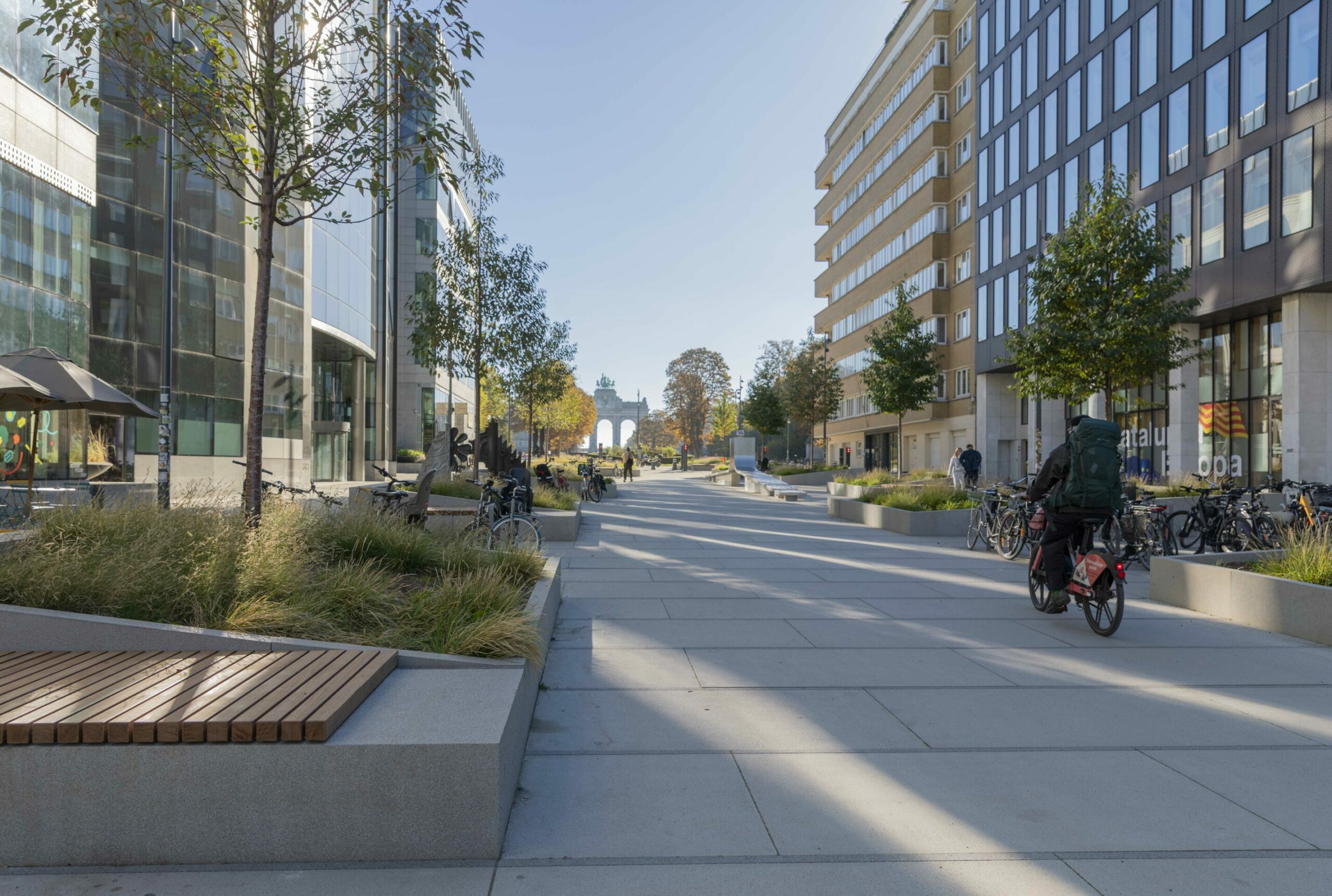
Joyeuse Entrée Street. Credit: Beliris.
The traffic plan has been changed to keep most regular vehicles away from the square. Motorists can travel from Avenue de Cortenbergh towards Rue Archimède and Rue de la Loi, while traffic between neighbourhoods north and south of Schuman is redirected through Avenue de la Joyeuse Entrée.
Access from Avenue d'Auderghem and Rue Froissart has been closed to regular through traffic, although local vehicles, authorised users and deliveries can still enter under certain conditions.
Beliris says these changes have made the area safer and more accessible.
Finished, but not quite
With Beliris washing its hands of the project completely, the question now is who will decide what happens to the centre of the square.
Any further changes are a matter for the Brussels Region. In July, the cabinet of Brussels Mobility Minister Elke Van den Brandt (Groen) acknowledged the disappointing result but insisted to The Brussels Times that the project was not necessarily at an end.
Nearly four months on, the Region continues to weigh up alternatives, with no clear timetable in sight.
“The results do not satisfy us either,” said Van den Brandt's spokesperson François Decamps at the time. "But this is the end of the first half, not the end of the match."
