
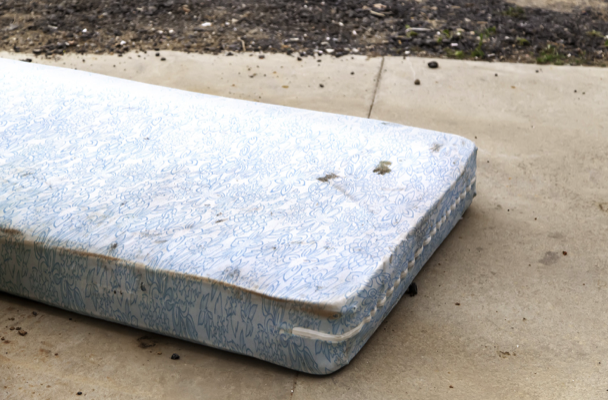
Every year, tonnes of mattresses are discarded in Belgium's capital region, ending up on public roads or in incinerators. Brussels is looking to reduce their environmental impact.
Discarded mattresses often end up on the streets of Brussels, posing a problem for public cleanliness. Meanwhile, nearly 500 tonnes of old mattresses from Brussels residents end up in waste incinerators, as their recycling is virtually non-existent. The region is now exploring ways to reuse or recycle mattresses.
To this end, the Brussels government approved an environmental convention introducing extended producer responsibility for old mattresses on Thursday, imposing clear targets to gradually increase mattress collection and recycling.
"Waste prevention and good waste management are essential levers for climate and economic transition," Brussels Environment Minister Alain Maron said.
Commitments by sector
The agreement calls on the sector to find solutions to prevent mattress waste and its all too frequent presence in Brussels' streets and obliges them to cover the costs of collection and processing. It is also expected to help end the systematic incineration of mattresses by designing them in such a way that they can be reused or completely recycled.
The industry is reportedly committed to finding solutions to prevent waste and fly-tipping. Stores selling mattresses can also offer customers to leave their old mattresses behind when buying a new one in exchange for a flat fee paid by Valumat, the organisation which represents the mattress manufacturers.
It then processes them into sound or thermal insulation, or sports equipment, among other things.
Related News
- Wallonia starts works to fix its landfill 'time bomb'
- Ten unusual initiatives to tackle the waste problem
Meanwhile, waste management service Bruxelles-Propreté will continue to collect used mattresses separately through the Recyparks. There, they will be stored in adapted containers to protect them from the weather elements so that they are able to be recycled.
"Avoided or sorted waste equals a raw material that is saved or that can be given a second life, a raw material that does not need to be produced and that therefore costs less, for the wallet and for the planet," Maron concluded.
The environmental convention is now subject to public consultation.
