
Earlier this month, as anti-government protests gripped Iran, thousands of people died at the hands of the regime’s security forces. Casualty estimates varied wildly amid weeks of near-total internet shutdowns, but the death toll likely runs into the tens of thousands.
Iranian state media report around 3,100 deaths, while human rights groups document at least 6,126 fatalities. Local health officials cited by the Guardian place the toll closer to 30,000, with many still missing.
Despite these astonishing figures, international attention has been limited, even as the death toll continues to rise. Such violence would, I believe, normally command sustained global focus. But in Iran’s case, it has not. The disparity raises an uncomfortable question about whose suffering is deemed urgent, and whose is allowed to remain peripheral to the global political agenda.
My father left Iran for London in December 1978, as protests were intensifying and the country moved toward what would become the 1979 revolution. His father, who served in the air force, secured him a seat on a military plane after commercial flights were halted and the airport effectively shut down to prevent further departures. His parents and siblings followed soon after, eventually settling in Southern California, which remains home to the largest Iranian diaspora community today.
Years later, I find myself as an American living in Brussels, where I have found a large, open, and welcoming Iranian community. That openness is something deeply Iranian: no matter how close or distant one’s connection to the culture, belonging is freely extended.
As someone who is half Iranian, I am now in the uncomfortable position of coming to terms with the fact that I once accepted Iran’s political reality without question, believing I was not “Iranian enough” to speak up and that this suffering did not fully belong to me.
In that sense, I understand the reluctance many now feel about speaking out. But it is precisely this reluctance that this moment demands we move beyond.
The systematic violence taking place in Iran can no longer be treated as distant or peripheral, not only by Iranians or those of Iranian heritage, but by anyone who believes in the universality of basic human rights. The question can no longer be a quiet, who am I to speak? but an imperative: who am I not to?
Protest met with force
My family was able to emigrate and pursue a free life outside Iran. In the 47 years since, the country has been governed by an authoritarian religious regime that replaced the monarchy with clerical rule, tightly controlling political life, suppressing dissent, and restricting civil liberties. Freedom of expression is criminalised, protests are met with force, and women are denied basic bodily autonomy. Opposition has long been punished through imprisonment, torture, and execution.
The recent protests began with cautious hope. What started as demonstrations over economic hardship spread nationwide and evolved into direct challenges to the Islamic Republic. In early January, the state’s response turned decisively violent, led largely by the Islamic Revolutionary Guard Corps (IRGC), which the European Union recently designated as a terrorist group.
Beyond the death tolls, investigations and testimonies from human rights organisations describe bodies withheld from families, secret burials, and deliberate efforts to conceal the dead. Reports document widespread torture, systematic sexual violence, and the detention of wounded protesters. Even hospitals have become sites of fear, as injured demonstrators avoid care and doctors who treat them risk arrest and possible execution.
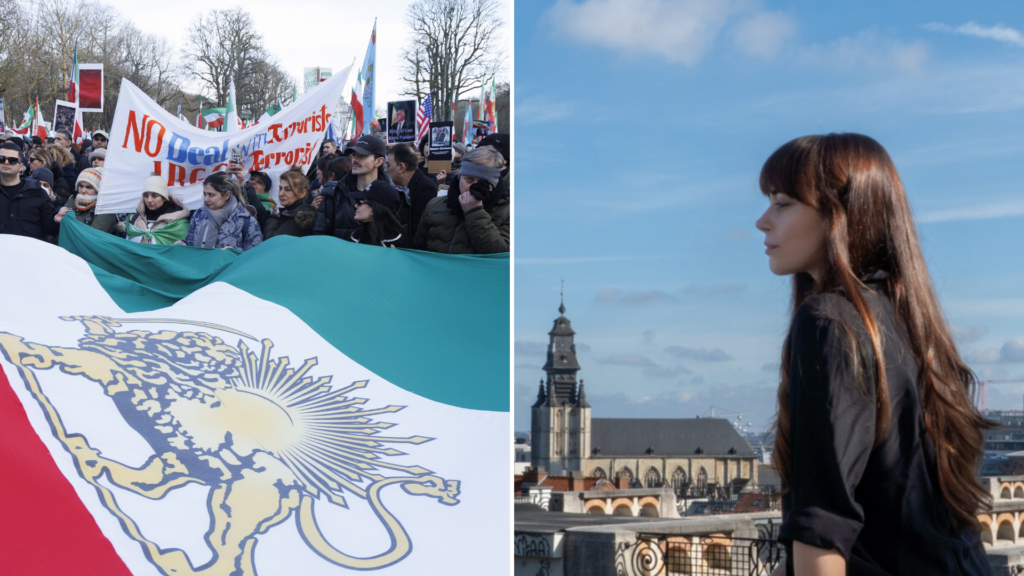
In Brussels on Sunday, 29 January, thousands of people demonstrated at the Schuman roundabout in solidarity with those inside Iran calling for political change. They echoed chants heard across Iran: “By the blood of our comrades, we will stand until the end”; “This is the final battle”; and “Long live the Shah”.
While the demonstration drew significant support, it fell short of the scale and cohesion seen during the Europe-wide protests in support of the ‘Women, Life, Freedom’ movement in 2022.
Pain and alienation within the Iranian diaspora in Belgium
A palpable silence hangs over both global media coverage and the city itself, a contrast not lost on the Iranian diaspora in Brussels. The lack of public acknowledgment has left a sting for those already watching the lives of family and friends be destroyed from afar. For many, this has deepened a sense of alienation, despite their physical safety in a city once seen as refuge.
These feelings are reflected in the words of an Iranian source in Brussels who requested anonymity for security reasons. After years away from Iran due to fears of political persecution linked to their activism, they write: “I want to tell them all [the names of our murdered children] but I can’t hold them in language, and I can’t stand how little it matters to people watching from a safe distance or those who deliberately look away. The killing is vast, and the silence around it feels just as violent.”
They continue: “It’s like living in a wound that never closes. I sit here trying so hard not to look defeated, to imagine a life on the other side of this. The day we get to live a life without the shadow of lies and terror. I survive on the thought of that day. The day when we finally get to tell our stories properly.”
Another source, a master’s student in Brussels who also requested anonymity, said they and other Iranian students sought permission to hold a campus event to raise awareness. They claim the university allowed them to assemble for only one hour to mourn the dead and barred them from distributing information. These restrictions stand out as unusual at a large university where protests on other international conflicts have often continued for days or weeks.
The situation in Iran is shifting rapidly, now further complicated by escalating tensions between Iran and the United States. As the crisis becomes increasingly entangled in global power struggles, it is critical that we do not lose focus on the people at its centre.
Those killed cannot be reduced to statistics or absorbed into geopolitical calculations. They were individuals with lives and stories, many of which may never be fully told, and those still living under repression remain at risk of becoming numbers.
If responsibility extends beyond borders, it is this: to speak up, to bear witness, and to refuse indifference – so no more lives are taken by a regime that relies on the world looking away.
