
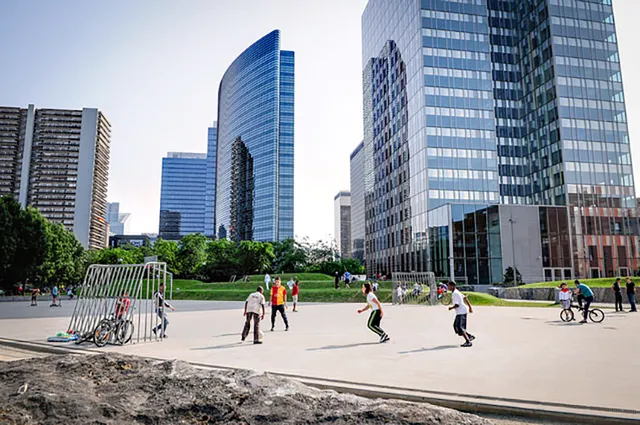
Children growing up in the Brussels-Capital Region do not have equal access to green and natural environments at school – and these inequalities are stronger than in comparable European cities, according to new VUB research.
The research assessed children's access to and use of green spaces in and around primary schools, during and after school hours. Elsa Gallez, a doctoral student in the Cartography and GIS research group, compared Brussels with Barcelona, Rotterdam and Paris.
Using spatial data on vegetation cover and socio-economic characteristics of schools and neighbourhoods, Gallez shows that children from wealthier families attend schools with greener, healthier and more climate-resilient environments, both in schoolyards and in surrounding spaces.
While inequalities exist in all four cities, Brussels stands out with the strongest socio-economic disparities. "In a European context, this is particularly striking. The spatial structure of Brussels, with a dense and deprived urban core, plays an important role," she said.
Limited access, higher use
The research also includes surveys of 418 parents and 72 teachers. These highlight the importance of a green environment for children, while showing that children from more disadvantaged backgrounds – despite having more limited access – use green spaces after school more frequently than children from higher-income families.
Factors such as time constraints, organised leisure activities and home-school distance appear to play a role, she found.
Finally, the researcher called for closer integration of urban greening and education policies, including prioritising schoolyard greening in disadvantaged areas, improving nearby public green spaces, strengthening outdoor learning in teacher training, supporting schools with additional human resources, and investing structurally in environmental organisations.
"To truly improve children’s well-being, policies must move beyond formal equality and actively work towards equity," she said.
