
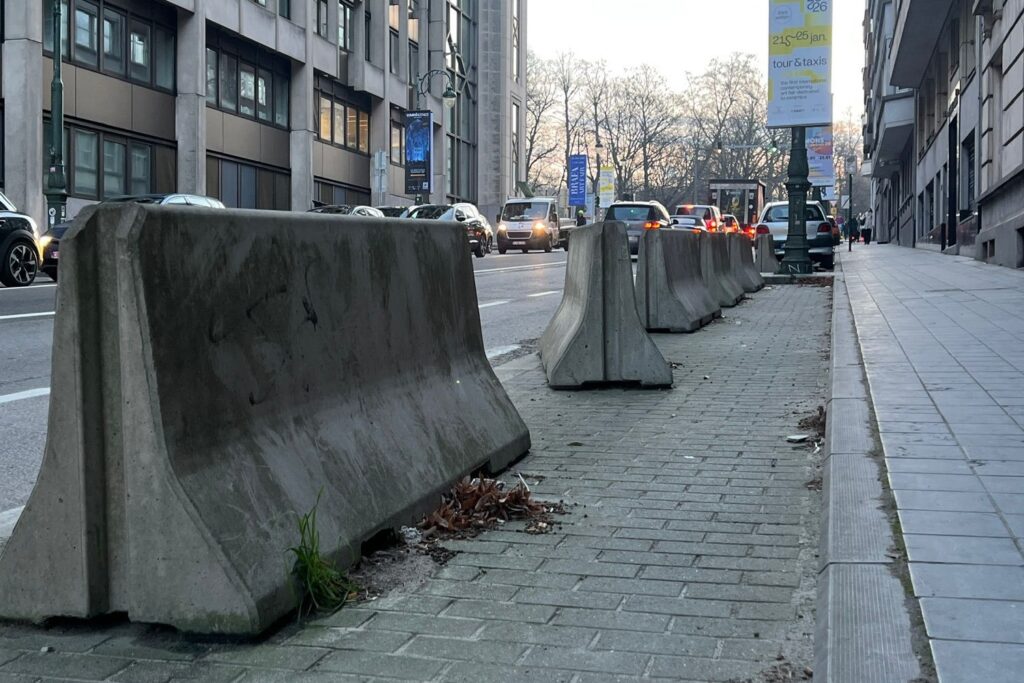
The Brussels government has officially launched the gradual removal of thousands of concrete blocks – otherwise known as Jersey barriers – installed across the capital since 2016, with regional leaders saying it is time to “make Brussels beautiful again”.
On Thursday, 21 May, Minister-President Boris Dilliès (MR), Secretary of State for Urban Planning Audrey Henry (MR) and Minister of Mobility Elke Van den Brandt (Groen) symbolically removed the first concrete blocks on Avenue de la Toison d’Or, near Porte de Namur, at the border between Ixelles and the City of Brussels.
3,000 concrete blocks
The operation marks the beginning of a broader plan led by Bruxelles Mobilité to progressively dismantle many of the approximately 3,000 concrete blocks currently spread across the Region.
“Since 2016, these blocks have multiplied throughout the Region,” the government said in a statement. “After drawing up an inventory and a timetable, the gradual removal can now begin in order to make public spaces more pleasant and restore the image Brussels deserves.”
The history of the concrete blocks goes back to the mid-2010s, when cities across Europe, including Brussels, introduced so-called "Jersey barriers" to prevent vehicle-ramming attacks following several terror attacks on the continent.
Initially conceived as emergency security infrastructure, the blocks later became widely used for mobility projects, temporary cycling lanes and traffic-calming measures, particularly during the Covid-19 pandemic. Over time, what was initially presented as temporary urbanism became increasingly permanent across the Brussels landscape.
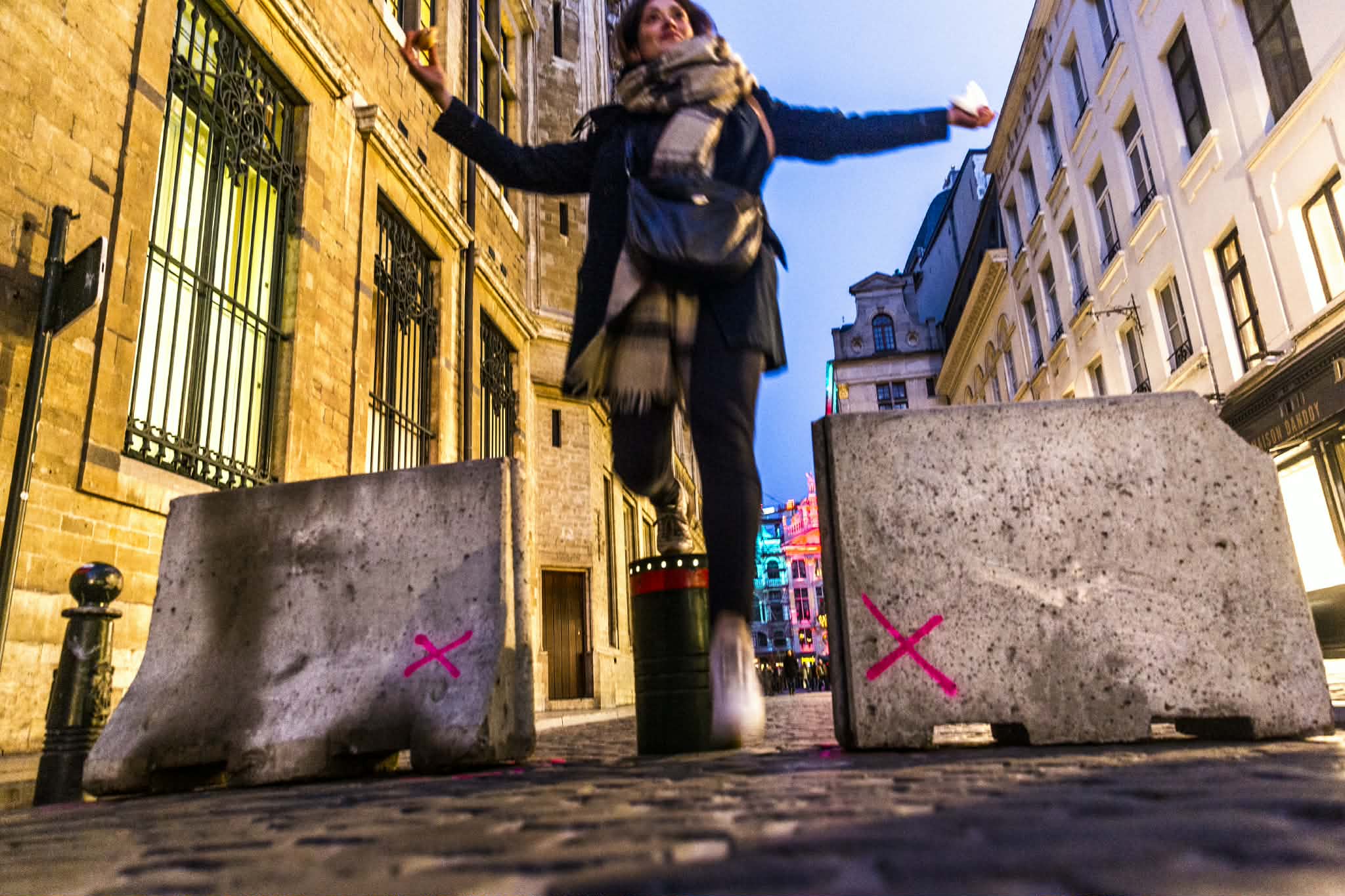
Why are there so many concrete blocks in Brussels? Credit: Belga
Their growing presence has fuelled political and legal tensions in recent years. Several temporary road layouts exceeded the legal two-year limit authorised without urban planning permits, prompting warnings from Urban.brussels. In some cases, such as Avenue Broustin between Jette and Ganshoren, residents filed complaints after temporary installations remained in place for years.
The concrete barriers also became politically associated with the controversial Good Move mobility plan promoted by Van den Brandt, with critics denouncing what they saw as an invasion of public space and a lack of consultation with residents.
“These horrible concrete blocks”
“We are at the beginning of a process that stems from a commitment to make Brussels more beautiful, and that obviously includes removing these horrible concrete blocks whenever possible,” Dilliès said during the removal on Thursday.
Henry said the initiative was also about changing the image of the capital after years of temporary urban planning measures. “We want to turn a page because some of these blocks have been in the public space for more than 10 years,” she said. “It is really time to move on and continue making Brussels shine.”
According to Henry, an inventory carried out by the Region highlighted the scale of the phenomenon. “There are nearly 3,000 concrete blocks across the Region. You come across a concrete block roughly every 250 metres,” she said.
Elke Van den Brandt acknowledged that the blocks had initially played a role in improving road safety but said the Region now wanted more aesthetic solutions. “In recent years, we caught up on road safety using concrete blocks and temporary solutions. But it is ugly,” she said. “Together with my colleague Audrey Henry, we agreed to replace the blocks with bollards.”
Louise roundabout
The move also comes against a backdrop of political tensions over the future layout of the nearby Louise roundabout. Earlier this month, Van den Brandt announced plans to permanently reduce the roundabout to one traffic lane, a proposal quickly criticised by Dilliès, who called for the project to be paused.
“We promised it, and we are doing it,” the Brussels government said in its communication campaign announcing the initiative. “Brussels is beautiful - let’s show it.”
