
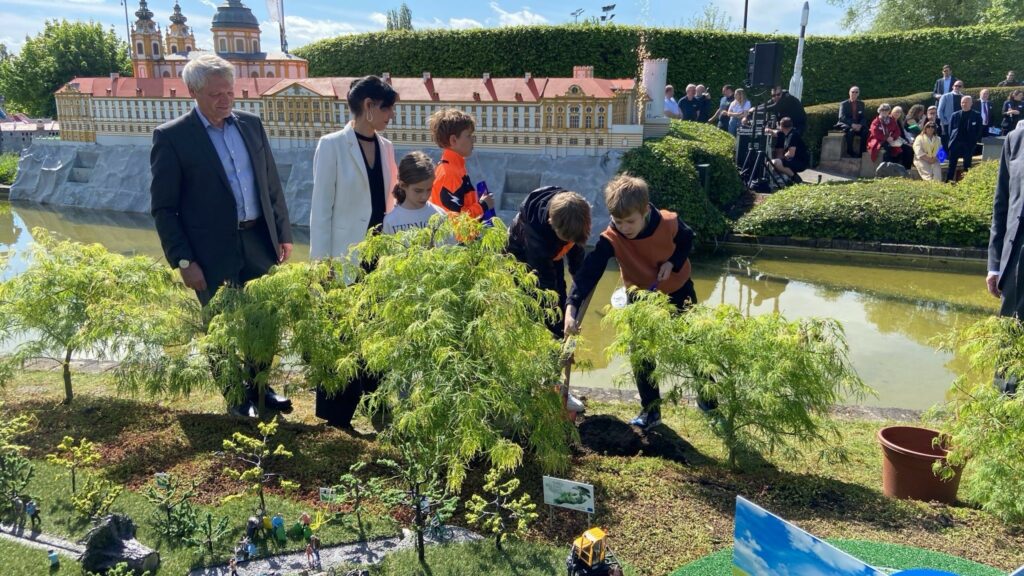
Mini-Europe has warned that the planned Sports Park under Brussels’ NEO redevelopment could threaten the attraction’s survival by severely restricting access to its site.
Speaking at a press briefing on Monday, Mini-Europe director Thierry Meeûs said the scheme would have harmful consequences not only for Mini-Europe but also for other operators based at the Heysel site.
The Sports Park, part of the wider NEO project on the Heysel Plateau, is due to cover 27 hectares and create a new area for walking and sport.
Plans include a synthetic pitch for rugby and football, hockey pitches with a stand, an athletics training ground with a 400-metre track, a water play area with cascade features, and waterside walkways lined with trees.
Mini-Europe says the expansion of the sports facilities immediately next to the attraction would cut it off from visitors. In its current form, the project would completely surround the site.
According to the park, visitor access would be drastically reduced, deliveries would become impossible, routes for people with reduced mobility would be made more difficult, and the reception of groups and other day-to-day operations would be disrupted.
“This is no small matter for us,” Meeûs said, adding that other organisations would also be affected, arguing that the loss of coach parking for the Atomium would be equally damaging.
Meeûs is calling for a full review of mobility and parking across the site. He said tourism is economically important for Brussels and argued that access by car should not be overlooked in the redevelopment.
Mini-Europe also criticised the Sports Park plans for not being part of a broader strategy developed with all Heysel stakeholders, and said there had been no proper consultation on the issue.
“We all need to sit around the table and try to develop everyone’s full potential, whether that is Kinepolis, the Planetarium, Mini-Europe or others,” Meeûs said.
The attraction has warned Neo SRL, the company leading the Sports Park project, that it will take legal action if construction begins. Meeûs also called on the City of Brussels to suspend the works until a coherent policy is agreed that reflects the realities on the ground.
The wider NEO project involves building a new district on the historic Heysel site, at the foot of the Atomium. According to the City of Brussels, it is intended as a hub for economic, commercial, tourist, cultural and leisure activity, as well as housing, and is expected to create more than 3,000 jobs.
The project also includes 590 homes, two nurseries, a senior residence, offices, 72,000 square metres of retail space and 9,000 square metres of restaurant space.
Its leisure component directly affects Mini-Europe, which is due to be fully renovated, and also includes plans for a Spirouland park, cinemas and a partnership with the Cité des sciences et de l’industrie.
