
As an increasing number of Brussels residents are leaving the Belgian capital to move to the Flemish municipalities surrounding it (often referred to as the Flemish periphery), real estate and property agencies are seeing that families' housing needs are changing.
Nearly 28,000 residents moved from the Brussels-Capital Region to Flanders in 2025 – more than double the number of Flemish people who made the reverse move, according to the most recent figures from Statistics Flanders.
"The trend has been going on for quite some time, you could even say several decades. But it has certainly accelerated more and more in recent years," Kurt Vermandel, responsible for Brussels and Flemish Brabant at Dewaele, told The Brussels Times.
This, he explained, is largely down to the population growth in Brussels itself, driven by international migration. "You see a natural spillover into the outlying municipalities."
It concerns the 19 Flemish municipalities that encircle the capital – an area known as the 'Flemish periphery'. It concerns Drogenbos, Kraainem, Linkebeek, Sint-Genesius-Rode, Wemmel, Wezembeek-Oppem, Asse, Beersel, Dilbeek, Grimbergen, Hoeilaart, Machelen, Meise, Merchtem, Overijse, Sint-Pieters-Leeuw, Tervuren, Vilvoorde and Zaventem.
Staying as close as possible
According to Vermandel, there are several reasons for this spillover. "Firstly, many families are looking for healthier and more spacious homes. They want a house with a garden, more green space, more open space. In Brussels, they often find they have reached their limits in that respect."
Another important factor is mobility. "The convenience of car travel, given that Brussels is increasingly having to cope with occasional serious traffic gridlock. The proximity to motorway slip roads certainly plays a part in the convenience of car access, particularly for commuters in general."
Additionally, the increased cost of living is not to be underestimated, Vermandel stressed. "Brussels itself has become too expensive for many families to buy a detached family home with a garden and a good outdoor space, so they broaden their search area."
As many of these people are still working in Brussels, they do not want to go too far away from the city either. "They like to stay as close as possible. That way, there is still an easy connection, including via public transport."
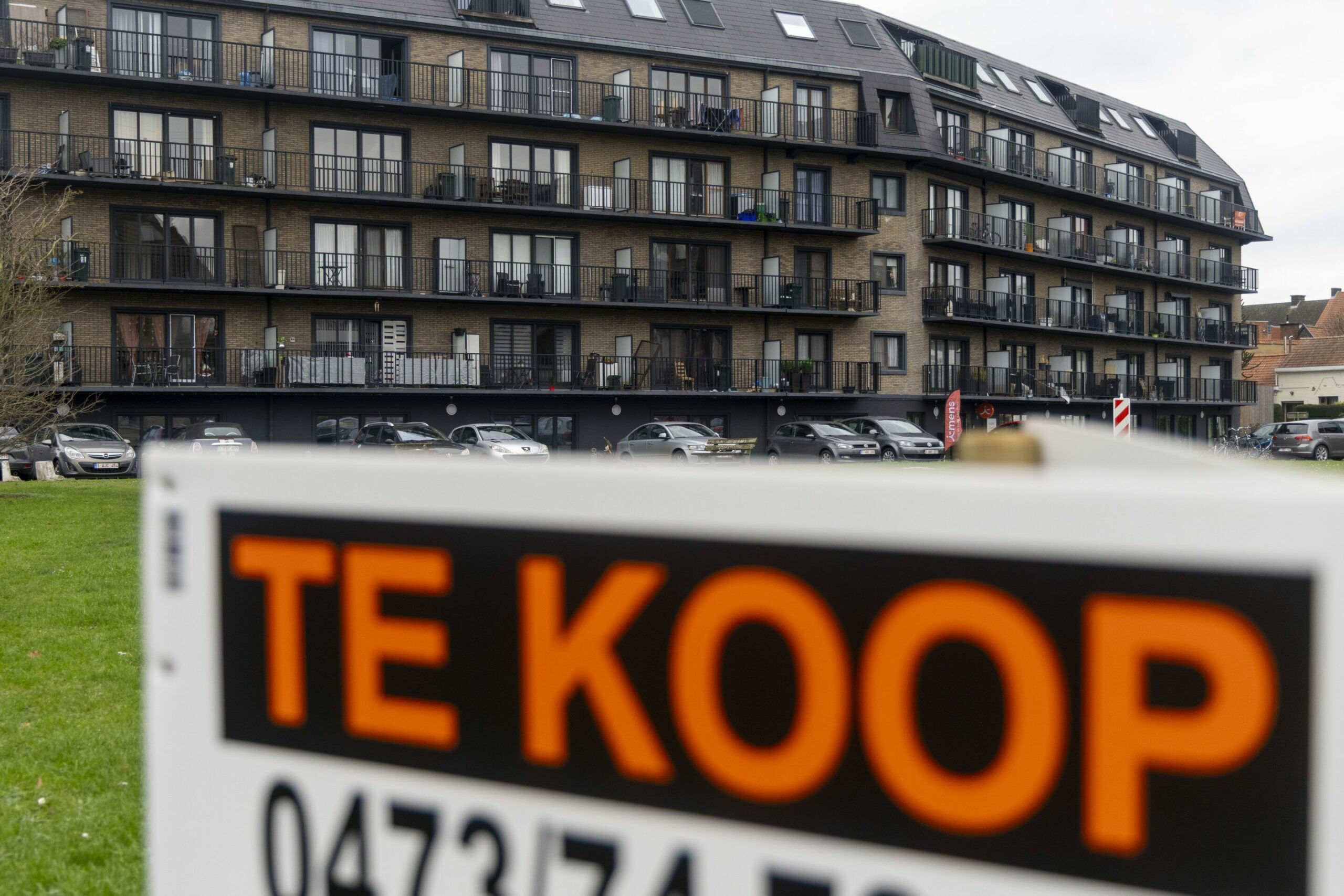
Illustration picture of houses for sale.
Credit: Belga / Nicolas Maeterlinck
What's more, the latest changes to regional tax regulations have also "encouraged and facilitated" people leaving Brussels for the periphery, according to Vermandel. Flanders recently passed an amendment to the rules regarding property taxation.
"If you look at an average family home, Flanders has introduced a further reduction in registration fees – or ‘sales duties’, as they’re now called – to 2% for a sole owner-occupied property," said Vermandel. "Flanders has a very clear advantage here in terms of purchase costs."
It comes as no surprise that this is also attracting many young families looking for a family home, and increasingly steering them towards Flanders.
In order to respond to this change, property group Dewaele is even opening a new office in the centre of Dilbeek, just outside of Brussels, to serve as a base for the periphery.
"The Flemish Periphery has been a growth region for years, and Dilbeek was a clear blind spot for us. By establishing a local presence there, we are building on the network we have developed in the area over recent years," said Sofie Spriet, CEO of the Dewaele property group.
Expanding Brussels
This shift also has an interesting side effect on the area: it is becoming increasingly French-speaking, and is even doing so at "an exponential rate", he said.
The majority of that migration from Brussels to the outskirts consists of people who tend to be French-speaking. "Over the past ten years, we have seen this process of francisation at an exponentially faster rate."
For Dewaele, that means that a growing number of purchases are happening in French. "I would even go so far as to say that in the majority of our sales transactions, at least one of the two parties, if not both, is already French-speaking."
As a result of this higher demand, property prices in the Flemish Periphery are rising faster than the Flemish average. "But the region remains attractive to prospective buyers, as it is a fair bit cheaper than if people were looking for a similar property in Brussels."
