
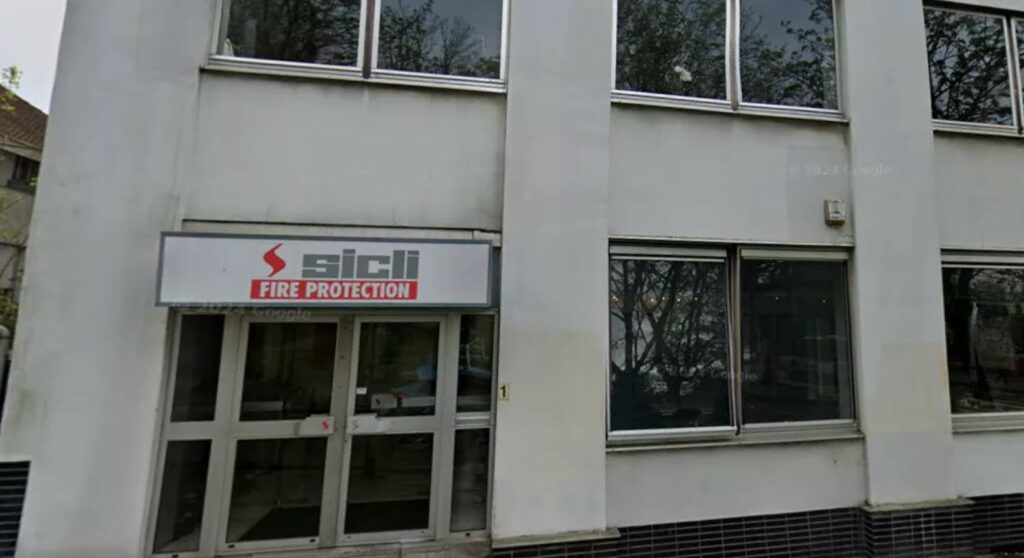
A former fire extinguisher manufacturer in Uccle has left behind severe PFAS contamination, with clean-up costs expected to run into millions of euros.
For decades, fire extinguisher manufacturer Sicli operated a factory in a residential neighbourhood of Uccle. The company produced fire extinguishers using PFAS, commonly known as "forever chemicals" because they break down extremely slowly in the environment.
The extent of the contamination came to light in late 2023, when the company applied to renew its environmental permit. Soil tests revealed PFAS concentrations up to 2,400 times higher than the threshold requiring intervention. In groundwater, levels reached 10,000 times the threshold, De Standaard reports.
Brussels Environment subsequently established a precautionary perimeter around the former factory, advising residents not to use well water or consume fruit and vegetables grown in their gardens.
The contamination has affected nearby households, including residents of Rue du Merlo. One resident, Lindita Ciku, told De Standaard that she had planted fruit trees shortly after moving into her home three years ago, unaware of the pollution. She now fears eating the fruit.
Millions needed for clean-up
Sicli was declared bankrupt in December 2024, shortly after receiving a €2.2 million fine from the Belgian Competition Authority for illegal price-fixing agreements with competitors. Since then, the company's assets have been sold off, including its stock of fire extinguishers, brand name and customer database.
However, the environmental damage remains. The necessary clean-up involves removing contaminated soil and pumping groundwater from the former industrial site, which covers more than 13,000 m². The operation also requires removing soil to a depth of 60 centimetres in six private gardens on Rue du Merlo.
Brussels Environment wants the company's bankruptcy trustees to organise and finance the work, but they have so far refused. In mid-October, Brussels Environment and the Brussels government launched legal proceedings to compel the trustees to carry out the clean-up.
The municipality of Uccle has also joined the proceedings, requesting a penalty of €10,000 for every additional day of delay.
Former employees also awaiting millions
The bankruptcy trustees argue that they simply do not have enough money to cover the clean-up costs. Alain Goldschmidt, one of the two trustees, told De Standaard that Sicli's 300 former employees are still owed millions of euros in unpaid wages.
According to Goldschmidt, there are insufficient funds even to pay the outstanding wages in full, let alone finance an environmental clean-up costing several million euros.
The dispute will now be examined by the courts, with a first hearing potentially taking place in early January.
