
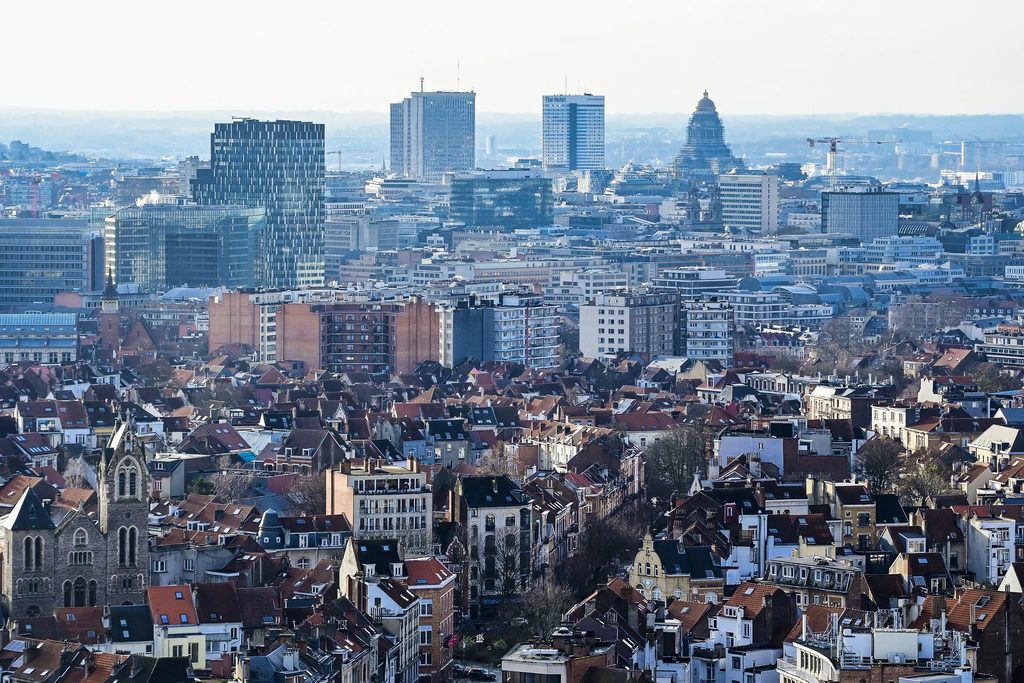
Gross wages in Brussels are continuing to outpace the rest of Belgium, according to HR specialist SD Worx's latest wage barometer.
The median wage in the capital has risen further to €4,200 gross per month, whilst in Flanders it stands at €3,585.
Over a five-year period, wages for full-time employees in the private sector in the Brussels-Capital Region rose by 29%, and in Flanders by 24%. This is shown by salary data from more than 400,000 full-time working Belgians.
"We see three clear trends: Brussels is pulling further ahead, Limburg and West Flanders are making a striking catch-up, and in Flanders a levelling-off is emerging around €3,600," said Virginie Verschooris, Reward Consultant at SD Worx.
Wages in Brussels are traditionally higher than in the rest of the country, but now, they are pulling even further ahead of the pack. For the first time, the median wage has exceeded the €4,000 mark – rising straight away to €4,200 gross.
In January 2021, the gross monthly salary stood at €3,256 in the Capital Region.
Comparing real wages accurately
By "gross monthly salary," SD Worx refers to the monthly amount shown on the payslip, excluding the end-of-year bonus and holiday pay. This amount also does not take into account additional pay elements or the employer’s costs.
As the median wage is a true midpoint, the HR specialist stressed that it provides a better picture of the "average" salary than an average: 50% of employees earn more and 50% earn less than this midpoint.
Working with actual wage data – particularly based on Belgium's largest sample – is more reliable than surveys, which are subject to bias depending on who responded.
The 25% rise in Flanders and 29% increase in Brussels over five years (partly due to automatic indexation) represent a significant increase in wage costs for employers, Verschooris pointed out. "With the new wage legislation, it is more important than ever to compare real wages accurately."
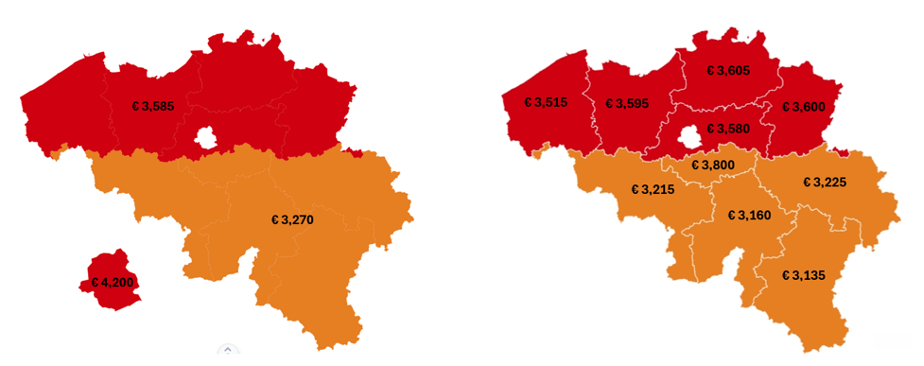
Median gross monthly salary per region (left) and province in January 2026. Credit: SD Worx
While the median wage in Brussels is at least €600 higher than in all other provinces, the strongest growth was observed in the provinces of Limburg and West Flanders over the past year, with 2.6% and 2.5% respectively.
Limburg now has a median wage of €3,600, putting it on a par with Antwerp (€3,605) and East Flanders (€3,595). West Flanders remains the province with the lowest median wage, but has now also risen above the €3,500 mark to €3,515.
Flemish Brabant, which last year was the second-highest-paying Flemish province after Brussels, has seen no increase in the median gross wage, staying at €3,580.
Flanders vs Wallonia
While the median wages in Wallonia are generally lower than in its Flemish counterpart, this is not true for Walloon Brabant; in the Francophone province closest to Brussels, the median wage is €3,800 – €195 higher than in Flanders's highest-paid province.
With €3,135 gross per month, the province of Luxembourg has the lowest median wage in the entire country. Second-to-last is Namur, with €3,160. Hainaut and Liège are very close together in earnings, with €3,215 and €3,225 gross per month, respectively.
The figures take into account the composition of the Belgian population in terms of, among other things, employment status (officer workers/manual workers), age, sector and company size, based on full-time employment.
