
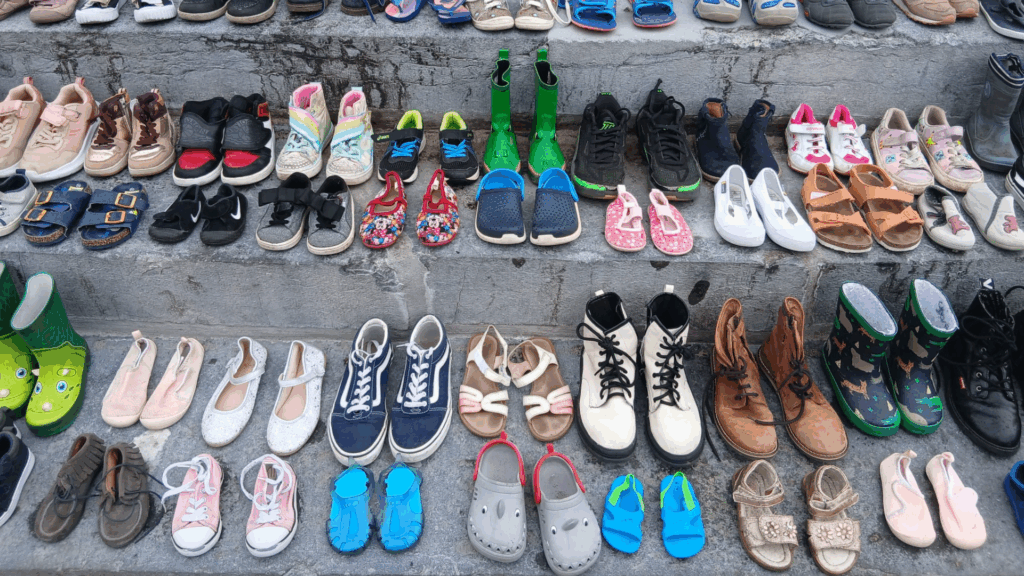
Amid yearly reports of over 250,000 cases of missing children across Europe, hundreds of children's shoes were displayed outside of the European Parliament on Thursday as a call to action from the federation for missing and sexually exploited children, Missing Children Europe.
In spite of the Brussels rain making an appearance on Thursday, a small crowd began to form at Place du Luxembourg around several rows of shoes, some of which were displayed in the shape of the missing children helpline number 116000.
"They represent individual stories of children fleeing abuse conflict, caught in the middle of family breakdowns or fallen victim to criminal networks," explained Missing Children Europe's Secretary General, Aagje Ieven.
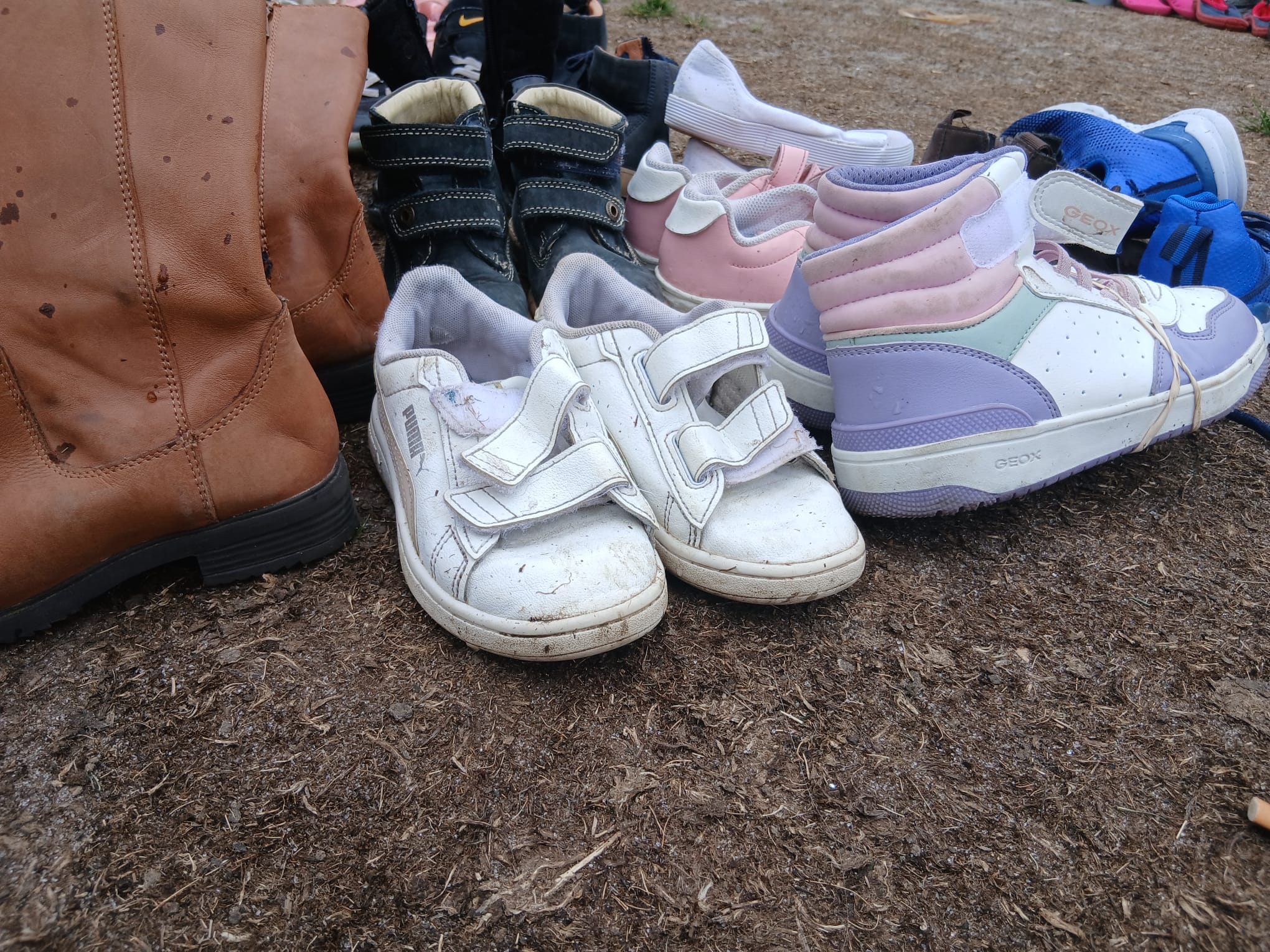
Children shoes at the Missing Children Europe's action. Credit: The Brussels Times/Rita Alves
While the causes of missing cases are varied, in Belgium, an increasing number are related to runaway incidents. In 2024, for the third year in a row, there was an increase in the number of minors running away, resulting in a total of 1808 cases, say Brussels-based child protection agency, Child Focus.
According to Ieven, while missing cases related to sexual abuse or trafficking tend to be taken seriously, the growing issue of runaway children does not always receive the same attention. "Every child who runs away does that for a reason, and behind each of these children is a gap in the child protection system," she said. "There's something that's bothering them and they don't have any way to deal with it or maybe they're leaving a home that isn't safe."
'Seat belt legislation'
The steps needed to change the current situation vary per country across Europe. "Child protection systems are made up of very different services, and those services need to be seamlessly integrated. And what needs to happen in every country is different," said Ieven.
Nonetheless, she believes gathering more data as to why children go missing in the first place is crucial. "Was it somebody else? Was there an external person? Was it family conflict? Was there abuse? What happened? Were they being bullied? What was the reason?"
Additionally, with rising threats to children's safety driven by the digital world, more needs to be done to hold large online platforms accountable. "We're part of a coalition that is advocating for stronger legislation because at the moment, what we're seeing is that the responsibility [for prevention] is very much being pushed towards children and towards parents themselves," said Ieven.
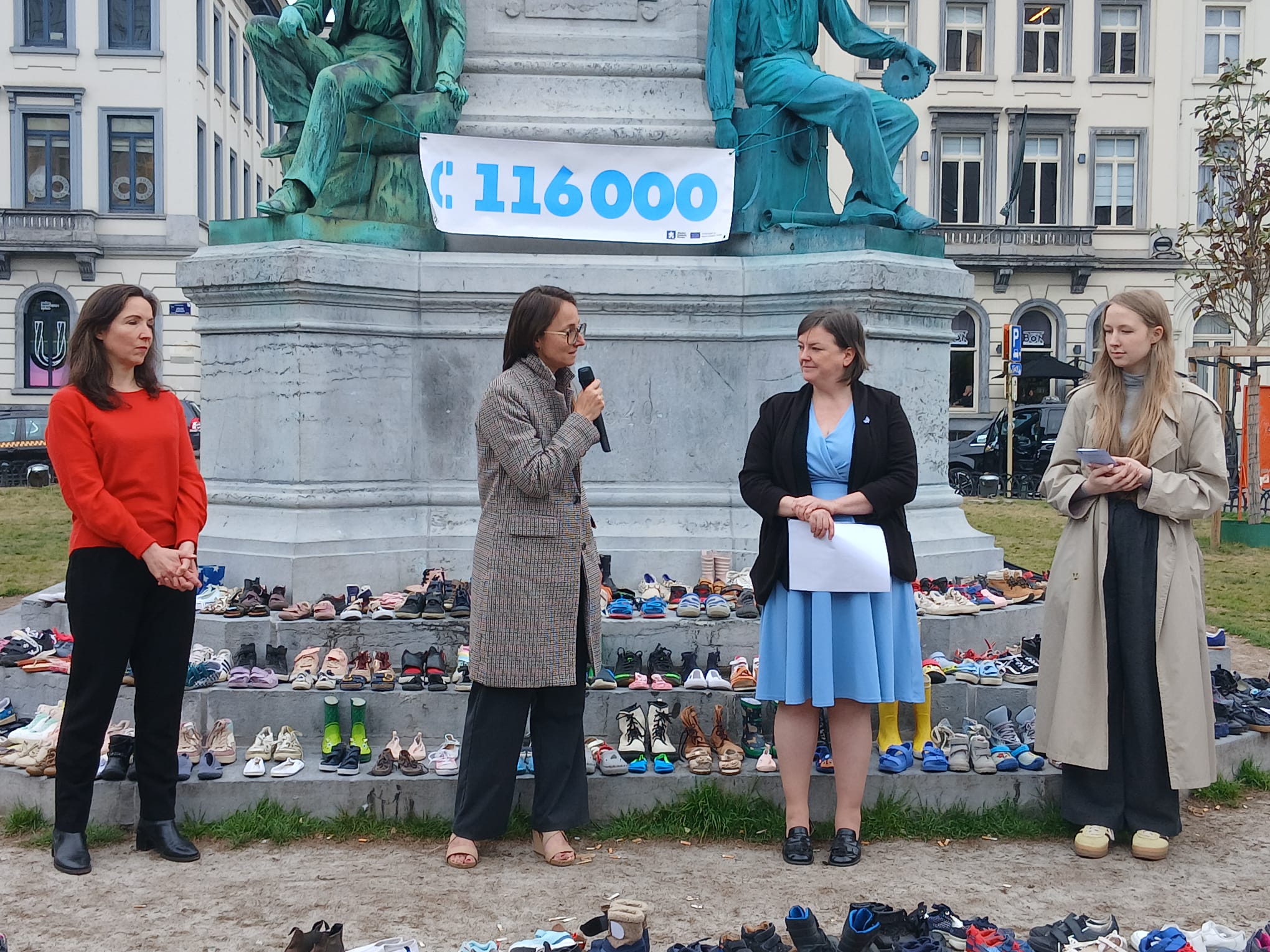
(L-R) European Commission's Coordinator for the Rights of the Child Marie-Cécile Rouillon, Belgian MEP Saskia Bricmont, Secretary General Missing Children Europe Aagje Ieven, and Missing Children Europe Youth board member Lisa-Marie Schaumburg. Credit: The Brussels Times/Rita Alves
Although she believes raising awareness of the digital dangers is important, making platforms safe in the first place is crucial. "Parents can't control their children 24/7, we should just make these platforms safe. You wouldn't drive a car without a seat belt, and you shouldn't be able to go on the internet without that seat belt," she said.
However, achieving this is not easy. "This is seat belt legislation. It's really making companies responsible for doing what is necessary to protect children. But there are quite a few companies, unfortunately, who feel that that's not economically advantageous for them and for policymakers, sometimes it is difficult to understand all the complexities. So what we need is political will."
'We betrayed collective commitments'
In addition, Ieven believes that there is a need for stronger social policies in Europe, particularly targeting more vulnerable children, such as those in care systems.
This is echoed by Belgian MEP Saskia Bricmont (Greens). "In order to make a change at national but also at EU level, we also have to change our policies," she said during Thursday's event.
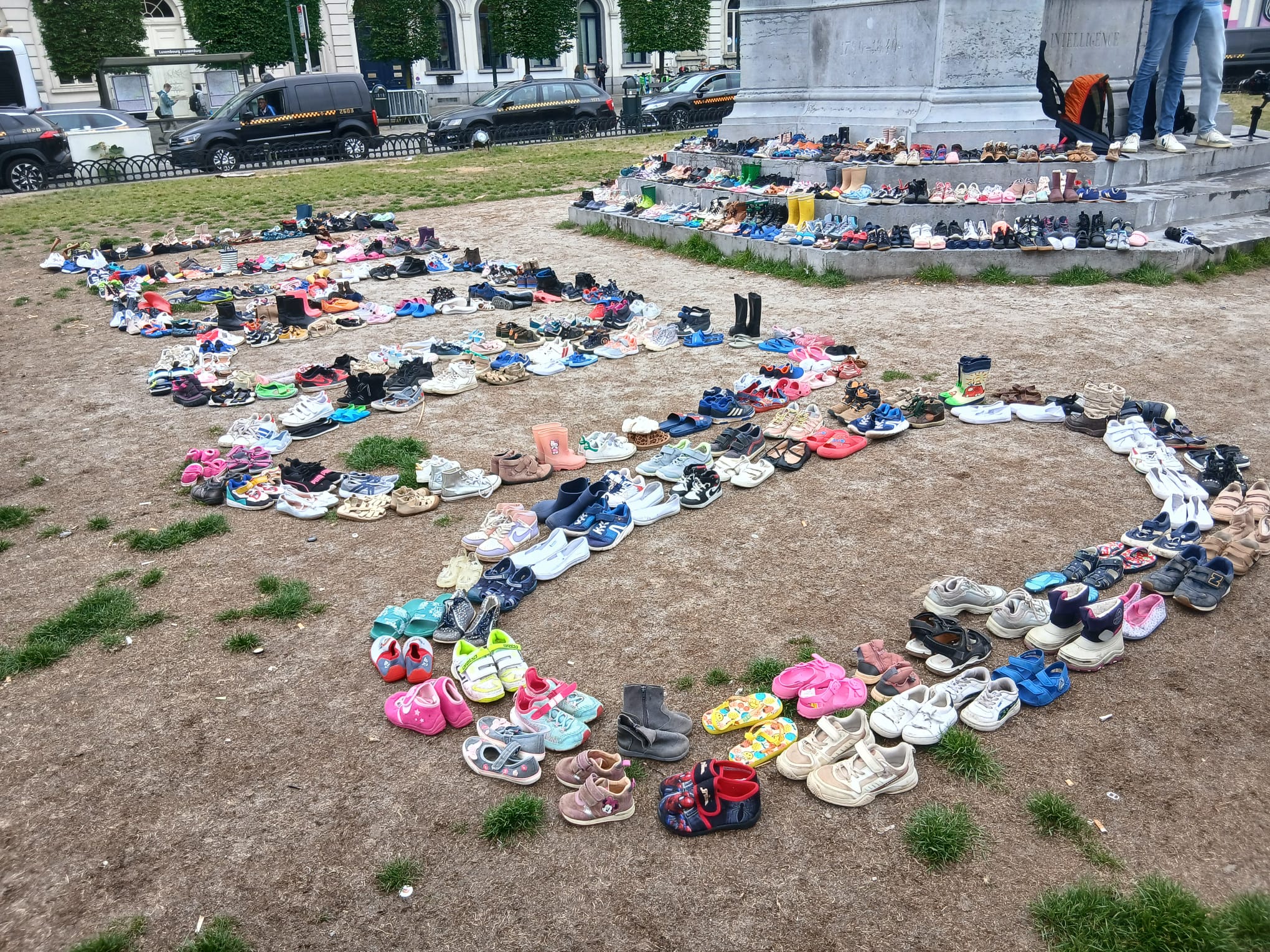
Children shoes at the Missing Children Europe's action. Credit: The Brussels Times/Rita Alves
For Bricmont, the adoption of certain legislation, such as the EU's asylum and migration pact, has "betrayed" the collective commitment to protecting particularly vulnerable children. "The current asylum and migration system, which is not based on solidarity and a human based approach, and even less on a child rights' based approach, brings and leads to missing children on the move and unaccompanied minors," she said.
Nonetheless, Bricmont underscores that in many countries, including Belgium, there are "good practices" from some organisations to support children. "This is also our responsibility and the responsibility of the national authorities to make all the services known and to make more campaigns at a national level to inform the public."
'A lifeline, not a forgotten line'
One of the existing support systems is the 116000 hotline network for missing children, which operates in 32 European countries and is coordinated by Missing Children Europe.
However, even such services are faced with a lack of investment from governments. "Those services [...] should work 24/7 but they're not funded enough in every country to do so and that's really unacceptable," said Ieven.
"What if I told you I'm sorry after 18:00 you can't call the police anymore. You can't call the firefighters. It doesn't matter if your house is burning down. I can't imagine that anybody could actually imagine that being a reality, but for missing children, that reality does exist in many countries," said Missing Children Europe's youth board member, Lisa-Marie Schaumburg.
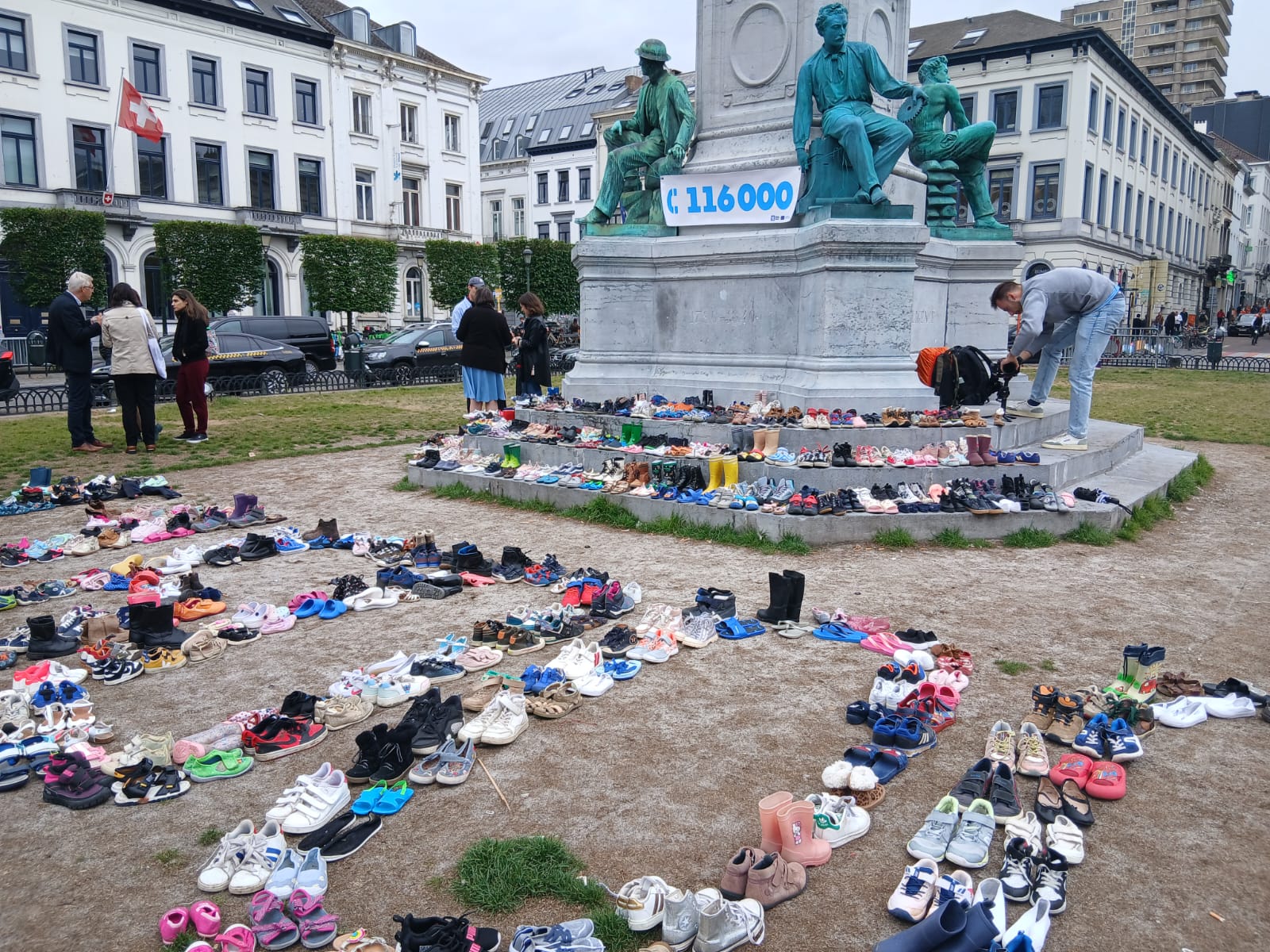
Children's shoes and the 116000 missing children hotline banner on display as part of an action by Missing Children Europe. Credit: The Brussels Times/Rita Alves
Ensuring the hotline is "fully operational" in every Member State is a priority, according to co-chair for the European Parliament's Intergroup on Children’s Rights, Evin Incir (S&D). "It must be a lifeline, not a forgotten line," she added.
In addition, more work is needed to raise awareness for the existence of the hotline network in the first place. "I recall being very young and adults and teachers drilling into us what to do when there is a fire, what to do when you're in danger, you call the police, you call the firefighters [...] this hotline really is the equivalent to that for the issue of 'missingness'," said Schaumburg.
In the meantime, as the cracks in the system become harder to ignore with the thousands of missing children cases, Incir emphasised that Thursday's action goes beyond being a visual reminder of the issue. "It's a mandate to protect every child everywhere, to find every missing one and to never stop until we do because how we treat the most vulnerable in our societies says a lot about our societies."
Related News
- 'Pay attention': Big rise in child sexual exploitation cases in Belgium
- 'Alarming' surge in child sexual abuse images hosted in EU, report shows
- Children as young as eight posting sexual content online in Belgium
Missing Children Europe is a federation for missing and sexually exploited children. It represents 35 non-governmental organisations active in 28 countries across Europe, including Belgium's Child Focus. It works on the prevention and protection of missing or sexually exploited children and their families.
The organisation coordinates the 116000 hotline network for missing children, available in 32 European countries, including Belgium. The hotline aims to provide free psychological, social, legal and administrative support to missing children, their families, or children thinking of leaving home. It can also be used by anyone with information about a missing child.
