
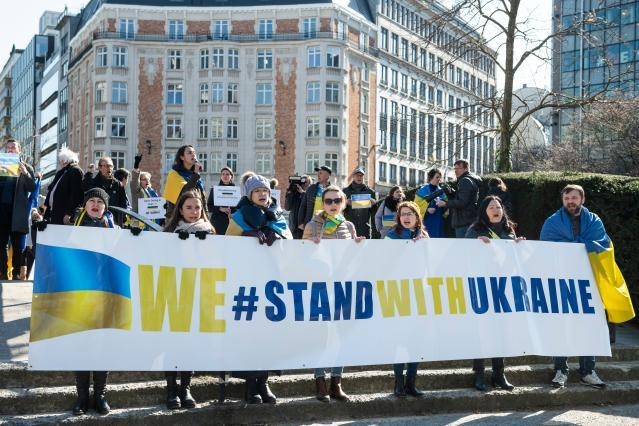
The EU decided last week to extend the temporary protection for Ukrainian asylum seekers by one year until March 2027 but the same rules will continue to apply and are not uniformly applied by the Member States.
The temporary Protection Directive (TPD) grants immediate protection and access to basic rights in the EU to Ukrainian refugees fleeing the war, including residency rights, access to the labour market, suitable accommodation, and necessary assistance in terms of social welfare, medial care and means of subsistence.
The current regime, which has been extended several times, runs until 4 March 2026. Considering the uncertainty about peace talks on ending the war, the European Commission proposed in beginning of June extending the protection by another year, until 4 March 2027. The ministers responsible for home affairs and migration unanimously gave the green light for this on Friday in Luxembourg.
The Directive was activated for the first time on 4 March 2022 after Russia’s invasion of Ukraine and was complemented with a 10-Point Plan on stronger European coordination. Since the start of Russia's war of aggression, over 4.3 million displaced people from Ukraine have found safety, shelter and opportunities across the EU, including more than 93,000 in Belgium.
With the activation of the Protection Directive, Member States and their citizens have sent “a powerful message of solidarity towards Ukraine and its people fleeing the war”, the Commission wrote, “by offering them immediate protection and support, including access to accommodation, healthcare, education and employment”.
The activation of the Directive sets out a “common EU approach”, giving predictability and legal certainty both to the displaced persons from Ukraine and to the Member States. A Commission spokesperson confirmed that the same rules will apply with the extension. There is no change in the scope, only the date of its application is extended, in line with legal provisions.
However, as previously reported, the Directive faces challenges in the application on the ground. Whilst the Directive sets the right to necessary social welfare assistance, it does not prescribe the level. Based on the EU Charter of Fundamental Rights, the assistance must be sufficient to ensure a dignified standard of living.
Within those limits, it is for Member States to set out their reception/accommodation policies, including the level of allowances or housing support. The directive does not provide for a specific amount or threshold of support, nor that it has to be the same as the support nationals of that country receive.
In practice, Member States have chosen to apply this differently, with some granting support to the level of beneficiaries of international protection, and others aligning to standard for beneficiaries of subsidiary protection.
In for example Sweden, the over 40,000 Ukrainian refugees that are living there do not enjoy the same rights as citizens. According to Swedish daily Dagens Nyheter, a residence permit issued under the so-called mass exodus directive is temporary, and cannot be converted into a permanent one irrespective of how long time they have been living there.
According to a new law (‘population registration light’), Ukrainian refugees can get a Swedish personal identity number but are excluded from things like child benefit, housing benefit and disability support. The Nordic countries have given Ukrainian refugees widely varying conditions, but Sweden is an outlier, forcing Ukrainian refugees into undeclared work.
In fact, to offer a more stable and lasting perspective, the Commission is also proposing to Member States to prepare for a coordinated transition out of temporary protection. The measures address the needs of those residing in the EU as well as the need for Ukraine to rebuild the country, including by supporting safe, voluntary and dignified returns and reintegration.
That said, many of those enjoying temporary protection have integrated into their host societies by learning the language, finding employment or following education. According to the Commission, they should have the possibility to transition into national or EU legal statuses that better reflect their new situation. These could be residence permits based on employment, education, research, or a national long-term resident status.
