
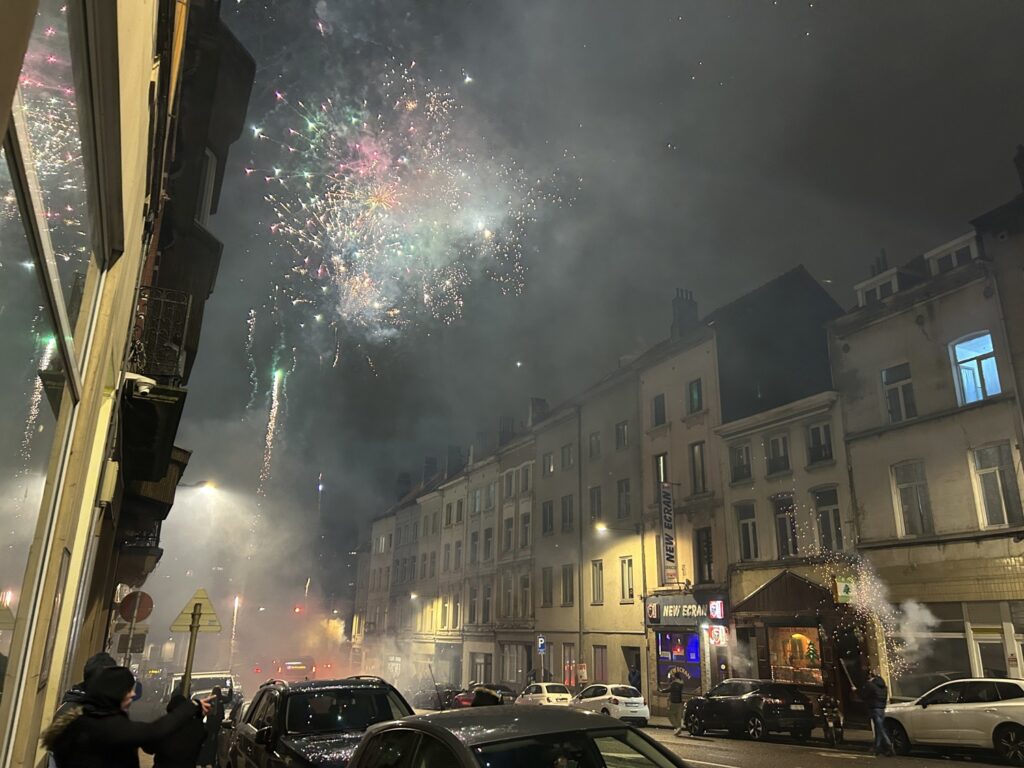
The EU has just celebrated the New Year with fireworks but as every year media reported about private fireworks that got out of hand or were intentionally used against people and buildings, raising questions about lax enforcement or insufficient regulation of the rules.
In Brussels-Capital Region, a ban against private fireworks and their transport has been in place in recent years and violators risk a fine and imprisonment for up to 14 days. However, the ban is not easily enforced and the festivities were marred by several incidents. Police, emergency services, and staff from transport operator STIB were targeted with fireworks during their work.
Trams, buses, and street furniture were also damaged, alongside reports of Molotov cocktails and explosive devices discovered in multiple locations, according to police. Furthermore, in Brussels, the capital of Europe, firecrackers are used in demonstrations which are supposed to be peaceful protests.
One of the worst incidents occurred in Amsterdam, where a massive fire destroyed a popular 19th-century church on New Year’s Eve in a night marked by fireworks-related deaths and unprecedented violence against police in the Netherlands. Local media reported that the church was likely hit by fireworks. The Dutch ban on the sale of consumer fireworks as of next New Year came too late.
The use of fireworks threatens biodiversity, humans and animals alike. According to an op-ed published last week in The Brussels Times, Europe does not have a ‘fireworks problem’ – it has a consumer‑fireworks problem because the Directive 2013/29/EU on pyrotechnics is not designed to address the cumulative impact of a multitude of private detonations.
“The loudest, most polluting, least controlled fireworks are not the ones handled by trained pyrotechnicians under a permit. They are the rockets and firecrackers sold to private individuals and launched from balconies, courtyards, streets and parks—often late at night, often with alcohol in the mix, and almost always with consequences we have normalised as part of New Year celebrations.”
Asked about the directive, a European Commission spokesperson replied that it sets out EU-wide rules on consumer and professional fireworks, theatrical pyrotechnics and other pyrotechnic articles. The rules include essential safety requirements, conformity assessment procedures and labelling. Member States had to transpose the rules of the directive into national law by June 2015.
Is regulation including banning of the use of private fireworks an EU or national competency? “The Directive allows Member States to further restrict the possession, use and sales to the general public of pyrotechnic articles, except certain categories, if justified on grounds of public order, security, health and safety, or environmental protection.”
“They may also increase the age limits associated with users of pyrotechnic articles in relation to consumer fireworks and certain other pyrotechnic articles. Many Member States have to some extent made use of this discretion, some taking a more restrictive approach than others.”
Critical evaluation of Directive
The spokesperson referred to an evaluation published in September 2025 of the Pyrotechnics Directive. “The European Commission is now considering whether changes to the EU-wide rules on pyrotechnic articles are warranted.”
According to the executive summary of the evaluation, the harmonisation of Member States legislation related to the market of pyrotechnic articles aims to achieve the free movement of pyrotechnic articles in the internal market while ensuring a high level of protection of human health and safety of consumers and taking into account the relevant aspects related to environmental protection.
This is first comprehensive evaluation of the directive since it entered into force in 2014. The environment in which EU pyrotechnics legislation operates has changed since the introduction of the substantive provisions in 2007 but also since the recast in 2013.
In terms of health and safety, the essential safety requirements do not seem enough to sufficiently protect users, bystanders and, in the event of criminal misuse, society at large. Non-compliance rates are still very high. Furthermore, the Directive has not effectively prevented security threats related to pyrotechnic articles.
Pyrotechnic articles are increasingly used for criminal purposes, such as to attack first-responders and law enforcement personnel, the cracking of ATMs, but also organised crime. This is possible because the Directive does not effectively prevent the diversion of legally manufactured pyrotechnic articles, especially when sold via online shops.
The essential safety requirements do not sufficiently account for environmental protection. Although they will be supported by harmonised standards, a stronger focus especially on pollution and animal welfare seems warranted in light of contemporary concerns and the EU’s environmental ambitions.
Most Member States have made use of the possibility to introduce bans or restrictions on certain categories of fireworks, theatrical pyrotechnic articles and other pyrotechnic articles. While it is important to tackle risks that are considered not sufficiently addressed by the Directive, this national discretion prevents laws from being fully harmonised and can cause trade barriers.
Overall, the evaluation concluded that the Directive has had an added value compared to what could have been achieved by the Member States acting alone . It did not include any specific recommendations to amend the Directive and address the identified shortcomings.
The overwhelming majority of pyrotechnic products, over 90 % to value of 400 million euros in 2024, are imported from China. Can the EU ban the import of pyrotechnics?
“As per WTO rules, the EU does not ban or restrict imports of individual products unless there is sufficient justification for doing so – such as, if such imports pose a risk to human health, or if their production contravenes human rights (if there is evidence that they were made by forced labour, for example),” the spokesperson replied.
The EU says that it is not aware of any such issues as far as imports of pyrotechnics from China are concerned. A ban would improve EU’s trade balance but might not be necessary. An EU-wide ban on the use of private fireworks would reduce the demand and import. The Commission’s own evaluation reinforces the argument for EU action.
“The EU has built a common market for pyrotechnics, but left the harmful effects to local bans that are easy to circumvent,” says Misha Istratov, a Swedish entrepreneur and journalist writing about sustainability and wildlife. “The next step should be to close these gaps – especially distance/online sales and access to consumer fireworks – if the goal is to reduce harm to humans, animals, and the environment.”
