
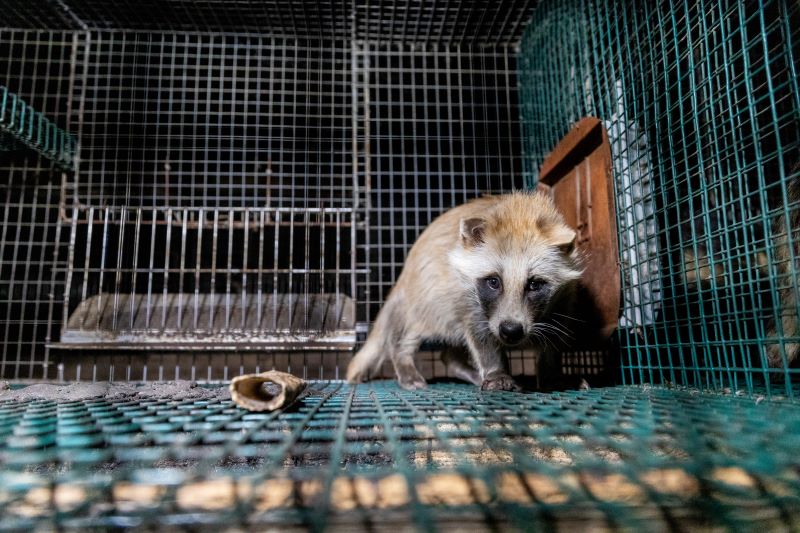
Ahead of the Commission’s decision on the ‘Fur Free Europe’ European Citizens’ Initiative (ECI), zoonotic disease experts and academics are warning that fur farming poses a preventable public health threat following lessons learned from the Covid-19 pandemic.
If the Commission is serious about One Health – the principle that the health of people, animals and wider environment are interconnected – it must propose a ban on fur farming rather than welfare standards, they wrote in a recent commentary published in The Lancet Regional Health – Europe.
“Fur farming is an unnecessary and preventable public health threat,” lead author Dr Joanna Swabe, director at Human World for Animals Europe, summarized.
“The EU cannot claim to champion One Health while allowing a declining fur industry to continue cruelly breeding susceptible species, such as mink, foxes and raccoon dogs, in intensive conditions where dangerous viruses can spread, adapt and potentially spill over to people.”
The ECI for a ‘Fur Free Europe’ was officially closed in June 2023 after a year of campaigning resulted in over 1.5 million signatures in 18 EU member states. The ECI goes further than most member states in calling not only for a ban on fur farming but also on a ban on the placing and marketing of farmed fur products in the European market.
To date, over 20 EU member states have totally or partially banned or strictly regulated fur farming, sometimes with phasing-out period, on grounds of animal welfare and public health. However, the EU is still one of the main regions for fur production globally. Some EU countries in the north and south (Denmark, Finland, Greece and Spain) reportedly oppose a EU-wide ban for economic reasons.
The European Commission was expected to table a legislative proposal by March 2026 which could lead to a future EU-wide ban but this did not happen because of internal disagreement according to a leaked document seen by Politico.
The Commission believes that that species-specific welfare rules, rather than a total ban, represent the “most appropriate follow-up” of the ECI. It also quoted “significant economic impacts” for the remaining fur-producing regions and changing consumer attitudes.
European Ombudsman investigating
The European Ombudsman has also become involved in the case. In beginning of March this year, it opened an inquiry following a complaint from animal welfare NGOs against the European Commission for its lack of response to a meeting request concerning the ‘Fur Free Europe’ ECI.
In the letter to the Commission, the Ombudsman suggested that the Commission should immediately reply to the complainants and inform her office about the meeting request. She asked that the reply be sent before the date by which the Commission intended to adopt its final position on the ECI.
A meeting did take place a few days later on 6 March but the NGOs were dissatisfied that the Commissioner in charge of animal welfare, Oliver Varhelyi, did not attend it.
The Ombudsman also addressed other concerns raised by the NGOs related to balanced stakeholder involvement and evidence-based decision-making. It expected the Commission to address these elements of the complaint in its reply.
Asked about the status of the inquiry, a press officer at the European Ombudsman told The Brussels Times that it is still on-going. He confirmed that the Ombudsman has received the Commission’s reply in the inquiry. “We are currently in the process of analysing the reply, along with the complainant’s comments on it.”
