
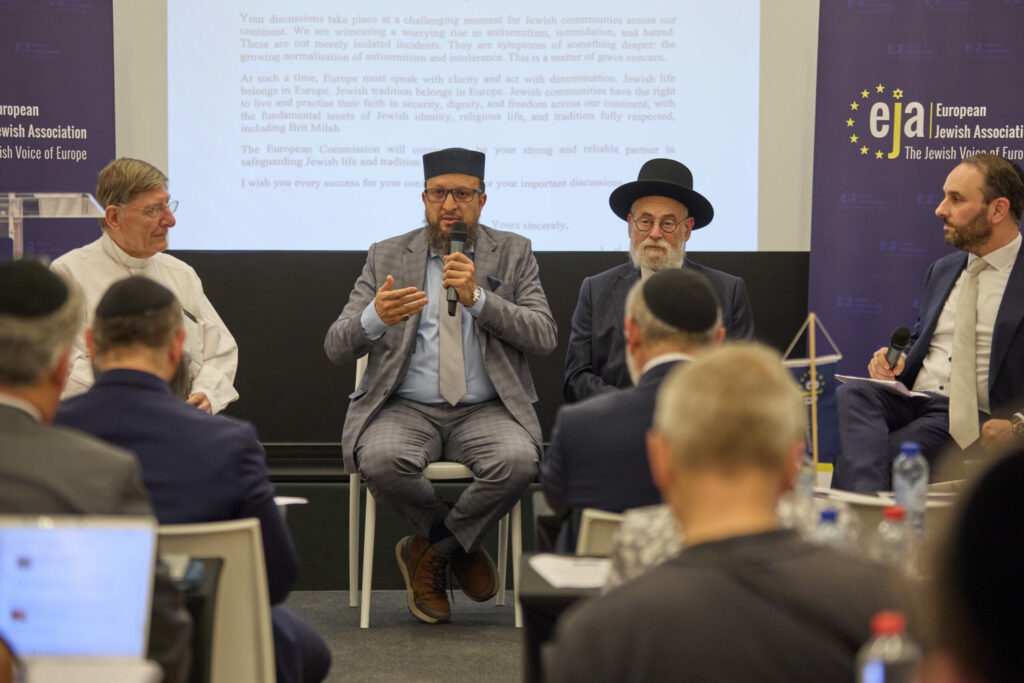
The European Jewish Association (EJA) and the Rabbinical Centre of Europe (RCE) announced last week the first comprehensive medical and professional certification program of its kind for qualified Jewish circumcision practitioners in Europe.
In Judaism, circumcision or brit milah (covenant of circumcision) for religious reasons of newborn boys is traditionally performed on the eighth day after birth. Circumcision at that early age is considered safe and significantly reduces the risk for complications compared to if it was performed at a later age. It is performed by specially-trained practitioners (mohalim) who do not necessarily have to be physicians.
The programme will be provided by a Brussels-based ‘Centre of Excellence for Religious Male Circumcision’ (CERM). The initiative comes against the backdrop of growing legal and political challenges to Jewish religious circumcision in Belgium and other European countries.
The program aims to work with health authorities across Europe to build confidence in qualified mohalim as the practitioners best placed to perform religious circumcision, ensuring that their competence is recognized through rigorous medical standards and independent supervision - rather than becoming a matter of political debate.
As previously reported, the Antwerp Public Prosecutor’s Office decided last April to indict three persons who perform circumcision according to Jewish practice. The indictment was seen as a threat against the future of Jewish life in Belgium and an escalation in a legal-medical dispute that erupted a year ago after police raided the homes of the circumcisers in the local orthodox Jewish community.
Since then, the practice in Belgium is in limbo. The founders of the new centre hope that it will lead to a mutually acceptable solution. The Centre has been established as a practical response to the crisis. It aims at strengthening medical safeguards, professional standards and oversight surrounding Brit Milah, while enabling Jewish communities to continue practicing an essential element of Jewish life in Europe.
“Brit Milah has been at the heart of Jewish life for thousands of years,” commented Rabbi Menachem Margolin, chairman of the EJA. “Faced with growing challenges to the practice and, in particular to the ability of trained mohalim to perform it in parts of Europe, we decided that our response must go beyond defending religious freedom. We are creating the highest possible professional framework to support it.”
The centre will provide already-qualified mohalim with structured supplementary medical and safety training, practical assessment and certification. The program will operate under the supervision of an international network of urologists, pediatricians, physicians and medical scientists.
The curriculum covers the medical and safety framework surrounding the procedure, including newborn assessment, hygiene and infection prevention, infant welfare, bleeding and wound care,recognition of complications, emergency response and infant basic life support, medical referral and aftercare.
Certification will include practical assessment, realistic clinical scenarios and emergency simulations, with particular emphasis on recognising warning signs, understanding the limits of competence and knowing when to postpone a procedure or seek medical assistance.
Centre of Excellence
“We deliberately called this a Centre of Excellence,” he added. “When it comes to the welfare and safety of a child, our ambition should never simply be to meet a minimum standard. We want excellence - and we want that excellence to be transparent, documented and capable of being independently demonstrated.”
In a reference to the EU, he said that Europe cannot claim to protect Jewish life while placing one of its most fundamental practices in doubt. The first reaction from the European Commission was positive. “Jewish life and Jewish religious practice belong in Europe,” commented Oliver Várhelyi, European Health Commissioner.
“Our responsibility is to ensure that longstanding traditions can continue in a framework that meets the highest standards of child welfare, medical safety and professional responsibility, in line with European standards. The Centre of Excellence for Religious Male Circumcision offers a constructive and credible model for doing exactly that.”
Katharina von Schnurbein, EU Coordinator on combating antisemitism and fostering Jewish life, told The Brussels Times that she agreed with Commissioner Várhelyi’s position. Magnus Brunner, Commissioner for Internal Affairs and Migration, said that the initiative is “good for Jewish life in Europe”.
The European Commission stopped short of confirming that the initiative will lead to EU-wide non-binding guidelines to the Member States on religious circumcision. Such guidelines are expected to encourage EU Member States to enable male circumcision for religious reasons without infringing on their health competency.
“We would certainly welcome EU-level guidance as soon as possible, particularly guidance encouraging Member States to combine high medical standards with respect for freedom of religion,” commented Rabbi Margolin. “But this is ultimately a question for the European Commission. We are encouraged by the constructive engagement and support we have received from Health Commissioner Várhelyi.”
Asked about the EU guidelines, a member of his cabinet told the The Brussels Times that it had nothing further to add to the Commissioner’s quote but left the door open for future development. The cabinet of Belgian health minister Fran Vandenbroucke did not reply to a request for comment.
The curriculum has been completed and the organisational structure is already in place, says EJA. “We expect the first training cycle to begin shortly after the Jewish holidays this autumn, with participants beginning the theoretical modules first and the practical training and assessment following afterwards. The number of active mohalim in the EU is relatively small and estimated to 40 – 70 persons."
While the programme has been designed specifically for mohalim, Muslim circumcisers could in principle also participate in it. However, it is probably less relevant for the Muslim community in Belgium as Muslim circumcision for religious reasons is carried out by physicians at hospitals. According to the Muslim Council of Belgium (CMB), the community is overall satisfied with this arrangement.
“We aren’t establishing the centre because we believe that mohalim are generally performing circumcisions unsafely,” concluded Rabbi Margolin. “On the contrary, we aren’t aware of evidence of a systemic medical problem involving Jewish circumcision in Europe. As our recent conference demonstrated, there is no public-health crisis related to Jewish circumcision.” Published literature places overall complication rates at below 0.4%, with infection rates of less than 0.06%.
“What has changed is society's expectation of formalisation, transparency and accountability. Governments and the public increasingly want to know precisely what practitioners are taught, what standards they follow and whether their knowledge is periodically assessed."
“Medicine also evolves. Techniques relating to hygiene, wound care, bandaging, pain management and the recognition of complications continue to develop. Continuing education is normal for doctors and other healthcare professionals, and we believe the same principle of continuing professional development is valuable here.”
In some countries additional medical personnel— such as a doctor or nurse — are required to be present at the Brith Milah. EJA accepts that. “Where national law or medical guidance requires particular forms of supervision or assistance, practitioners should of course comply with those requirements.”
