
Belgium’s national health insurance, INAMI, reportedly spent close to €76 million in 2024 reimbursing new-generation weight-loss and diabetes drugs such as Ozempic. €76 million, enough to make anyone ask: is Belgium becoming addicted to shortcuts to losing weight or, is this simply a reflection of a global medical trend?
To get clarity, we spoke with a dietitian working in the endocrinology department at Montlégia Hospital, Chantal Wey. She sees firsthand how these drugs are being used, and indeed misused, by patients. Her view; Belgium isn’t uniquely “unhealthy,” but the popularity of these medications raises deeper questions about lifestyle, food culture, and long-term health.
“It’s more or less comparable everywhere, a little more perhaps in Germany, and in England, perhaps a little less in France and the Netherlands,” she tells The Brussels Times.
“We just want to use a tool that is presented to us as more efficient than those we had until now. If you’re offered something, you inject yourself once a week, it allows you to lose weight… so, inevitably, it’s still easier than having to limit yourself.”
In other words, the appeal of Ozempic isn’t Belgian, it’s human. Not to state the obvious, but when a simple solution appears to solve a difficult problem, people gravitate towards it.
'We have people who continue to eat as they did before; unbalanced.'
Ozempic’s secret? A lab-made version of GLP-1, a hormone that suppresses your appetite and slows digestion. Wegovy, the same molecule at a higher dose, is even more effective for weight loss. Patients report smaller appetites and reduced cravings, especially for sugary foods. In purely biological terms, the drug works.
But that’s not the whole story. “Since they eat much less, it triggers more deficiencies, especially in protein, due to a lack of muscle mass,” the dietitian says. Lose weight too fast, skip the diet changes, and it is muscle, not fat, that disappears. You end up lighter, yes, but also weaker.
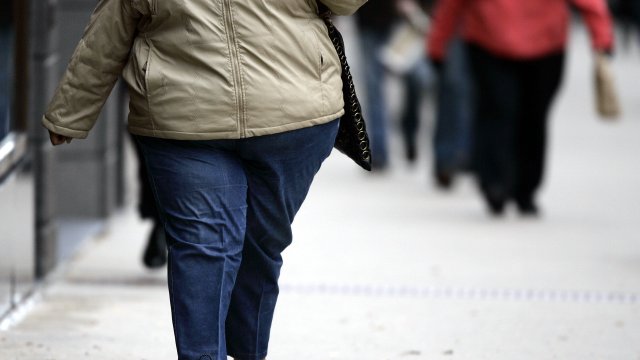
Almost half (49.3%) of Belgium's population is overweight according to the Belgian association for obesity patients, Vox Obesity.
Current reimbursement rules in Belgium restrict these drugs to patients with type 2 diabetes, a body mass index (BMI) of 35 or higher, or a BMI over 30 (obese) combined with other risk factors. Chantal Wey supports this system: “For me, they’re still perfectly acceptable criteria as long as it’s combined with dietetics… that the patient aims for a balanced diet.”
But rules only go so far: plenty of patients just pull out their wallets. “People are really asking about it… not everyone who meets the criteria gets reimbursement.” This willingness to spend substantial sums highlights how powerful the promise of easy weight loss has become.
Beyond individual choices, Chantal Wey sees a broader cultural problem. “People shop less, cook less, and take less time to eat while sitting at the table. We also have a lot of temptations,” she says.
Busy schedules, sedentary jobs, and food delivery apps have eroded traditional eating habits. While a small minority of Belgians embrace local, organic produce and less processed food, most remain stuck in a “junk food and quick fixes” loop. According to the Belgian professional federation Comeos in 2022, a quarter of Belgians had already ordered meals online.
To Chantal Wey, these prescriptions aren’t just a pill or an injection, they are a lifestyle shift: “Care needs to be more comprehensive, work on anything emotional… re-teach people to eat things they like. We are dealing with patients who still have an emotional burden related to their weight.” Patients need personalized guidance, from dietitians, psychologists, and other specialists, to understand why they overeat, not just how to eat less.
'An effective tool… but how far are we going to go?'
Newer drugs are pushing the boundaries of pharmaceutical weight loss. “Ozempic is an analogue of GLP-1 that is lower in dosage than Wegovy, Mounjaro is an analogue of GLP-1 and GIP, so it is even more effective,” she explains. Some doctors even compare Mounjaro’s impact to bariatric surgery, though it is far less invasive.
But no one yet knows what the long-term consequences will be. “We don’t know yet. It’s still a new molecule… how far are we going to go? How are we going to stabilize the patient’s weight the day we stop the injection?” Researchers are exploring whether doses can be tapered or maintained indefinitely, but answers are years away.
Meanwhile, cultural forces are complicating matters. The arrival of these products coincided with a real return of thinness, especially on social media. In some cases, people with only a few pounds to lose are seeking these medications for purely aesthetic reasons, something the dietician warns against: “What is needed for people who only have a few pounds to lose is personalized support. If we don’t understand why some people eat beyond their needs, the person will always gain weight.”
In extreme cases, misuse can be dangerous. “I had the case of a patient with anorexia who told me she had found Ozempic in a hotel drugstore in Egypt. Now, Ozempic sold in a drugstore in Egypt, over the counter, I’m not sure it was really Ozempic.” Whether authentic or counterfeit, the fact that vulnerable people seek these drugs outside medical supervision alarms her.
'Healthier doesn’t mean depriving yourself of everything.'
Despite these concerns, she believes Belgian regulators have done a decent job. “I have the feeling that the authorities have managed the regulation quite well. We have the doctor who doesn't know much about the molecule and doesn't venture into it. There's the doctor who will prescribe it a lot. And then, we still have quite a few doctors who will prescribe it wisely.” In other words, the framework is solid, but enforcement varies by doctor.
The problem isn’t the price tag. Or even the rules. It’s something deeper: how we see food, weight, health itself. Social media pushes unattainable ideals. Daily life encourages speed over quality. People are confused about what a balanced diet even looks like. “One says black, the other says white. People no longer know at all what a balanced diet means,” the dietician laments.
She calls for a return to slow meals, home cooking, and simple pleasure in food. “We need to re-dedicate time to cooking, to eating, to moving, and to understanding why we eat the way we do,” she says. “Above all, no restrictions. Above all, kindness.”
The message is clear: drugs like Ozempic and Wegovy can be powerful allies in treating obesity and diabetes, but they are not magic. Without fundamental lifestyle changes, patients risk losing muscle, developing nutrient deficiencies, or regaining weight once the injections stop. And for those chasing quick weight loss without a medical need, the risks may outweigh the benefits entirely.
Related News
- Use of slimming pills soaring in Belgium
- Ozempic's little brother soon available in Belgium
- Bad food and vicious cycles: Obesity doubles for adults and quadruples among children
- High cost of slimming medicines holding up health boost
- Health agency warns against fake online weight-loss drugs
- Ozempic boom in Belgium as weight-loss drug use rises twentyfold since 2021
