
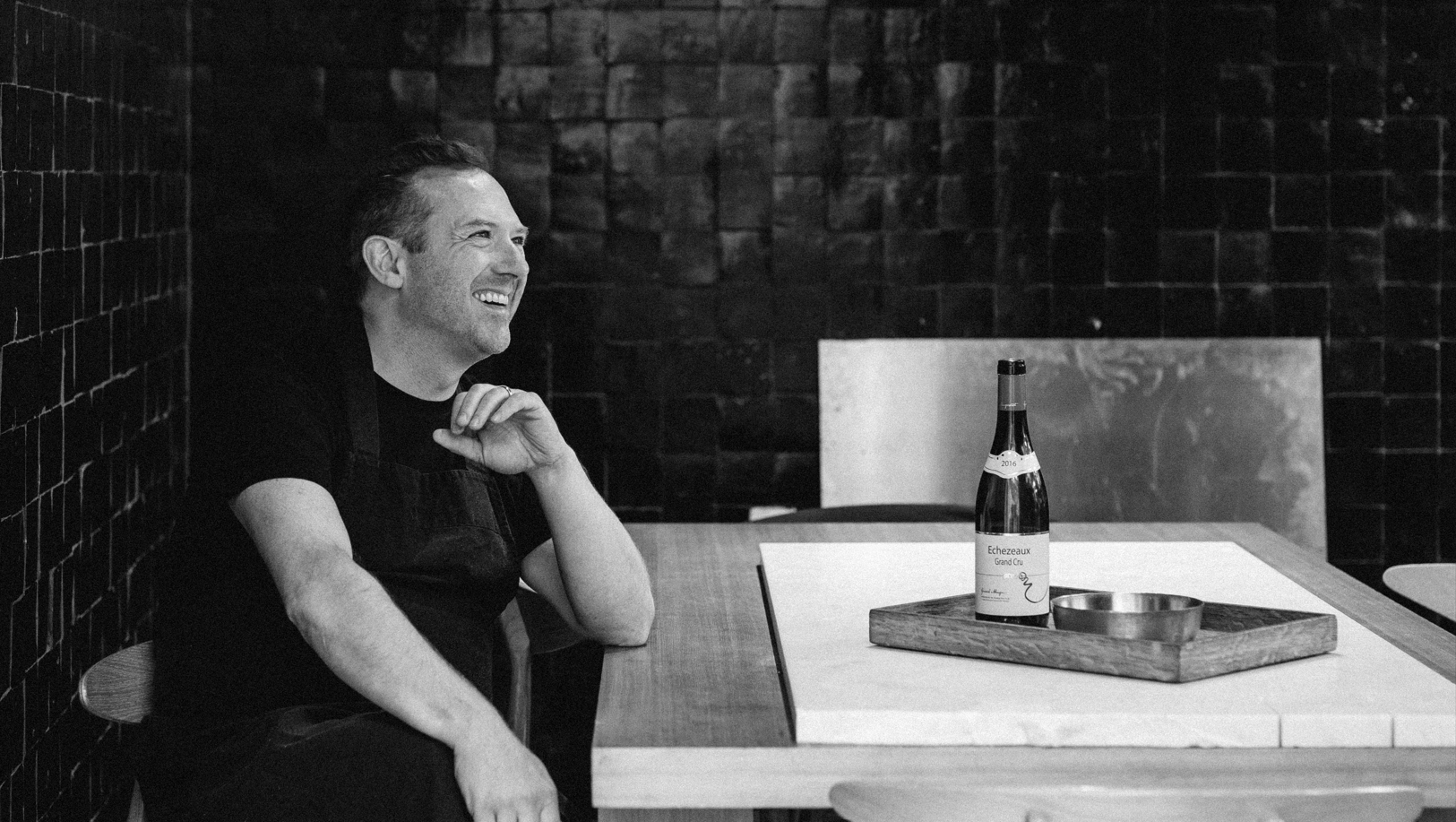
Trained as an art historian but drawn to the kitchen, Flemish chef Matthieu Beudaert has found a way to combine his two passions. His new cookbook transforms masterpieces from Antwerp’s KMSKA into dishes inspired by everything from slashed canvases to Spanish fury. Hughes Belin discovers how Old Masters can produce fresh flavours.
Flemish chef Matthieu Beudaert produced an unusual masterpiece this winter. Not a dish, but a cookbook – audaciously titled Chef d’oeuvre.
The name is not intended as self-congratulation. Instead, it pays tribute to the artists who, unknowingly, contributed to its recipes. Every one of the book’s 40 dishes was inspired by a work in the collection of the Koninklijk Museum voor Schone Kunsten Antwerpen (KMSKA), Antwerp’s Royal Museum of Fine Arts.
The book grew out of Beudaert’s stint as the museum’s Artist in Residence. An art historian by training and a self-taught chef, he was unusually well qualified for the job.
Beudaert, 49, became a cook almost by accident. He studied art history in Ghent until 2003 while working in his spare time as a cook in a tourist restaurant. His chef also taught a weekly evening cookery course and invited him to join. By the time Beudaert finished his master’s degree in art history, he had also graduated in basic cooking.
“I gradually became obsessed with cooking,” he recalls.
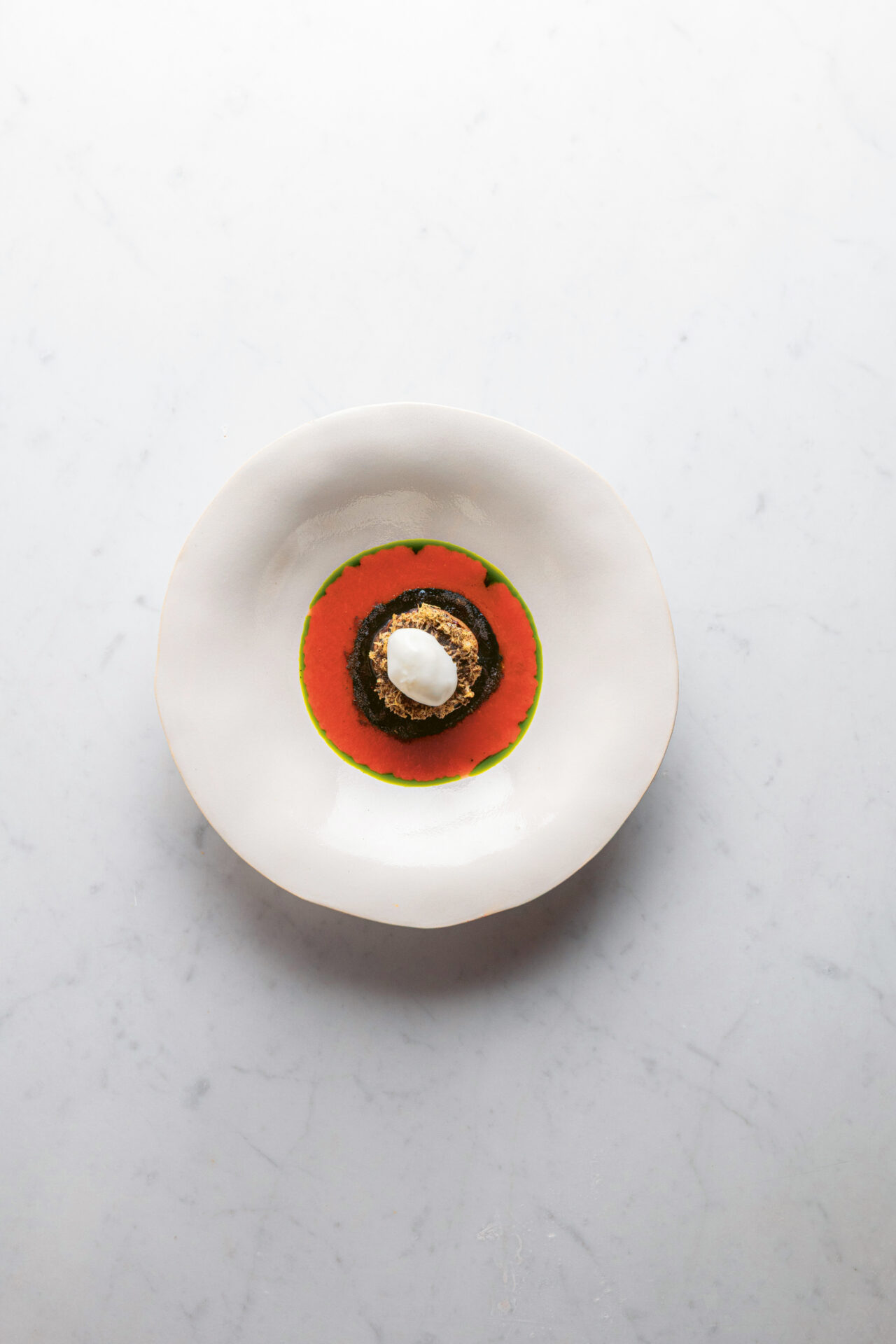
Otto Piene, Grote zon. Credit: Piet De Kersgieter
He moved to Brussels to work at Bozar while moonlighting as a private chef. After three years, he realised he was having more fun cooking than working in a museum. At about the same time, his wife, Sofie Delbeke, was looking for a career change.
In 2009, they took over a restaurant on the outskirts of Kortrijk and called it Table d’Amis. Roadworks later prompted a move into the city centre, while its initially casual cooking gradually evolved into fine dining.
Recognition followed. In 2013, Beudaert was named Young Flemish Chef of the Year by Gault & Millau and won a Michelin star.
Back to basics
Beudaert moved back towards simpler cooking in 2018, and during the Covid pandemic the couple opened a successful trattoria on the premises. At the same time, he began the Chef d’Oeuvre column in Sabato, the weekend magazine of Belgian newspaper De Tijd.
The idea originated in an art gallery. Beudaert saw Enroulement, a sculpture by Belgian contemporary artist Michel François featuring a rolled piece of paper studded with small pieces of clay.
“I immediately imagined a white cabbage where juniper berries would be embedded, like you do with cloves of garlic in a leg of lamb,” he recalls.
The point was not to reproduce the sculpture in edible form, but to “cook” its concept. He put the cabbage dish on his menu and pitched Sabato a regular column based on recipes inspired by art. For Beudaert, the column allowed him to “see new connections between art and gastronomy”.
Food for thought
In 2024, his creations caught the attention of KMSKA, which was looking for an Artist in Residence.
“The aim of this project is to keep the connection with today’s creators,” explains Samuel Mareel, KMSKA curator and leader of Beudaert’s residency project.
That, Mareel argues, is part of the original purpose of museums. “Big museums were created in the 19th century to inspire artists with past creations. They became tourist places only later.”
The Artist in Residence programme brings the museum together with practitioners from other disciplines, including dance, theatre, music and literature. This time, it was gastronomy.
The choice was not as unlikely as it might appear. Antwerp has been a major international port since the 16th century, with foods and ingredients from around the world entering Europe through the city. Food also features prominently in many paintings from the 16th and 17th centuries.
Beudaert visited KMSKA around a dozen times over the following year, exploring its galleries and talking to curators. He initially shortlisted around 60 works.
“For some of them it did not work,” he says. “For others, I had to do them five or six times before being satisfied with the result.”
Painting with flavours
Roger Raveel’s De Wandeling (The Stroll), for example, led Beudaert to a Belgian classic: tomato with shrimps.
It proved surprisingly troublesome. He wanted to capture the painting’s old-fashioned palette of orangey red, yellow and green, while allowing each colour to represent a distinct element. Eventually he devised two mayonnaises: one yellow, coloured with turmeric and Madras curry, and another pale green, made with chervil and spinach.
The exercise illustrates an important aspect of the project. Beudaert did not restrict himself to artworks already featuring food, such as James Ensor’s still life Bloemen en groenten (Flowers and Vegetables) or Lucas van Valckenborch’s Vismarkt (Fish Market).
Instead, he tried to translate the essence of a work into food.
Lucio Fontana’s Concetto Spaziale, one of the artist’s slashed canvases, inspired a kind of ravioli: a sliced sheet of gelatine laid over sea bass tartare with dill mayonnaise.
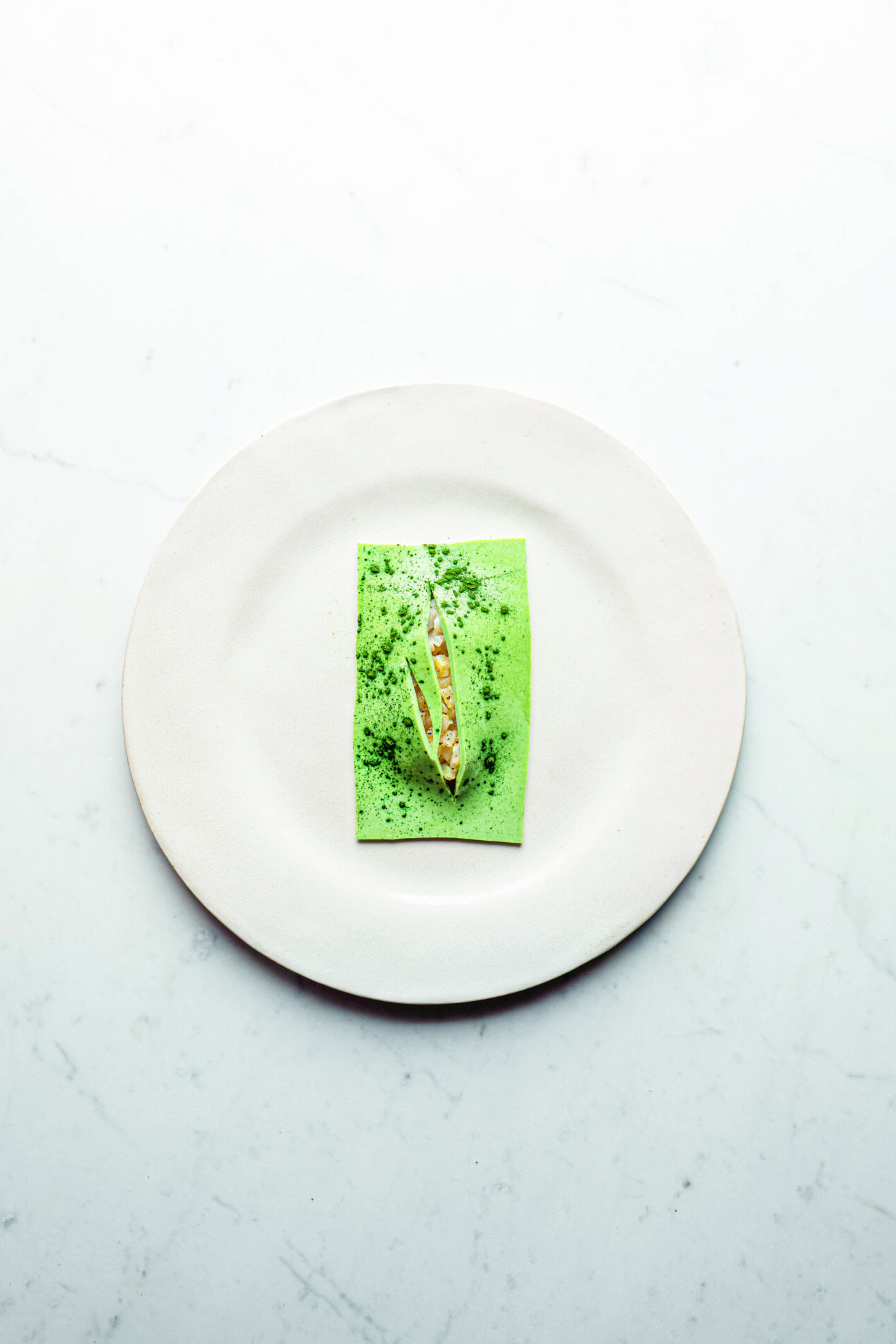
Concetto Spaziale. Lucio Fontana. Credit: Piet De Kersgieter
The connection is also personal. The dish reminds Beudaert of childhood, when his father would feed him canned ravioli whenever his mother was away.
“It’s more interesting for the public when the inspiration comes from a work of art which contains no food,” he says.
Sometimes the connection is emotional rather than visual. In Louis van Lint’s Landschap (Landscape), Beudaert saw “the Spanish fury, a bulk of energy, a wild colour bomb” that suggested “an explosion of taste”.
His response was an exuberant combination with a Spanish accent: squid, white beans and preserved paprika – “a traditional combination which works”.
Other inspirations are more literal, although rarely obvious.
For an aubergine parmigiana inspired by Otto Piene’s Grote zon (Great Sun), Beudaert drew on the firing technique used by the artist, burning the aubergine as part of the cooking process. The dish has since become a permanent fixture on the menu at Madonna, the museum’s brasserie.
Some of the cookbook’s creations also make occasional appearances at Table d’Amis. They include tobacco-smoked veal sweetbread inspired by Constantin Meunier’s Sigarenmaaksters in Sevilla (Cigar Makers in Seville), and an oyster risotto prompted by Walter Leblanc’s Collage.
A recipe for creativity
Published by Hannibal Books, Chef d’oeuvre has found what Mareel calls “a rather big niche of people fascinated by the book”.
For KMSKA, its appeal goes beyond gastronomy.
“We are looking for original ways to attract the public to our collections, so that they see them differently, not just as sacred or abstract,” Mareel says. “We want to showcase the creative process preceding the final result.”
For Beudaert, that creative process was more demanding than he had anticipated. His residency involved repeated museum visits, research, experimentation and dishes that sometimes had to be made half a dozen times before they worked.
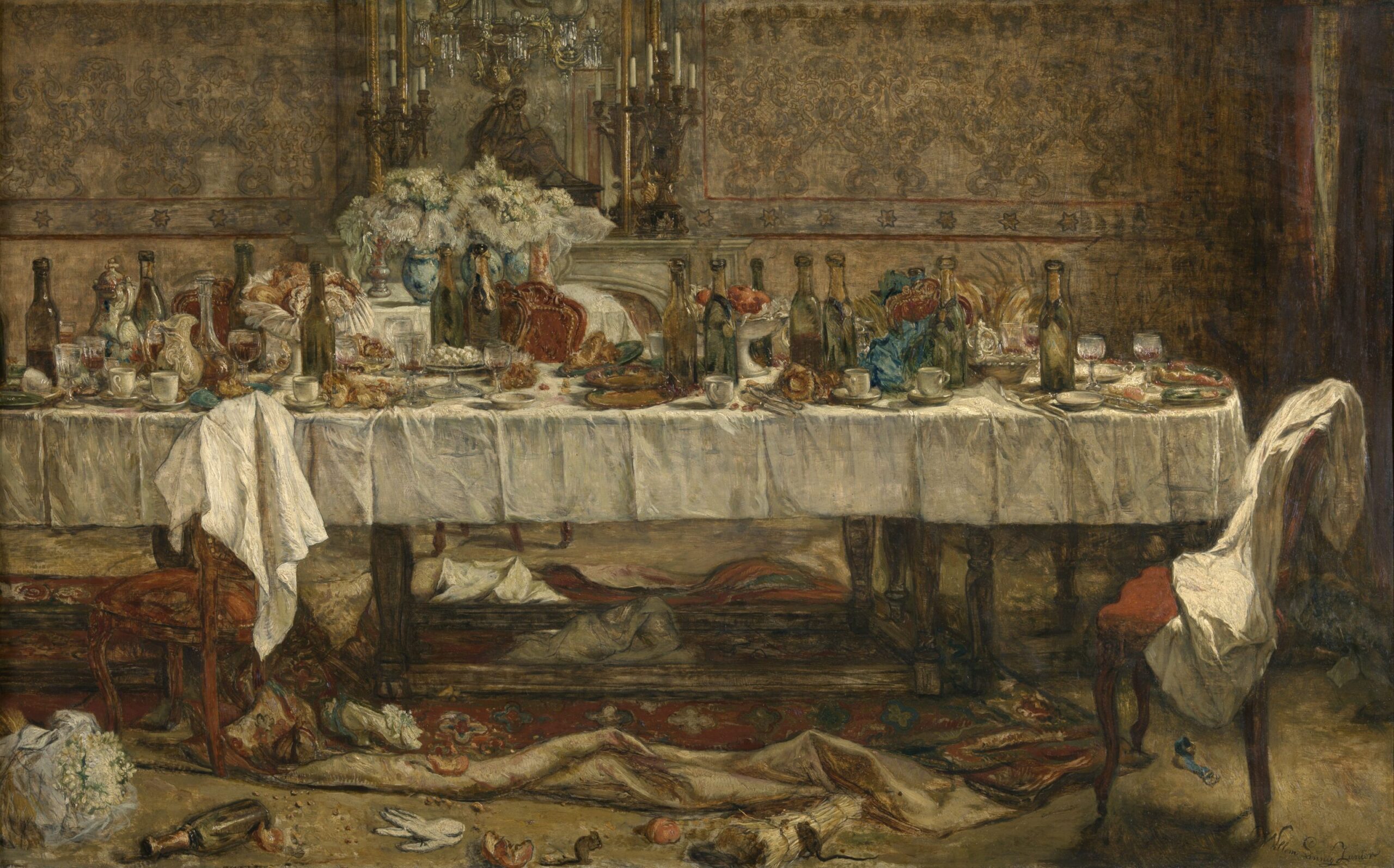
Willem Linnig, Na het bruiloftsfeest (1875). Credit: KMSKA
The result is 40 recipes that bring together the two strands of a career that once seemed to be heading in different directions: art and cooking.
Now Beudaert is preparing another reinvention.
Table d’Amis has been closed since last year and is due to reopen in November as Chambre d’Amis. Delbeke’s pizzeria and trattoria will move to a floor with room for more customers, while Beudaert’s restaurant will become even more intimate, seating fewer than two dozen diners.
More than two decades after abandoning the museum world for the kitchen, the self-taught chef and trained art historian has, in a sense, found his way back.
Only this time, the gallery is on the plate.
