
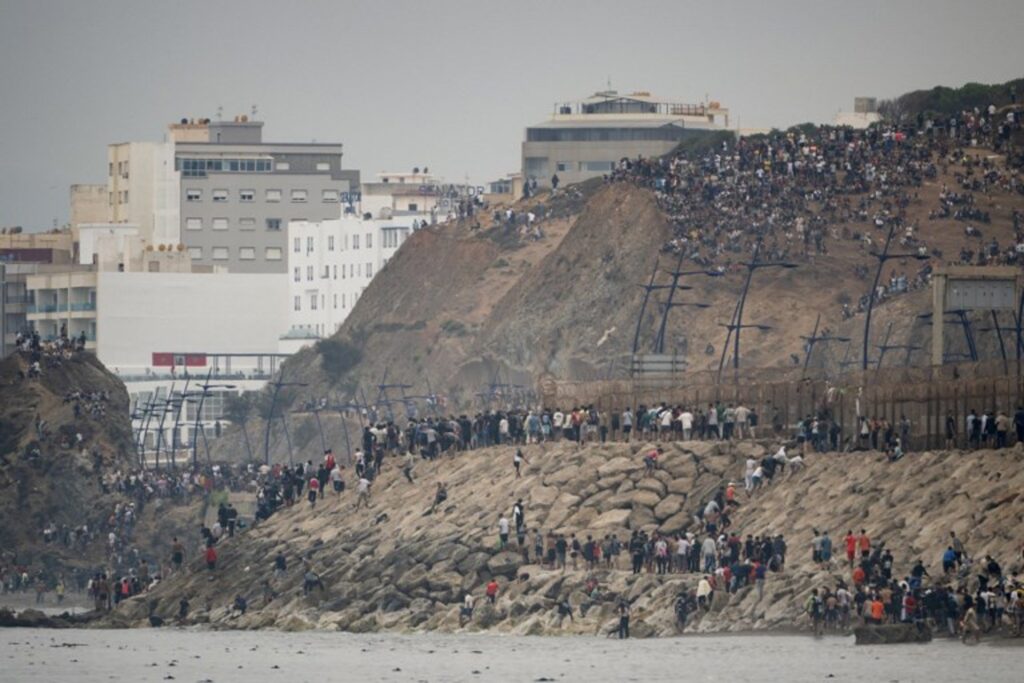
The European Commission says that the situation in Ceuta has been brought under control and that the vast majority of the irregular migrants have returned to Morocco but is unaware about the plight of unaccompanied minors.
As previously reported, the Commissioner for Internal Affairs and Migration, Magnus Brunner, told journalists last week that out of around 72,000 persons, who had tried to cross the external border into EU territory, about 70,000 had already voluntarily returned to Morocco, which is included in the EU list of safe countries of origin. At least 83 persons had lost their lives.
His colleague, the Commissioner for the Mediterranean, Dubravka Suica, twitted on Saturday that the EU appreciates the joint efforts of Morocco and Spain to bring the situation under control and ensure the vast majority of arrivals have returned to Morocco. “These efforts continue,” she added.
However, media reports indicate that the majority of unaccompanied minors have not been returned or cannot not be returned summarily to Morocco as they are protected by Spanish and international child welfare laws. Over 1,100 unaccompanied minors are currently living in overcrowded temporary reception centers, warehouses, or on the streets of Ceuta.
The Spanish authorities must first carry out lengthy administrative procedures to formally verify their identities, evaluate their individual family situations, and ensure that repatriation strictly complies with international child protection rules.
“The whole of the EU saw its worst nightmare turn into reality,” Kelly Petillo, programme manager at the European Council on Foreign Relations (ECFR), wrote in an op-ed, referring to Morocco’s high youth unemployment as an explanation to the sudden surge in young migrant arrivals in Ceuta.
“Hundreds of people, many of whom unaccompanied minors, were suddenly sleeping in car parks and wondering in the streets, faced with the total collapse of local migrant reception structures.”
Reuters reported on Friday that Spanish Youth Minister Sira Rego had recognized the situation. 1,342 minors had been registered so far and more staff would be drafted in to help the effort. She acknowledged the "painful images" of children sleeping rough on Ceuta's streets, and said two schools had been opened and more spaces would be evaluated as potential reception centres.
"I think it might only be a matter of a few weeks before we start seeing (minors) transferred to and welcomed on the mainland.”
In fact, the figures can be higher according to The Guardian. The Spanish government estimated that about 72,000 people had crossed into Ceuta and about 2,500 remained, while Juan Jesús Vivas, the president of the autonomous city of Ceuta, believed that about 80,000 had entered, with between 3,000 and 5,000 still in Ceuta.
Those who remain in Ceuta include an estimated 1,300 unaccompanied children, with NGOs expressing concerns that hundreds more – including some as young as 10 – could be wandering the city unprotected. The precise number of people who lost their lives in the crossing also remains murky, with estimates as high as 141.
Asked about a comment on Monday, a Commission spokesperson told The Brussels Times that “Spain and Morocco continue to work together efficiently and effectively in handling the returns of those that entered Ceuta illegally from Morocco.”
“We understand from the Spanish authorities that illegal movement onwards to mainland Spain and Europe has so far been successfully prevented,” he added. “The expectation is that all those who remain in Ceuta illegally must be returned.” Regarding the latest figures, including unaccompanied minors, he referred to the Spanish authorities.
