

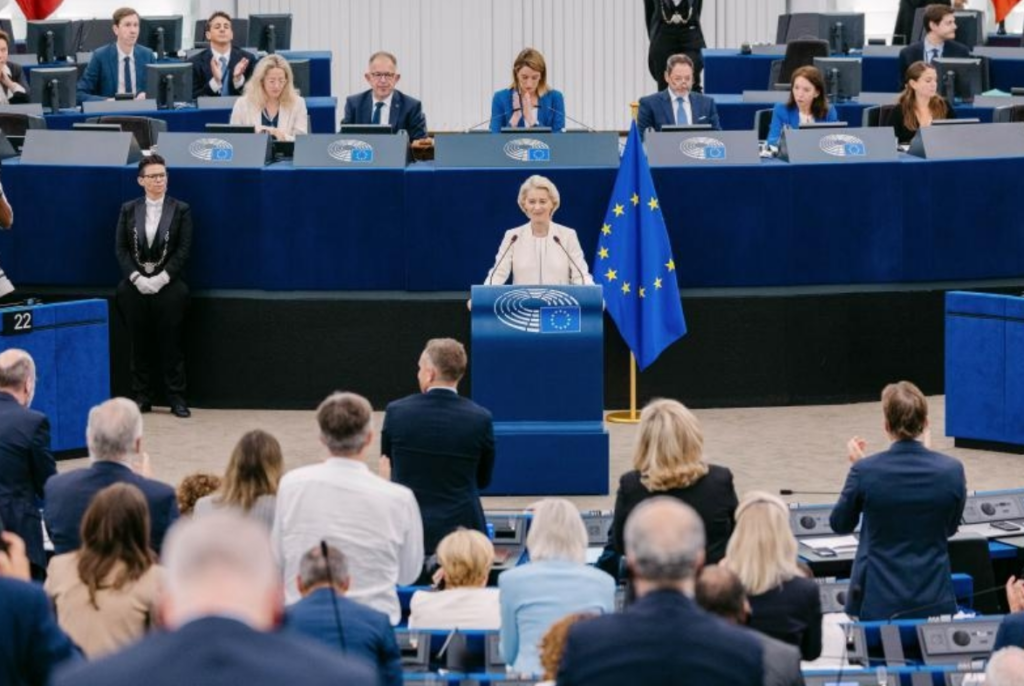
European Commission Ursula von der Leyen’s State of the Union speech on Wednesday was drafted to mobilize political support across political party lines in the European Parliament and included emotional parts where she paid tribute to invited guests besides Canada’s prime minister Mark Carney
As already reported, she announced several new plans and initiatives for the upcoming years to address the challenges that the EU is facing, among them a surprising proposal for Canada to be the first associate member of the EU which would require treaty change For the whole 2026 State of the Union speech, click here.
As in last year’s speech, many of her ideas lack details and it cannot be taken granted that they will be implemented. Some areas were again omitted, such as animal welfare and EU’s fight against racism, antisemitism, islamophobia, and antigypsyism.
As regards foreign affairs, there is much talk about EU geopolitical challenges, in particular in its trade and partnership relations with third countries. Her speech focused on Russia’s war of aggression against Ukraine and the EU’s support to Ukraine, a future EU Member State.
“They are also fighting for our freedom and our self-determination,” she said. “Our task remains to support Ukraine as best we can.” The EU needs to protect its national security and reinforce its defence.
On the Middle East conflict, she mentioned in passing that the EU’s “economy has withstood the impact of the Middle East wars better than expected” but the complexity of the conflict was not addressed. Condemnations of Hamas, proxies, terrorism, and Iran were missing.
What affected deeply Europeans, and rightly so, is the “deep suffering in Gaza and unchecked settler violence in the West Bank”, she said. Last year she also declared her long-standing friendship with the people of Israel, ignoring its current far-right government. “I know how much the atrocious attacks on 7 October by Hamas terrorists shook the nation to its core.” Not this year.
She acknowledged that “Europe supports the right to self-defence for Israel. And the Palestinian people have an equal right to live in safety and with dignity.”
Overall, “Europe's belief in cooperation has always been driven by peace”, she underlined in her 2026 speech. “It is our raison d'être.” However, she was pessimistic about how a divided Europe could change the course of events in the Middle East. Last year she mentioned the Commission’s proposed sanctions against Israel but admitted that there was no majority for them in the EU.
The sanctions are still on the table. Von der Leyen deplored that “the Member States have not been unable to build the necessary majorities for a unified response”. She disappointed both those who have called for targeted sanctions against Israel and those who had hoped for an improvement in EU’s strained or even toxic relations with Israel.
The months ahead in the region will be critical, she added, without explaining why. She might have been referring to the upcoming parliamentary elections in Israel on 27 October and the Palestinian legislative elections on 28 November.
von der Leyen recalled the Hungarian elections on 12 April as a miracle. “The day the Hungarian people took their future into their hands. They chose democracy. They chose Europe. They brought Hungary back to where it belongs: at the heart of our Union.”
Elections could be turning points
Kaja Kallas, the High /Vice-President for EU’s foreign affairs and security, seemed more optimistic about the elections in her statement on Tuesday to the European Parliament. She explained that the title of the debate in the Parliament - “escalation in the Middle East” - described recent trends.
“The Israeli elections next month and the Palestinian legislative elections scheduled for November could be important turning points,” she said hopefully. “We stand ready to assist in any way we can, notably when it comes to the Palestinian elections.”
Kallas is is certainly right about the elections in Israel, where the opinion polls show a lead for the opposition parties. They are likely to achieve a majority in the parliament with the support of the Arab parties. It does not help Prime Minister Netanyahu that media disclosed last week that he had ignored warnings before 7 October from the leader of United Arab Emirates about an impending Hamas attack.
Asked if the EU is considering sending election observers or expert teams to the elections, a Commission spokesperson told The Brussels Times that the EU has received an invitation from the Palestinian Central Elections Commission to observe the Palestinian elections and is currently assessing it.
“The EU has consistently supported efforts towards genuine and democratic elections, which are crucial with a view to the Palestinian state-building process. From Israel, the EU has not received an invitation.” Election observers are usually not sent to long-standing democracies but the push for a judicial reform in Israel has eroded democratic safeguards and there are concerns about the integrity of the elections.
The situation in the Middle East remains fragile with sporadic eruptions of violence. Negotiations on all conflict areas have stalled: Gaza, Lebanon, Iran, and freedom of navigation in the Straits of Hormuz and Bab-el-Mandeb. The EU is at a loss as to how to activate its missions in the region and contribute to political-diplomatic solutions.
Even the start of two early recovery projects concerning water supply and waste treatment in Gaza have been delayed despite an agreement between the EU and Israel during the visit last June of the Commissioner for the Mediterranean, Dubravka Šuica. Since then, the water in the sea has been polluted by an exceptional algae bloom which hit Israel as a boomerang.
“Commitment is there, funding is there, now we need the conditions on the ground that will allow this support to reach the people in Gaza,” a Commission spokesperson told The Brussels Times. “We keep working with all international and regional partners on the next steps.”
