
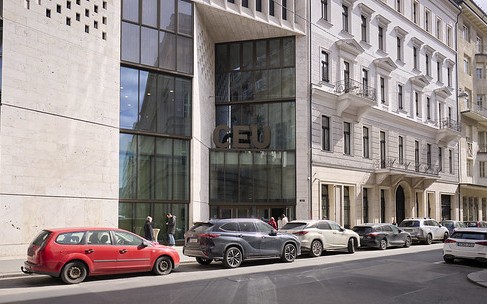
There has always been a tension between capitalism and democracy but today wealth inequality has risen to levels not seen since the invention of representative democracy, according to speakers at the Annual Conference organized last week by the CEU Democracy Institute in Budapest.
The CEU Democracy Institute strives to enable the renewal and strengthening of democratic and open societies through research. The institute’s research areas address challenges to democracy in our world and include among others de- and re-democratisation, the history of democracy, and inequalities and democracy.
As previously reported, the Central European University (CEU) in Budapest was forced by the Hungarian government to close down and moved to Vienna in 2020. The university was founded in 1991 by Hungarian-born Holocaust survivor, investor and philanthropist George Soros. The government pictured Soros as an “enemy” of Hungary and a symbol of global capitalism.
“After our teaching programme in Budapest closed down, our research programme remained in the same university building,” Sociology Professor Laszlo Bruszt, Director of the CEU Democracy Institute, told The Brussels Times.
“We have been researching concentration of wealth and financial power, and the links between private and public power, since the very start in the 90ies.” With researchers from all over Europe and other continents, the CEU Democracy Institute strives at carrying out frontline research on the challenges to democracy, both globally and in the Hungarian context.
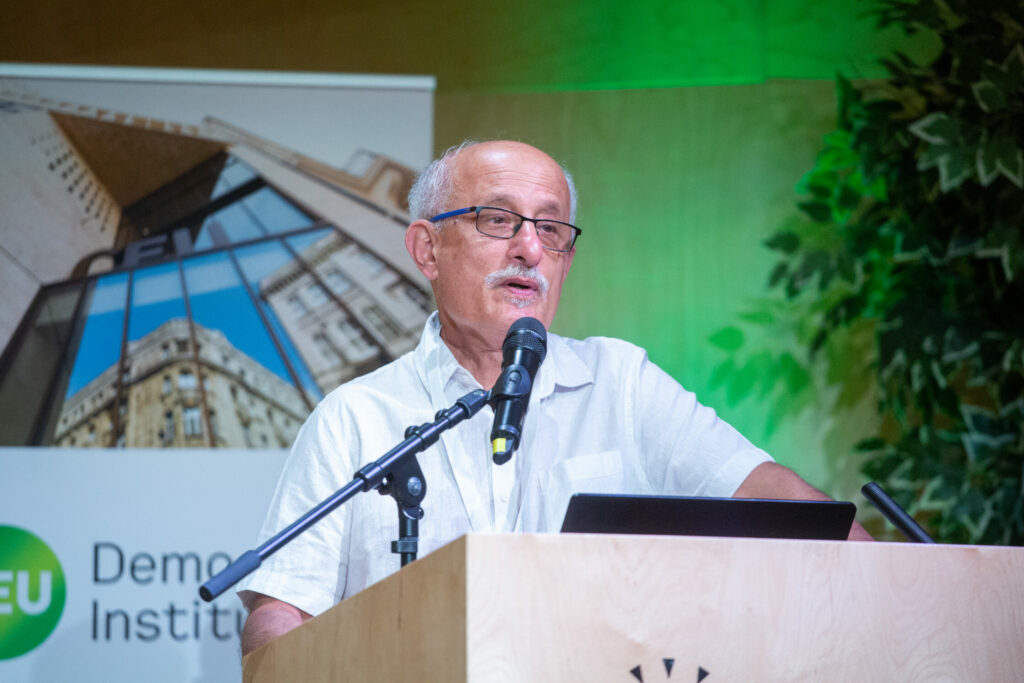
Professor László Bruszt, director of the CEU Democracy Institute, opening the conference, credit: András Mayer
By one estimate, the 10 richest men in the world now own about as much wealth as the bottom half of the world's population. Income and wealth are also highly concentrated in Belgium according to new figures released last week by the National Bank.
The wealth of hyper-rich is unprecedented, unaccountable and unlimited. Wealth is power and the hyper-rich exercise it as they please. While some engage in philanthropy and sponsor social projects, to remedy market failures, they do it without democratic oversight or accountability. They also undermine democracy by lobbying and unchecked funding of political parties and elections.
In a key note speech, Professor Katharina Pistor at Columbia Law School talked about her book ‘Transforming the Law of Capitalism’. “The book expounds a theory about the essence of capitalism today as a legal structure with examples from both the US and the EU,” she told The Brussels Times.
“My argument is that we need to change this legal structure which is based on the duality of private and public law.” This duality empowers private persons and companies to transform various assets into capital and secure their protection and accumulation, thereby contributing to wealth inequality.
Property rights are seen as conditions for wealth generation and economic growth but the super-rich are taking advantage of the legal structure in market economies. With the help of lawyers, they use litigation to “code” assets into capital and acquire legal titles to them. They also exploit “legal arbitrage” to profit from temporary price discrepancies in the market.
She argues that even in rule of law countries, where independent courts adjudicate legal disputes and supreme courts rule whether legislation is consistent with constitutional rights, private law has become a powerful tool which precedes constitutional law.
While most of her examples relate to the excesses of American capitalism, she is also concerned about the EU. In the EU, legislation is enacted in the common interest of the Member States, with the Commission acting as guardian of the treaties. The single market generates economic growth and convergence. But this does not spare the EU model from her criticism.
The EU enables a basically capitalist system by the free movement of goods, persons, services and capital within the EU, she says. The single market is ruled by private-corporate law, controlled by companies and governed by legislation full of loopholes.
Her concerns about the excessive wealth and inequality generated in capitalism might be inspired by Marxism but she agrees that Karl Marx could not have foreseen the development of the global economy and the economic crises in our century. “Never before has the world been dominated by so many superrich people,” she summarized.
Contrary to Marx, who believed in the revolution of the proletariat (working-class people), she thinks that civil society must be involved to transform society from the inside in what she calls a transformative revolution.

Professor Katharina Pistor, Columbia Law School, giving keynote speech, credit: András Mayer
Super-rich and oligarchs
Among the super-rich, is there a difference between “benevolent” billionaires, who became rich by hard work and inventions, and Russian style oligarchs, who were close to the state and bought up assets when the Soviet economy was privatized? Some of them, such as George Soros who founded the Open Society Foundation, are donating large parts of their wealth to good purposes,
Basically not, Professor Pistor replied, they all became rich because of their access to the state. “Billionaires are part of the problem and not the solution. They all have their pet projects. Why should we be grateful to them for deciding for us on what universities or other public goods should be financed?”
Professor Laszlo Bruszt placed the development of wealth concentration in a historical perspective. There were also oligarchs in the past, he says, and mentions the robber barons in the US in the late 19th century. They did not become superrich in a very short time. But like the oligarchs today, they accumulated enormous wealth and power and the more corrupt society was the more power they had.
The 19-century experienced monopolist capitalism in societies where political power was unequally distributed. This changed in the 20th century with the establishment of representative democracies with equal voting rights for all and the formation of civil society organisations. However, globalization would lead to the generation and concentration of enormous economic power.
The robber barons in the US amassed their fortunes through monopolistic control. This would lead to the anti-trust movement to curb their power. In the 30-ties we see again a counter movement in the US of new deal lawyers against the exploitation of workers and for collective and individual rights.
“Perhaps we should be waiting for a new wave of similar action,” Professor Bruszt added, referring to the laissez-faire capitalism which minimal government functions, which is taking form in the US under the Trump administration, while the classical separation of branches of power (legislative, judicial and executive) is undermined. The latter happens also in other countries that are becoming illiberal and authoritarian.
“The crucial question is not whether the superrich are benevolent or not,” he stresses, “but what institutional structures can prevent the concentration of power.”
If excessive wealth leads to grand corruption and state capture – how can it be prevented? “It’s possible”, he replied and referred to Ukraine, which has been dominated by oligarchs. Following its application for EU membership and the start of accession negotiations, Ukraine has made good progress in meeting EU’s reform conditions, including legislation to overturn oligarchs’ control over media and political parties.
A Commission spokesperson said today that it has assessed that Ukraine has met the criteria to open the fundamentals cluster. However, for the time being the opening of the cluster is on hold because of Hungary’s veto following a non-binding “national consultation”, where a majority of participants voted against Ukraine's membership in the EU.
