
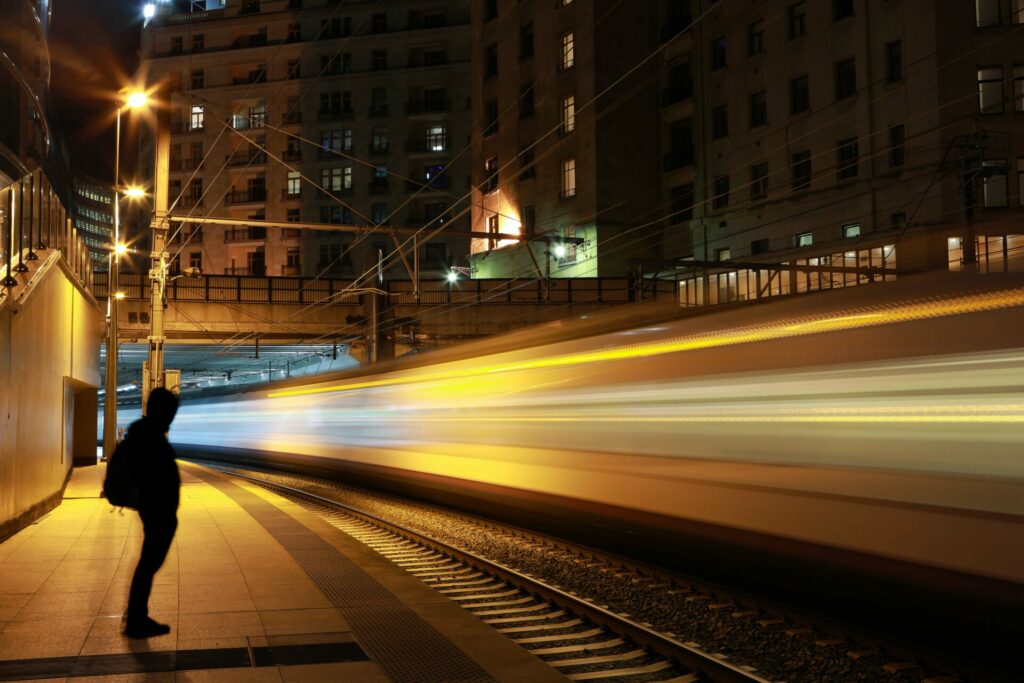
While night trains are becoming increasingly popular in Europe, getting them on the rails as a convincing alternative to air travel remains a challenge. But Dutch company European Sleeper wants to change this, and is asking its passengers to get on board.
New night train routes – whether it be to Venice, Copenhagen or Slovakia – are almost always welcomed with much enthusiasm from passengers, and while operators have spoken of a "golden era" for railway travel in terms of demand, improvement is needed in terms of implementation. Now, European Sleeper is asking the public to help it get better – by way of selling company shares.
"In itself, European Sleeper is quite a unique project, because it is entirely community-funded, driven by people's enthusiasm for night trains. We do not have any major investors backing us," Chris Engelsman, co-founder of the company, told The Brussels Times.
Getting new projects on track
After successful rounds of selling shares to raise funds in 2021, 2022 and 2023, European Sleeper will hold a new round at the end of August. The company is selling 10,714 shares at €140 each – representing 11% ownership, Engelsman explained.
In total, €5.5 million of seed capital was raised in the previous three rounds. "That is about what is necessary to get these kinds of projects on track. We tried doing it this way, and we are noticing a lot of enthusiasm for participating."
With the money raised from this year's sharefunding campaign, European Sleeper hopes to reach at least €1.5 million. (In 2023, they reached €3 million.) With this money, they want to launch a second route – most likely to Barcelona – and "insource" its own tour operator.
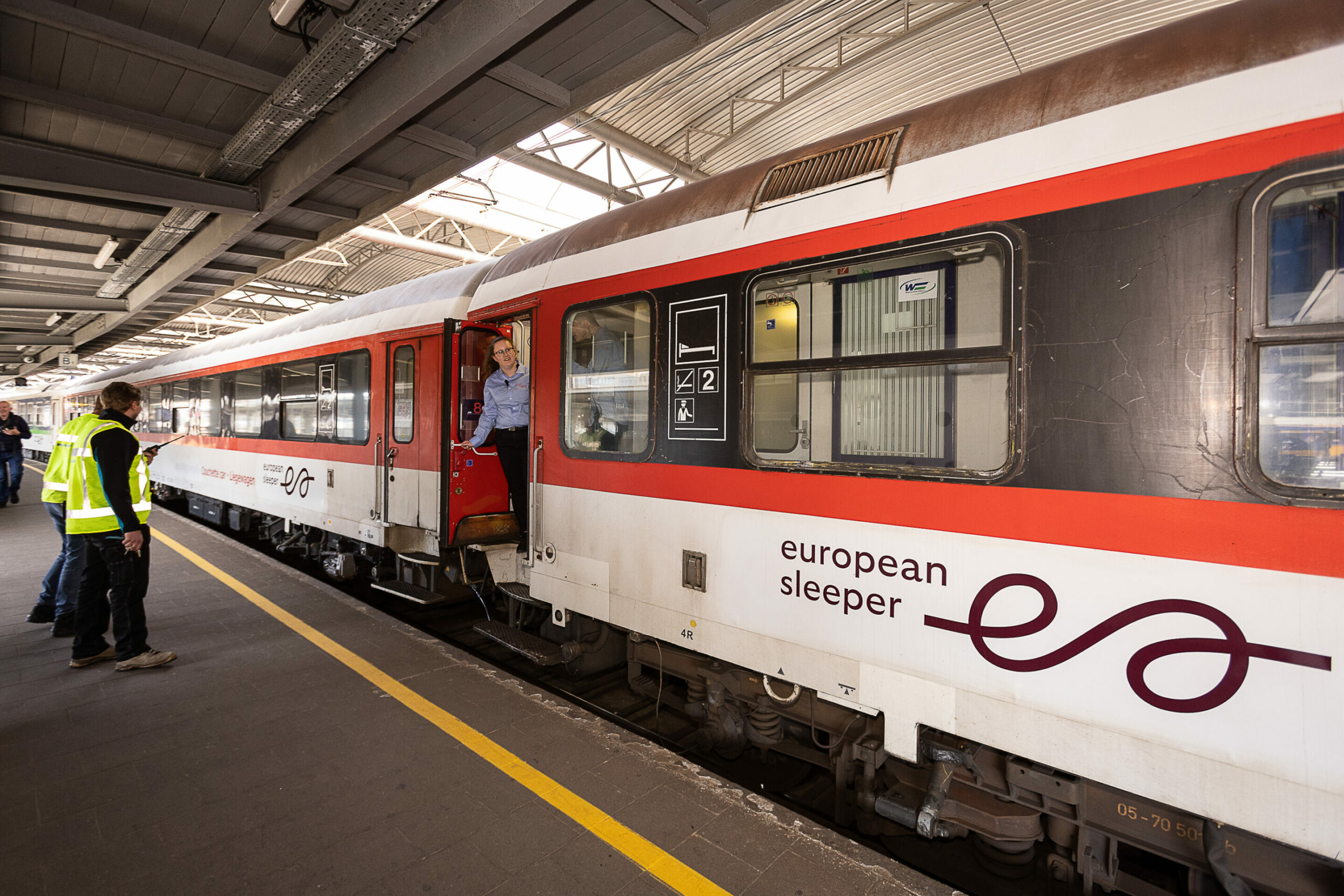
European Sleeper. Credit: Belga / James Arthur Gekiere
"While it is proving more difficult than we anticipated to operate profitably, the Brussels-Prague connection is doing very well: passenger numbers are very favourable and are growing and generating more revenue every year," Engelsman said.
However, funding new initiatives from that money might be a bit too much to ask. "So we thought this was a good time to ask the community to get involved again and help us take the next steps," he said.
Currently, the company is working on securing a partnership with a partner that can supply carriages for its new route. "We will probably rent them initially, but it could also involve purchasing and converting carriages in the longer term, if necessary."
A package deal?
The tour operator they want to acquire is a relatively small company specialising in night train travel, Engelsman said. "That way, we will be able to generate more revenue and possibly expand it in the future."
In practice, this means that European Sleeper wants to start offering "train and hotel" package trips, and potentially tours, among other things. "But that also requires an investment to acquire the label, set up the website, and so on. And that is also one of the reasons for raising money now."
Since launching night trains several years ago, Engelsman has noticed that one of the big challenges is connecting sales channels. "We are working very hard to sell the night trains through various channels, but not all of them are equally enthusiastic about it or quick to help."
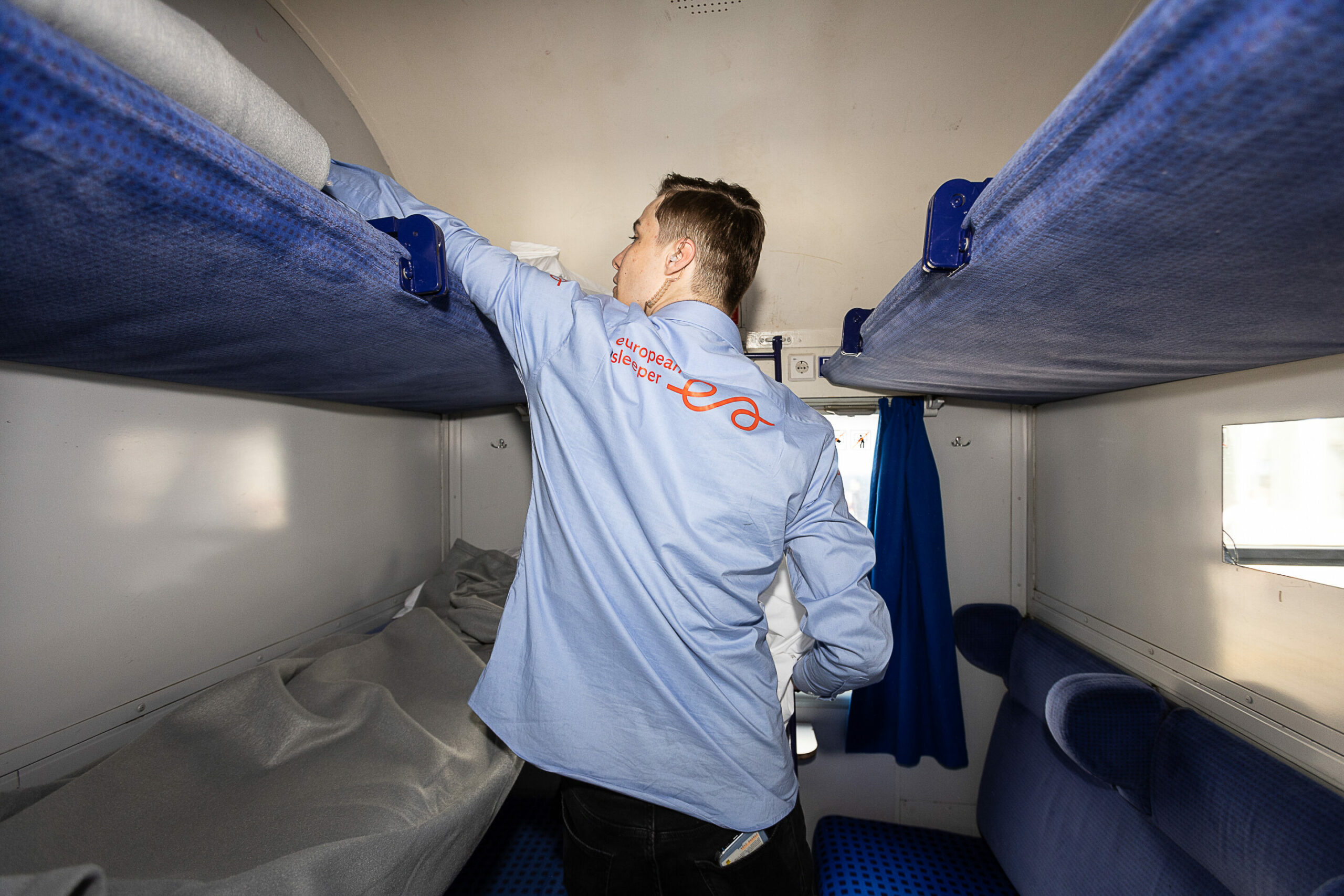
A host on the European Sleeper night train. Credit: Belga/ James Arthur Gekiere
Strikingly, Belgian railway operator SCNB/NMBs has been an exception, he stressed. "They are extremely supportive, and have been selling European Sleeper tickets through their channels from the beginning. In terms of being visible and generating more sales, this helps enormously. That is not only important for us, but also for rail passengers in Europe in a broader sense."
If all European railway operators could provide links to the websites of other operators, or offer the option to purchase each other's tickets on their websites or apps, that would help people trying to cross Europe by train enormously. "But we notice a lot of resistance and bureaucracy."
While some tour operators who specialise in train travel do sell European Sleeper tickets, Engelsman stressed that this has remained very small-scale so far. "We had expected the big package holiday operators, such as TUI or Sunweb, to make bigger efforts to include train travel – partly due to climate considerations. But they have not."
Long-term effort
Still, Engelsman believes that the demand for more train travel is there, but nearly all existing systems are based on air travel: flight tickets are very easy to book, but trains are much more complicated.
"That also has to do with the railways. There are no agreements about allotments or reservations on the train tracks. We are happy to do that, but we are a relatively small company, and a complete software integration would cost too much."
Companies are "quite conservative" and risk-averse when it comes to night trains, he said. While some offer package holidays by train on their website or city breaks from the Netherlands to Prague with European Sleeper, they barely promote them.
"And then they say, 'see, it barely sells.' But anyway, it is proving to be a long-term effort. We have to prove ourselves a bit more. We are pushing those companies and trying to get visibility on all kinds of platforms, but it is taking more time and persuasion than we had expected," he said.
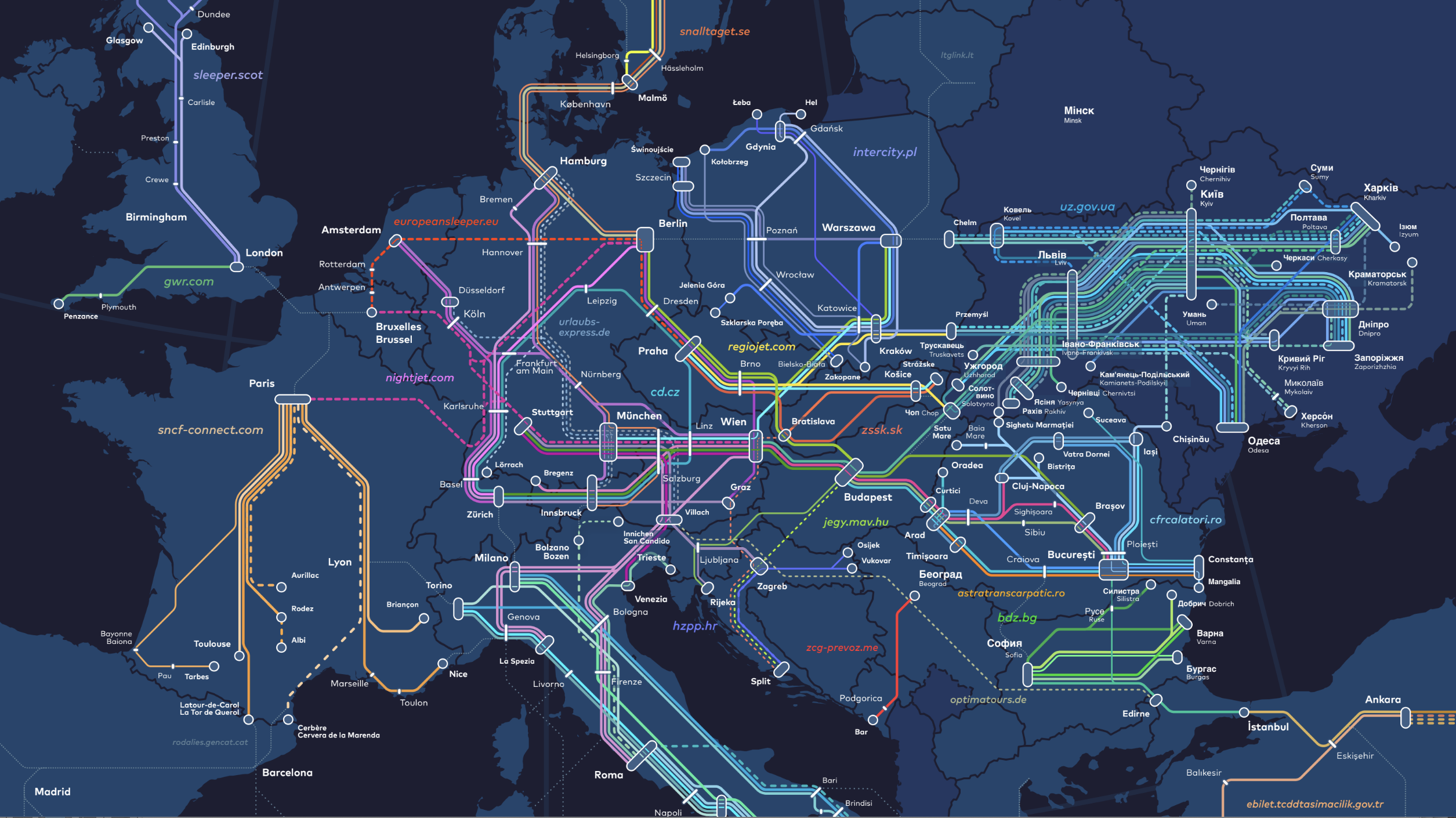
The 2024 night train map of Europe. Credit: Back-on-Track.eu
This is partly what drove Engelsman to start offering his own package holidays. "It is not so hard. If no one else wants to do it, we can come up with some city breaks by train ourselves," he stressed.
In a sense, the demand is higher than the supply, Engelsman said. "It is a bit difficult to capture the market, but one of the main challenges is that the costs are very high. We think the train to Prague will become profitable next year. That is great, and then we want to continue to grow."
Such a new route, however, also comes with a bit of a run-up period, and it will take some time before that one becomes profitable as well. "But we definitely believe in it. I think the route to Barcelona has even more potential than the route to Prague."
With four capital cities on its route (Brussels, Amsterdam, Berlin and Prague), the current route is "already quite something," Engelsman said. "But one route is no network yet. So we are really ready to take the next step."
