
In December 2024, as pro-democracy demonstrations in Georgia gathered pace in the wake of contested elections, European observers noted the astonishing number of EU flags on display at the protests.
“We want Europe,” said the protesters, furious about the government’s decision to freeze Georgia's EU accession talks. It was a timely and even moving reminder of the EU’s potency as a symbol of freedom and democracy — something we can sometimes lose sight of here in Belgium and elsewhere in the bloc.
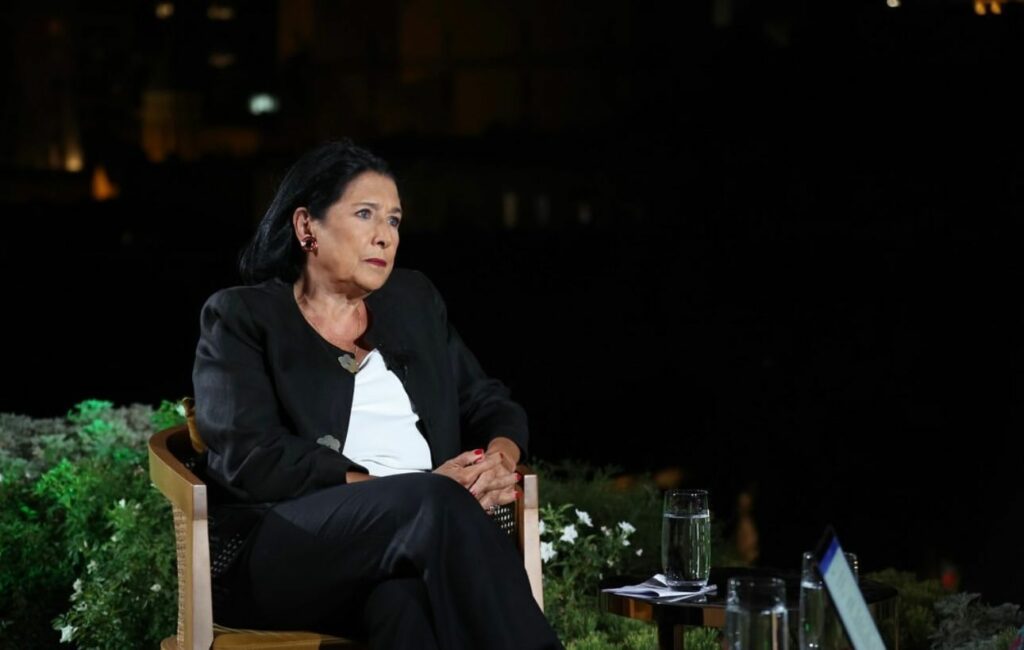
Georgia’s fifth president, Salomé Zourabichvili, knows the power and promise of the EU better than most. She has made it her life’s mission to bring Georgia into Europe and out of Russia’s sphere of influence.
Speaking to The Brussels Times, Zourabichvili, 73, said, “The sense that Georgia has to be independent, and has to have its own natural European future, is very much entrenched in the people.”
Born in France to a family of Georgian émigrés, Zourabichvili was immersed in Georgian culture at home, but succeeded in becoming part of the French establishment, studying at Sciences Po, then joining the French foreign ministry, where she enjoyed a 30-year career as a diplomat.
After acquiring Georgian citizenship in 2004, she entered politics, first becoming Georgia’s foreign minister, before being elected president in 2018. As her term in office progressed, the ruling Georgian Dream party to which she was once aligned became increasingly authoritarian, anti-Western and pro-Kremlin.
Georgia’s election ‘travesty’
In the October 2024 presidential elections, there was only one candidate: former Manchester City footballer Mikheil Kavelashvili. Election observers from the OSCE's monitoring mission noted intimidation, coercion and pressure on voters.
Zourabichvili, meanwhile, denounced the elections as a “travesty” and refused to step down as president, branding her successor “illegitimate”.
She claims Russia has been pulling the strings in Georgia. “They [the ruling party] are clearly putting into effect the instructions of Russia to cut links with Europe — to start this harsh anti-European and anti-Western rhetoric that doesn't come naturally to any Georgian,” says Zourabichvili.
This is a portrayal rejected by Georgia's leaders, who say their approach to Russia is "pragmatic" and deny pro-Russia bias.
Since the disputed elections, Zourabichvili has become an important opposition figurehead amid continuing anti-government protests. Her main task, she explains, is to take the “voice of Georgia” out into the world.
“It's very important to keep Georgia and Georgia's crisis somehow on the map,” she says, while admitting it is something of an uphill struggle amid the many geopolitical crises currently engulfing the world.
Frustration with Europe
Zourabichvili is pleading for support — and, more importantly, action — from an increasingly distracted and divided West. Although a committed Europhile, even she appears frustrated with the EU’s response to the situation in Georgia.
Last year, after issuing a damning report on the country’s democratic backsliding, the EU formally declared Georgia to be an EU candidate country “in name only”.
Although this was a huge blow to the European movement in Georgia, Zourabichvili was unfazed by the decision, which she says was targeted at the government, not at Georgia itself.
“That's the reality,” she says. “As long it's not the country, it's the regime — and it's a responsibility of the government, and maybe that should be said even clearer.”
What she is less understanding over is the EU’s apparent dithering over sanctions against members of the Georgian government. Shortly after Kavelashvili’s inauguration as president, EU foreign affairs chief Kaja Kallas proposed a list of targeted sanctions against several individuals, but Kallas's plans were blocked by Hungary and Slovakia.
“There has been so much talk about sanctions, frankly, that it's more disruptive than it's helping,” says Zourabichvili. “If it's not a nominative list of people that are targeted and cannot travel really to any of the European countries, then all the rest is just symbolic.”
She fears the impact the EU’s inaction will have on people’s attitudes to Europe. “It’s creating a negative effect on the population because they hear these calls for sanctions and then they discover that really in fact nothing is done,” she says.
“And there is a type of pessimism about the capacity of the European Union, which is very strange when you compare [our sizes]. We are a small country and the European Union is a huge power with all these resources.
“To discover that they cannot do anything to just preserve a country that was almost at the door of the European Union from being overwhelmed by Russia is a concern for us, but should be a concern for Europe also.”
Hybrid warfare in action?
Zourabichvili does not fear a Russian military invasion like the one endured by Ukraine. In her view, it simply isn’t necessary, since, as she sees it, the Kremlin has already established control in Georgia through other means.
“It's another kind of takeover,” she explains. “I think that Russia has taken the lesson from Ukraine after four years of a war that didn't give the results that they were hoping.
“So now they're testing how you can capture a state without capturing the territory, but through hybrid means — propaganda, proxy government, and control the fate of the country — which is what they need strategically to ensure that Georgia does not become part of the European Union.”
According to Zourabichvili, it is incumbent on Europe to take preventive action to ensure something similar does not happen in other countries which might be vulnerable to Russian influence.
“What is important is the understanding of what has happened in Georgia, what type of manipulation of elections took place, because that is a test again that is then transferred to other countries and adapted,” she argues. “And we've seen these attempts in Romania, in Moldova, in European countries like Germany or Poland."
She wants the EU to have the “means and instruments” to react to Russian manipulation and “not be passive in front of what we see happening”.
‘Prudent, cautious optimism’
Looking to the situation in neighbouring Iran, where protests have erupted against the theocratic regime, Zourabichvili says she has “a sense of prudent, cautious optimism”, and welcomes anything that “brings some forces of change”.
“When they look outside, each time there is a dictator falling — whether it's in Syria or whether it's in Venezuela or whether maybe tomorrow Iran — people see that as a trend that could also reach Georgia, not necessarily because the US would intervene, but because the general trend of people rejecting autocrats and dictators would extend to Georgia.”
Despite everything, Zourabichvili remains optimistic for her country’s future. “I always have hope,” she says. “That's the reason why I'm in the country, I'm staying in the country. I think that my role and my future is there, and I think there is a future for Georgia.”
