
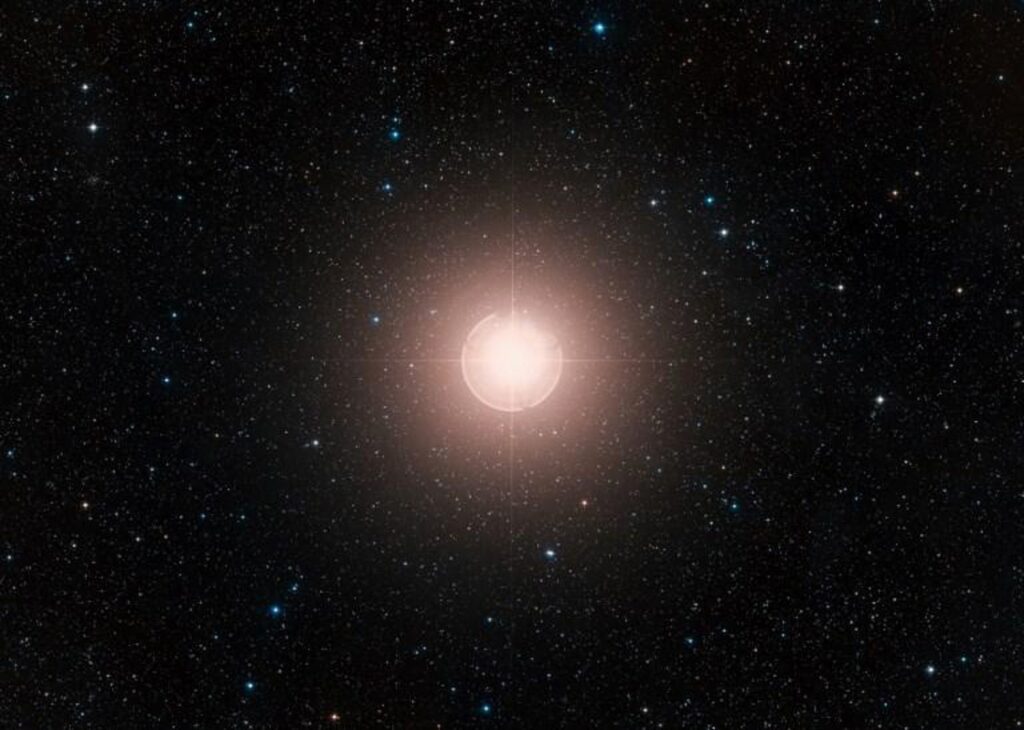
Astronomers have found strong evidence that Betelgeuse, one of the best-known stars in the night sky, has a companion star, ending a search that has lasted a century.
The finding was published on Tuesday in the journal Astronomy & Astrophysics. Researchers captured an image of the companion, which they have named Betelgeuse B.
Betelgeuse, in the constellation Orion, is visible from Earth with the naked eye and has long been a popular object of study. One of its most notable features is its changing brightness.
Scientists had suggested that these variations might be partly explained by a companion star orbiting Betelgeuse and affecting the light reaching Earth. Until now, however, no such companion had been detected, largely because Betelgeuse itself is so bright.
Earlier studies indicated that, if a companion existed, the end of 2024 would be the best time to observe it. From Earth, it would then appear at its greatest distance from the much larger star during its orbit.
That prediction proved correct in December 2024. Using the Very Large Telescope in Chile’s Atacama Desert, the team produced the sharpest image ever taken of Betelgeuse and identified the companion star.
Lead researcher Miguel Montargès said he “jumped out of my chair” when he saw the processed images. He said he had not expected the telescope to be able to detect the star, but that it was possible because the companion turned out to be heavier and brighter than predicted.
Before the observation, astronomers had assumed the companion would have a mass similar to the Sun. Instead, Betelgeuse B appears to be two to three times more massive, while Betelgeuse itself is estimated to have a mass 15 to 20 times that of the Sun.
Although the companion is clearly visible in the image, Montargès said final confirmation will require another observation in about a year, when the star should appear on the other side of Betelgeuse. Even so, he said there is now hardly any room for doubt.
