
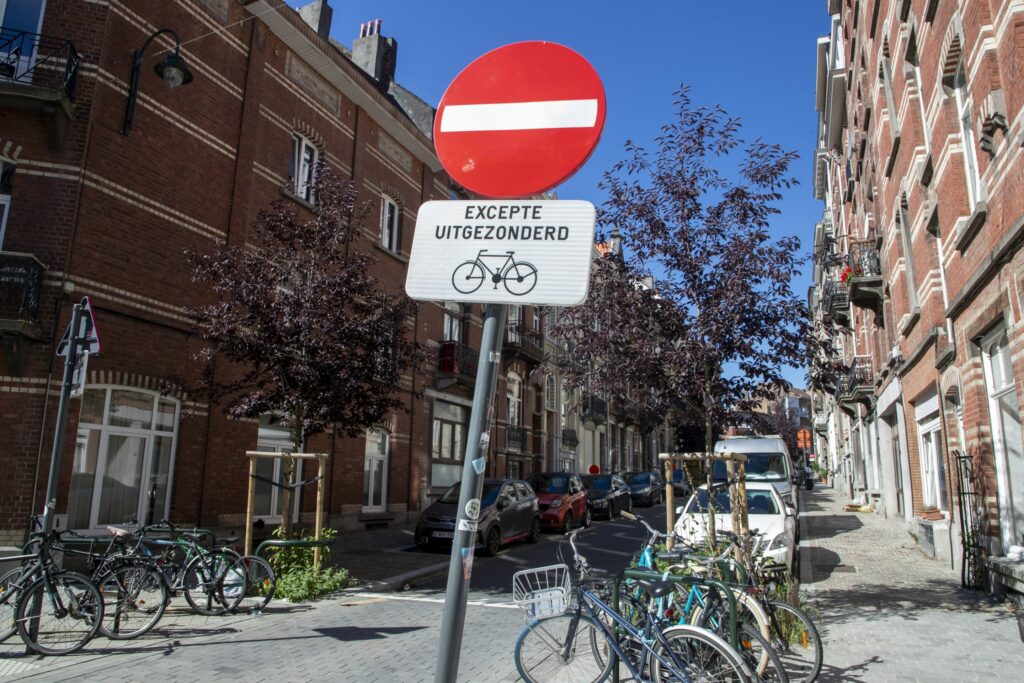
The Brussels-Capital Region has the lowest levels of car ownership in the whole of Belgium.
According to new data released by Statbel, 56% of Brussels households admit they do not own a car, meaning they rely on public transport, soft mobility or walking. In the other Belgian regions, Wallonia scores 24.7%, and Flanders, 23.6%.
It comes days after the Constitutional Court suspended the order postponing the implementation of the Low Emission Zone (LEZ) in Brussels. Many LEZ proponents argue that most of Brussels’ traffic comes from commuters travelling from outside the capital region.
Among the Brussels communes, Saint-Gilles is the municipality with the lowest car ownership in the entire country with 72.2%, followed by Saint-Josse-ten-Noode (72.1%). Both report having 0.33 cars per household.
Aside from their central locations, these low rates can be explained by the fact that they also have the highest population density in the entire country: Saint-Josse-ten-Noode has 23.173 inhabitants / km², while Saint-Gilles follows with 19,454, according to data form last year.
In the rest of Brussels, car ownership is lowest in Ixelles (67.6%), Etterbeek (65.9%), and the City of Brussels (64.7%).
The inner suburbs of Woluwe-Saint-Pierre, Uccle, Auderghem and Watermael-Boitsfort, have the highest car ownership rate in the region, according to another study by the Brussels Institute of Statistics and Analysis (BISA).
Overall, car ownership has gone down in the Brussels-Capital Region by 1.8% compared to 2023 and has been decreasing since 2021.
Brussels’ regional average rate equates to well below the national average with 0.54 cars per household. Across the whole of Belgium, households had on average 1.06 cars.
Wallonia and Flanders
Walloon households have on average 1.12 cars, a small increase of 0.9% compared to 2023, while Flemish households have on average 1.13 cars, a number unchanged since 2022.
Certain municipalities in Wallonia have the lowest rates of households without a car across the whole country.
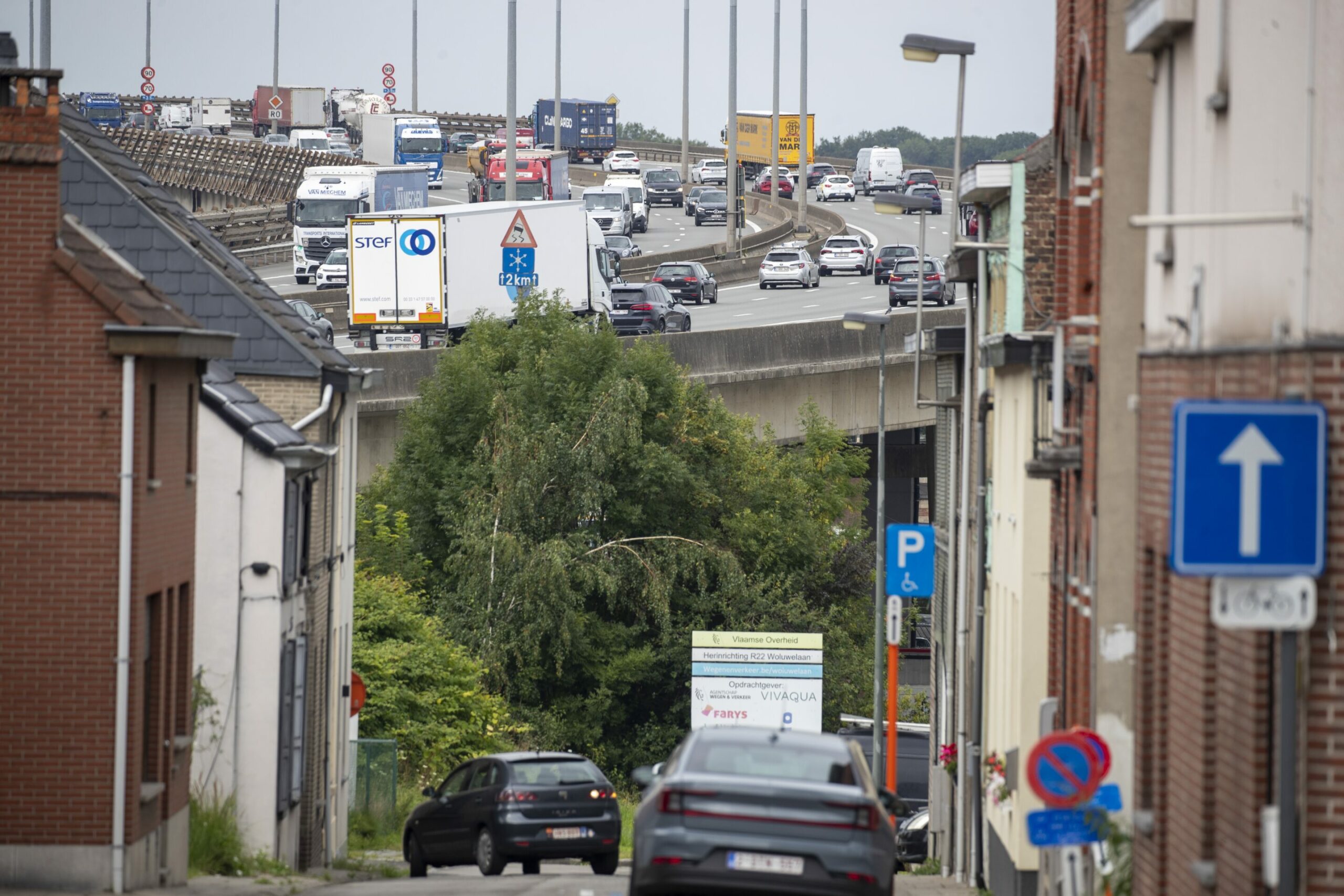
The Vilvoorde viaduct, on the outskirts of Brussels in Flemish Brabant. Credit: Belga
Nandrin stands out with only 8.5% of households without a car, ahead of Verlaine (9.8%), La Bruyère (10.0%), Olne (10.5%) and Tinlot (10.6%). Apart from La Bruyère, located in Namur, these are all in the Liége province.
Walloon Brabant’s Lasne remains the municipality with the highest figure of cars per household with: 1.68.
Couples and single people
Other findings included car ownership among couples and people living along.
One person living alone out of two does not have a car. In 2024, 49.0% of people living alone did not own a passenger car, and 47.5% had only one. Compared to 2023, this proportion has decreased by 0.3 percentage points.
Among couples living with at least one child, 10.3% do not have a car. This increase of 0.2 percentage points compared to 2023 is in line with the rise observed since 2021.
Those who have one only one car amount to 36.9% (-0.3pp), while 38.6% have two (+0.2pp) and 14.2% have at least three (+2pp).
