
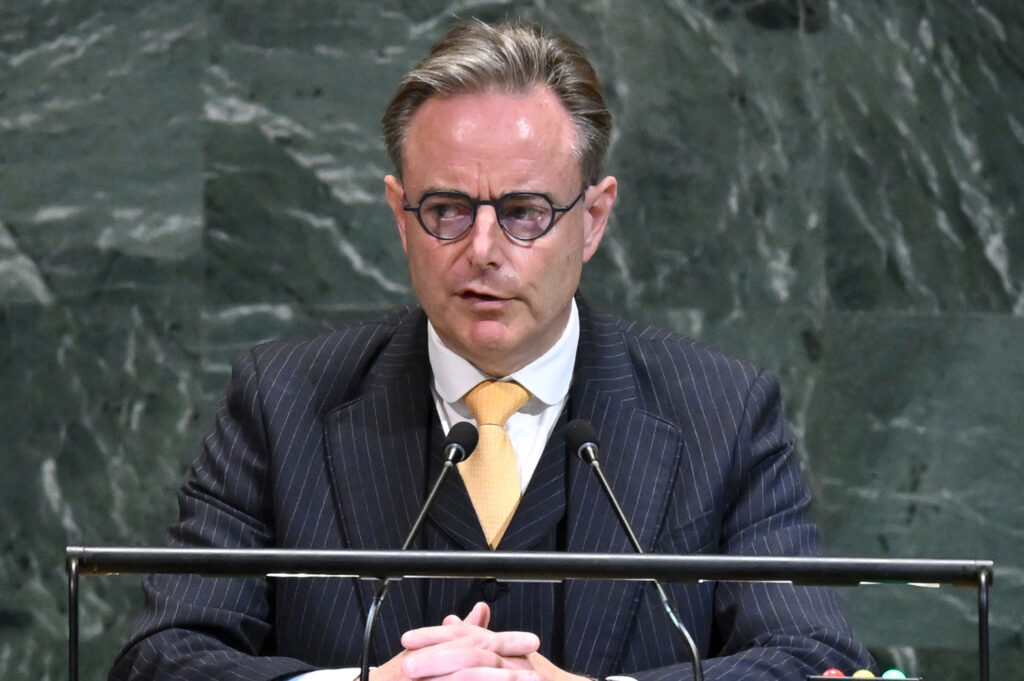
Belgian Prime Minister Bart de Wever has spoken out against a proposal by German Chancellor Friedrich Merz to use frozen Russian assets - and not just their interest - to fund a loan for Ukraine.
In an opinion piece on Thursday, Merz advocated offering Ukraine an interest-free loan of approximately €140 billion. This would only be repaid once Russia compensates Ukraine for the damage it caused during the war. Until then, Russian assets would remain frozen.
According to the proposal, member states would initially guarantee the loan, and from 2028 onward, it would be covered by the next European multi-year budget.
Most of the over €200 billion in frozen Russian assets are held at Euroclear in Brussels. Currently, only the interest from these funds is being used to support Ukraine.
European Commission President Ursula von der Leyen recently announced that the EU is exploring a “new solution” for these assets. She aims to create a mechanism for providing Ukraine with a recovery loan without directly using the frozen assets, with the financial risk shared collectively among member states.
However, Merz argues that a “fresh impetus” is necessary to pressure Russia into ending the war in Ukraine. He advocates for an approach that would “send an unmistakable signal of resilience to Moscow.”
'Taking Putin's money and leaving the risks with us'
Merz's proposal to use the Russian central bank's blocked funds for a loan to Ukraine has been met with scepticism by De Wever.
"Taking Putin's money and leaving the risks with us. That's not going to happen, let me be very clear about that. It's not going to happen, that's not what anyone would pass," the prime minister said on the sidelines of the United Nations General Assembly in New York.
De Wever said he takes a "slight offense" at Merz for openly discussing the use of the money, while the he had asked his European colleagues not to do so.
"I told everyone: I'm happy to speak, but let's speak and come up with something, and not with an opinion every day. I find that rather reprehensible," he added.
Since the beginning of the Russian invasion, the assets of the Russian central bank in Europe have been frozen. Approximately €170 billion in cash is held at the securities firm Euroclear in Brussels. Currently, only the interest on these funds is being used to support Ukraine, which is legally acceptable for Belgium. However, Belgium has long warned against seizing the money of another country's central bank.
"If countries see that money can disappear from a central bank if European politicians deem it necessary, they might decide to withdraw their reserves from the eurozone. That might not necessarily be what we want to experience," the prime minister warned.
Moreover, there are enormous legal risks. Belgium could be exposed to arbitration. "It's not certain that Russia cannot ever successfully reclaim that money," De Wever argued. Belgium therefore demands a 'mutualisation' of the risks.
"The moment you start talking about that, you see everyone disappear like the wind. No one has ever said: you're right, where can I sign?"
De Wever understands why there is increasing scrutiny of Russian funds. According to him, US President Donald Trump has clearly shown that he is withdrawing his support for Ukraine and is only offering weapons, in exchange for payment.
"Ukraine's annual financing needs will run into tens of billions of euros. Then we'll see whether the coalition of the will will also be willing to play the coalition of the bill. I think you'll see everyone disappear on the wings of the wind," the prime minister said.
Besides the legal impact for Belgium, our country also risks losing tax revenue from the frozen assets if the EU were to decide to use the assets for Ukraine itself, a source confirmed. With that revenue, over a billion euros annually, Belgium finances its military support for Ukraine.
Crunch meeting in October
The German Chancellor plans to present his proposal during informal discussions with EU leaders in Copenhagen on 1 October. He hopes that the EU summit on 23-24 October will grant a mandate to legally prepare the mechanism. Ideally, he said, the decision would be unanimous, but if not, a “strong majority of member states committed to supporting Ukraine” would suffice.
Belgium has maintained a cautious position on the matter, partly due to the risks it faces as the host of Euroclear. Belgian Budget Minister Vincent Van Peteghem recently expressed scepticism over the Commission’s preliminary and vague recovery loan proposal.
