
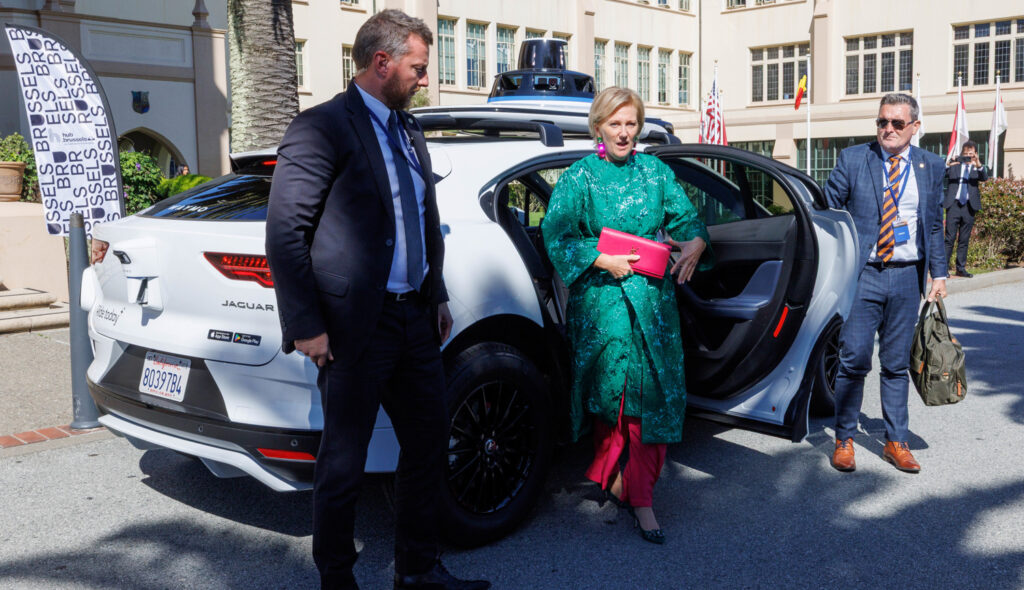
Princess Astrid, leading Belgium’s economic mission to California, experienced a ride in a driverless Waymo car, an autonomous vehicle brand owned by Alphabet, Google’s parent company.
On Monday, the princess travelled to the University of San Francisco in one of these white Jaguar-built saloon cars, equipped with an array of sensors but no driver.
“It was a fantastic experience. You feel very safe,” she said upon arrival. She recounted an instance where the car automatically stopped for a vehicle that wasn’t initially visible and waited to allow a bus to pass.
"This is the transportation of the future. I hope it can be deployed in Belgium," she added while emphasising the importance of aligning regulation with innovation.
The topic of driverless technology was also addressed during a series of seminars as part of the economic mission’s visit to San Francisco. Known as a hub for artificial intelligence, the city has been pivotal in testing autonomous, fully electric vehicles.
These trials began in 2009, with the official launch about five years ago. While initially met with resistance from taxi drivers and some residents, as well as minor incidents, the vehicles have now become a common sight.
San Francisco’s steep, winding streets and frequent intersections challenge autonomous technology, making the city a rigorous testing ground. Proponents argue that if these cars can operate safely in San Francisco, they can be deployed anywhere in the world.
Riding in a Waymo vehicle is simple: users book a ride via a mobile app, similar to hailing an Uber or a taxi. The car arrives within minutes, identifiable by a distinctive-shaped sensor on its roof—the colour and initials can be customised by the user.
The driver’s seat remains empty, and the steering wheel moves autonomously. Once inside, passengers receive instructions on a screen, including a reminder to fasten their seatbelts. Payment is made by card, and the ride begins.
No European service
However, this unique service remains limited to certain groups. The Waymo app is currently restricted to the U.S., and most European phones cannot access it.
Without local American contacts to arrange a booking, European users, including Belgians, are excluded – though residents of countries like Britain, Japan, and Canada are able to use the service.
According to Waymo spokesperson Sandy Karp, over 800 Waymo cars currently operate in cities such as San Francisco, Los Angeles, Austin, Phoenix, and Atlanta. International expansion has started with tests in Tokyo, while operations remain absent from Europe, mainly due to regulatory challenges.
"At the moment, we’re focused on ride-hailing – transporting passengers from point A to point B. But the same technology could later be used for tasks like goods delivery," Karp stated.
As of early 2025, Waymo cars were completing 200,000 paid rides weekly in the cities where they operate. The company claims their vehicles are significantly safer than human-driven cars, with Karp noting, "Our autonomous vehicles have 90% fewer accidents than those driven by humans."
