
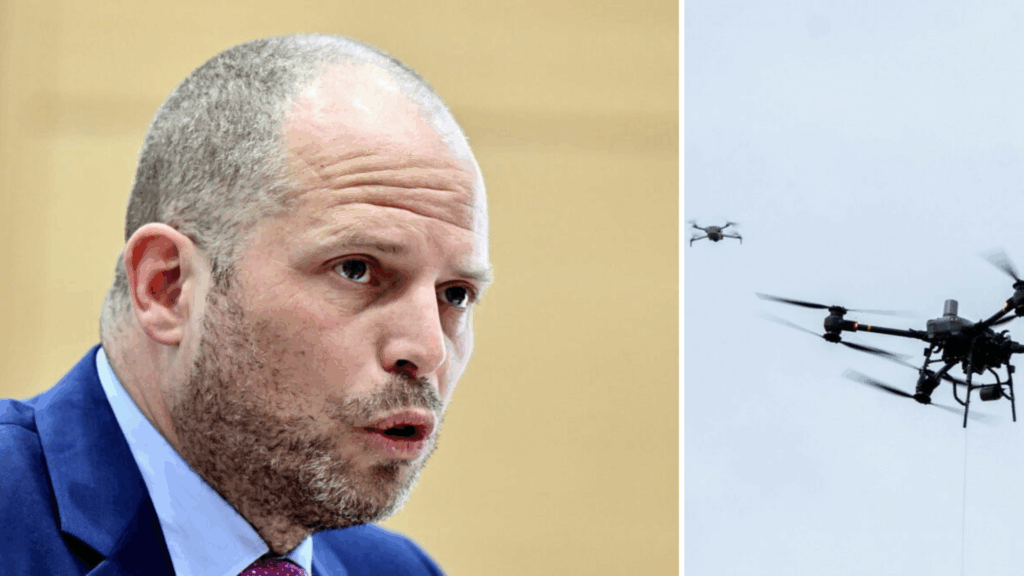
Belgium's National Security Council convened on Thursday morning to discuss the threat posed by drones, with several counter-measures announced following the discussion.
The meeting came in the wake of several sightings of drones in recent days. On Tuesday evening, drone sightings shut down the airspace above five airports in Belgium, and more sightings were reported on Wednesday, including in the coastal town of Ostend and at the army barracks in Heverlee.
Following this morning’s meeting, Defence Minister Theo Francken confirmed to The Brussels Times that a National Airspace Security Centre (NASC) will be operational by 1 January 2026.
The centre in Beauvechain, Walloon Brabant, is not yet fully operational. A centre exists for the navy but one is now also needed for airspace, to enable all services to work together effectively.
The government aims to establish a new organisation involving various entities, such as customs and the aviation directorate. The centre will be based on the Control and Reporting Centre (CRC) operated by the Defence Ministry, which has been monitoring Belgian airspace from Beauvechain for several years.
In the coming weeks, relevant services are expected to gain consolidated access to a full picture of Belgian airspace activity, according to Francken’s plans.
The minister also mentioned “international cooperation decisions,” stating that Belgium is naturally committed to collaborating with its NATO partners and neighbouring countries, although he did not provide further details.
Francken also said the introduction of a Counter Unmanned Aerial System will be discussed at a meeting of the Council of Ministers tomorrow (Friday). At tomorrow’s meeting, Francken is expected to propose an investment plan of €50 million to deploy an "anti-drone initiative." The package should pay for detection systems, jammers and drone guns to protect key installations.
'We must send a message of calm and seriousness to the authorities and the public'
Following the National Security Council meeting, Interior Minister Bernard Quentin admitted that neutralising drones is “not easy”. He confirmed that Belgium is setting up a suitable legal framework to deal with the issue and said he is working with counterparts in neighbouring countries to align policies.
“Detection, identification, and possible neutralisation are the key measures we will focus on,” Quintin explained. He added that ministers across Interior, Defence, and Mobility would each take responsibility for their respective areas.
Despite the challenges, Quintin assured that Belgium is not without resources to tackle drone-related threats. “I don’t want to give the impression we are lost; that’s not true. We acted on Tuesday,” he said.
He stressed the importance of maintaining public confidence. “We must send a message of calm and seriousness to the authorities and the public. We have control of the situation, but everyone has a role to play, particularly in detection. Citizen reports have proven valuable, and it’s vital that people continue to report concerns.”
Who is behind the drone incursions?
While there is still no clarity on who is behind the drones, Francken has suggested that Russia could be the culprit. "The Russians are trying to do this in all European countries," he told RTBF after the previous wave of drone sightings over the weekend.
"Is it the Russians now? I can't say that, but the motives are clear, and the ways of doing things like this are also very clear. War is truly a drone war, and the Defence Department really needs to prepare for that," he said.
According to Francken, the drones are "coming to spy" and trying "to see where the F-16s are, where the ammunition is, and other highly strategic information."
Despite the lack of hard evidence, the Belgian security services agree with Francken, saying that there is "no reasonable doubt" that these drone incidents are the work of Russia, VRT reports based on a reliable source.
The timing and frequency of the reports are also striking: the number of incidents is rising rapidly, precisely at a time when Belgium is in the spotlight for the role it is playing in releasing around €190 billion in Russian assets frozen in Euroclear in Brussels, and the fierce exchanges between Francken and Dmitry Medvedev, the vice-chairman of the Russian Security Council.
Related News
- Security Councils and NATO support: What we know about the drones over Belgian airports so far
- Federal Prosecutor launches probes intro drone incursions over Belgian sky
- 'A Defence Minister should know what not to say publicly': Francken criticised over drone incursions
- Flights resume at Brussels Airport after further drone sightings disrupt operations
- US to help protect Belgium after suspected Russian drone incursions
