
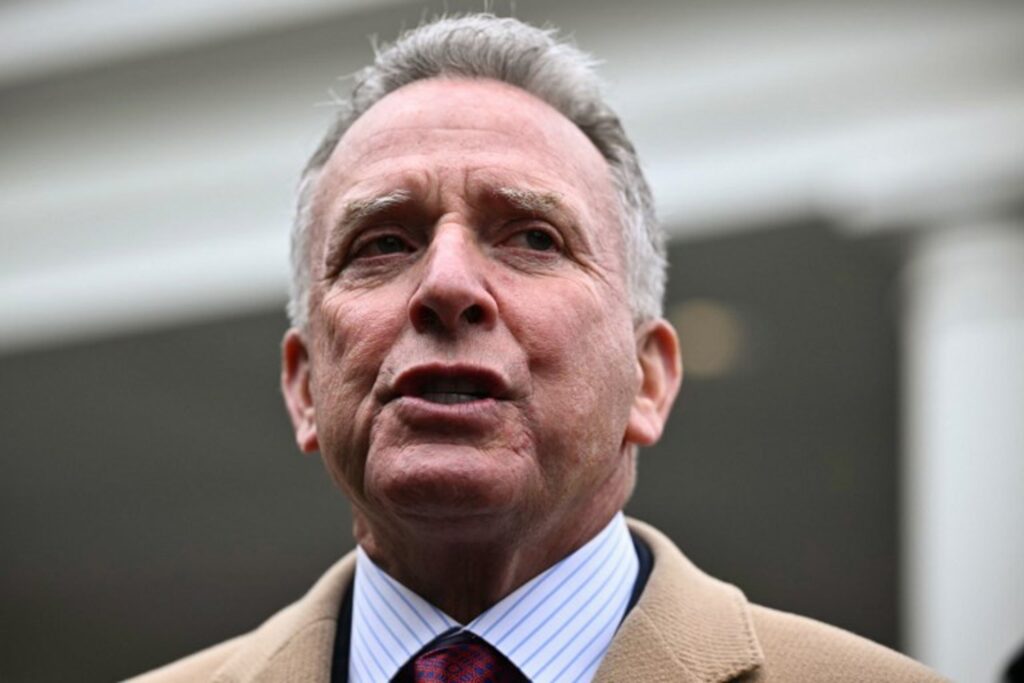
There was no agreement reached on Tuesday over Russian-occupied territories in Ukraine following a five-hour meeting in Moscow between Russian President Vladimir Putin and US envoy Steve Witkoff.
During the meeting, the Americans' proposed peace plan for the four-year-old conflict was discussed.
Steve Witkoff, accompanied by Jared Kushner, son-in-law of US President Donald Trump, presented Washington’s latest proposal, which had been modified after consultations with Ukrainian officials.
Yuri Ushakov, Kremlin diplomatic adviser, stated that while certain points of the plan found common ground, others were criticised, though both sides agreed to continue talks.
Regarding the Russian-occupied territories, which make up approximately 19% of Ukraine, Ushakov confirmed that no compromise had been reached but noted that some American proposals could be explored.
Ushakov deemed the discussion "useful" but cautioned that significant work remains. This comes as Russian troops intensify their advances on the battlefield in Ukraine.
US Secretary of State Marco Rubio told Fox News that progress had been made toward determining what might be acceptable to Ukraine while ensuring future security guarantees.
However, it was unclear if Rubio’s remarks came after the talks concluded.
Following the Moscow meeting, Witkoff and Kushner were expected to meet a Ukrainian delegation in Europe on Wednesday, according to a Ukrainian official speaking to AFP.
Hours prior to the talks, Putin accused European nations of attempting to obstruct Washington’s peace efforts, stating at an economic forum that Russia would respond should Europe "wish to start" a conflict. "We are ready right now," he warned.
His remarks stood in contrast to NATO Secretary General Mark Rutte, who expressed optimism that US-led efforts would eventually restore peace in Europe.
US President Donald Trump reiterated the complexity of the Ukrainian conflict on Tuesday, calling the situation "a mess". Ukrainian President Volodymyr Zelenskyy, facing mounting political and diplomatic pressure, accused Russia of using the negotiations as a ploy to weaken sanctions imposed on Moscow.
Zelenskyy emphasised the necessity of ending the war, rejecting the idea of merely pausing the fighting.
The US last month announced significant sanctions on Russian energy firms Rosneft and Lukoil, the first major penal measures against Russia since Trump returned to power. European allies have voiced concerns that Trump’s administration might compromise Ukraine’s position in an effort to placate Putin.
The talks occurred against the backdrop of Russian forces’ most significant advance in Ukraine in a year, according to analysis by the US-based Institute for the Study of War (ISW) and the Critical Threats Project. Russia seized 701 square kilometres of territory in November, marking the largest gain since November 2024.
On Monday, Russia claimed to have captured the eastern Ukrainian city of Pokrovsk, a critical logistical hub, as well as Vovchansk in the northeast. Ukrainian officials countered the claim on Tuesday, insisting that clashes in Pokrovsk were ongoing.
Last month also saw a surge in Russian missile and drone attacks, with 5,660 long-range projectiles launched – 2% more than in October.
Internally, Zelenskyy faces additional challenges amid a corruption scandal involving close allies. On Friday, the investigation culminated in the resignation of his influential Chief of Staff, Andriy Yermak.
