
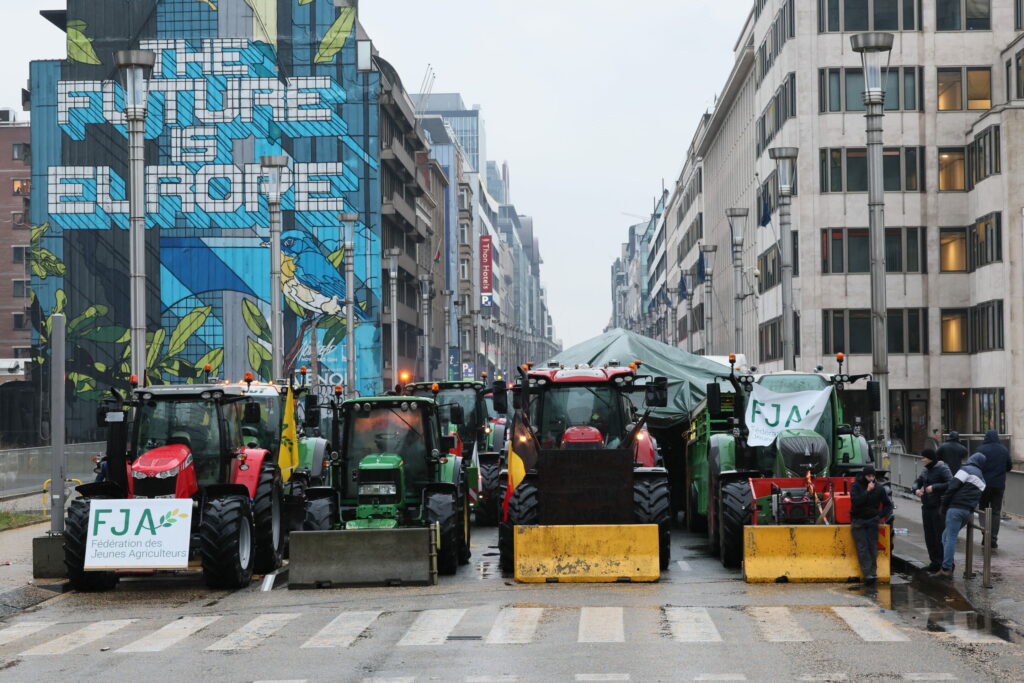
An estimated 10,000 farmers from across Europe will descend on Brussels for a large-scale protest against EU agricultural policy on Thursday, to coincide with the EU Council summit at the end of the week.
Thursday the 18th's demonstration will be the first major farmers' protest in the Belgian capital since the huge demonstration in June 2024. This time, around 10,000 farmers from all 27 EU Member States are expected to take to the streets of Brussels.
"This is the first time farmers from all Member States will be present at a protest. It is historic. They all fear that the decisions by the European Commission will put unbearable pressure on the sector," Maëlle Mabecque, a spokesperson for the European agricultural umbrella organisation Copa-Cogeca, told The Brussels Times.
Some 40 agricultural organisations have confirmed their participation. They want to send a "strong and united message" to the European Commission and are protesting for three reasons.
'Not blocking Brussels'
First and foremost, they are denouncing the "unacceptable" post-2027 Common Agricultural Policy (CAP) proposals that they say lack "commonality and adequate funding," Mabecque stressed.
Secondly, they are protesting against the Mercosur trade policy pursued by the EU, "at the clear disadvantage" of the European agricultural sector. They believe the deal would be "a historic mistake" for the EU, European farmers and consumers, emphasising that agriculture and food security are "cornerstones of European security and sovereignty."
Lastly, they are calling for simplification, better regulations and legal certainty in their jobs.
Unlike during previous protests, Brussels will not be blocked by tractors on Thursday. While some farmers will bring their tractors and drive them into the EU quarter, the focus of the demonstration is the march to the European Parliament.
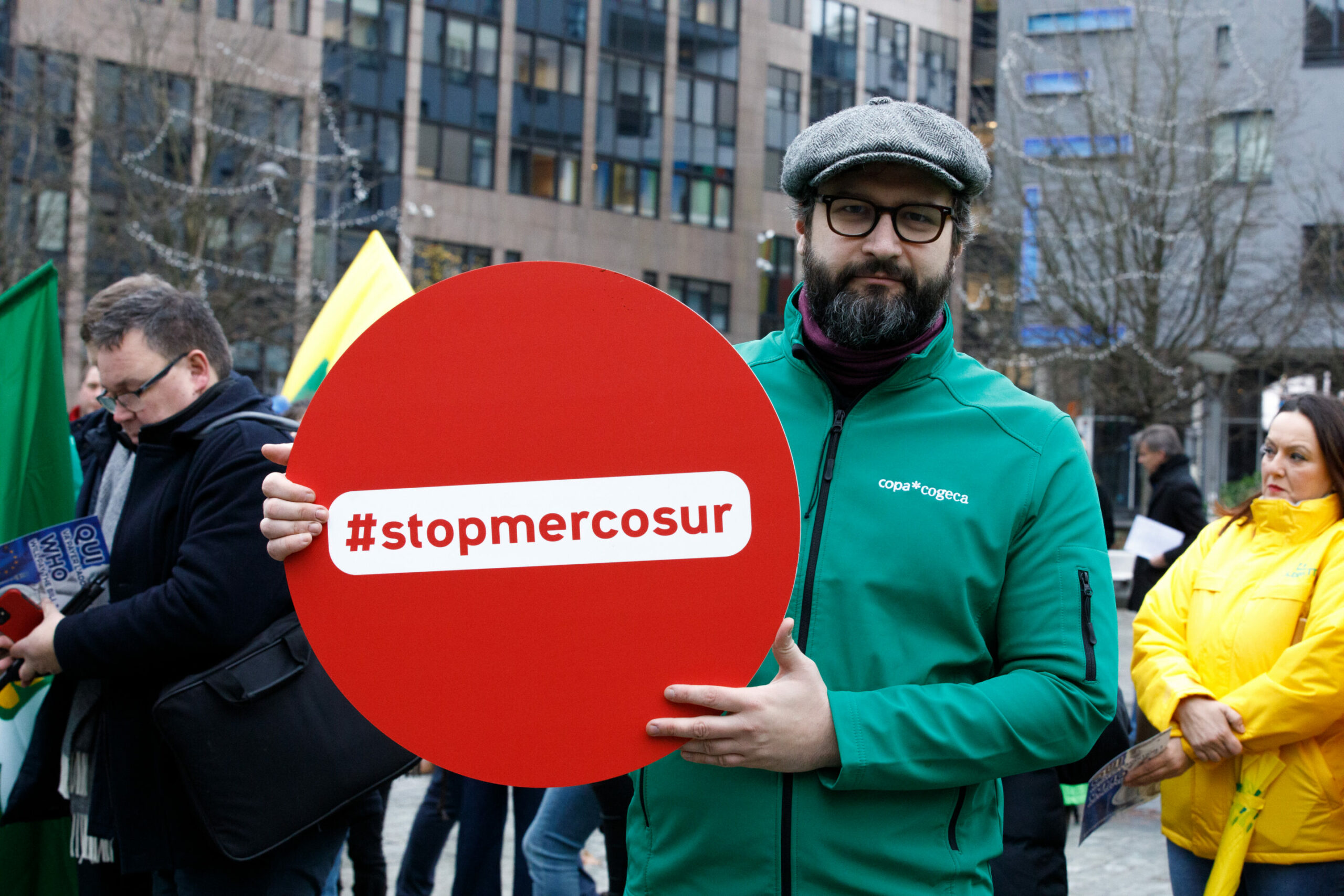
Protest against the Mercosur deal on Monday 9 December 2024. Credit: Belga/Hatim Kaghat
"There is no plan to put up blockades at the Brussels Ring Road or to block traffic in Belgium," Mabecque said. "We are not trying to block anything, we just want to be heard."
The protest comes at a strategic moment: a few hours before European Commission President Ursula von der Leyen is flying to Brazil to discuss the planned Mercosur free trade agreement.
The protest coincides with an important European Council meeting in Brussels. In addition to the EU's next multi-annual budget framework, leaders will also discuss the situation in Ukraine, enlargement, the geo-economic situation in the EU, the Middle East, European defence and migration.
What disruptions to expect
The protest, in combination with the security perimeter in place for the EU summit, is expected to result in "significant traffic disruptions" in and around Brussels on Thursday.
The farmers are expected to gather from 9am at the Boulevard Roi Albert II near Brussels North Station. From 11am, they will march via Botanique and Rue de la Loi to Place du Luxembourg in the city's European Quarter, where they will arrive around 2:30pm. The end of the protest is scheduled for around 5pm.
In addition to the closed streets, a number of tunnels on the main incoming roads will be closed to traffic as well.
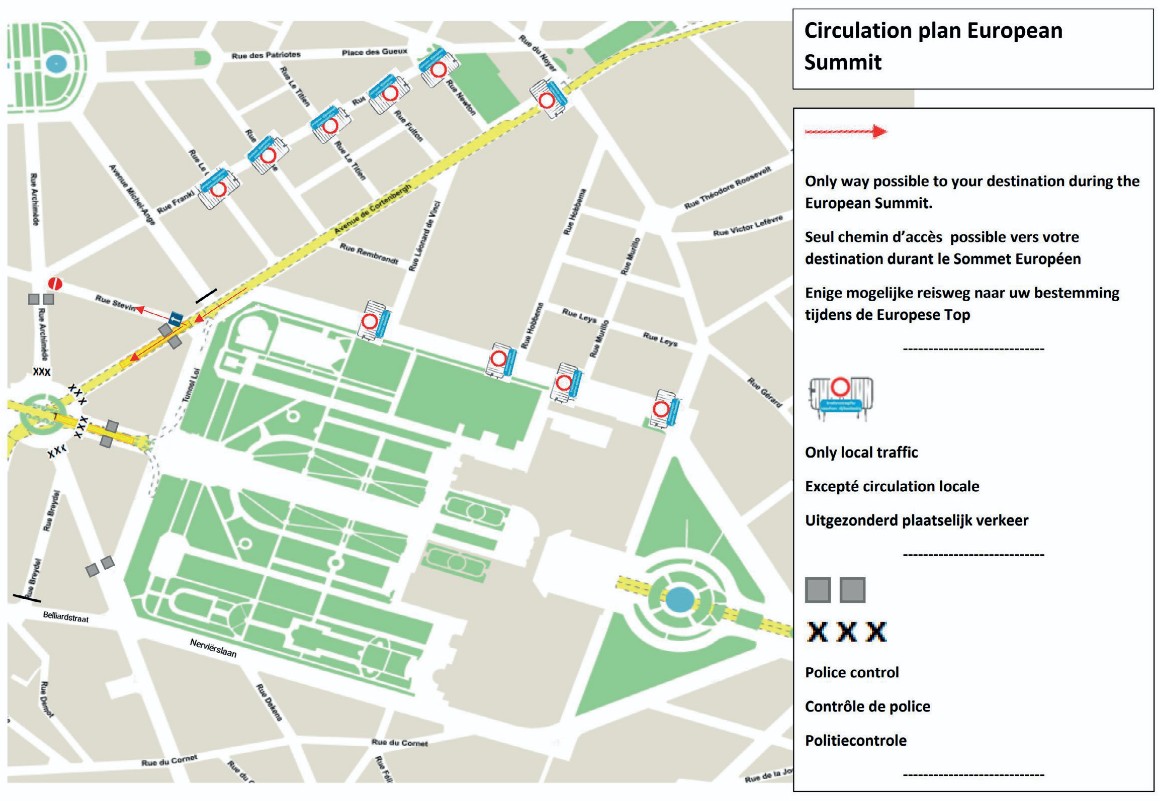
Credit: Brussels-Capital/Ixelles police zone
The so-called "safety zone" around the EU buildings will be closed on Wednesday 17, Thursday 18 and Friday 19 December for the summit.
In practice, traffic will be closed off on the Schuman roundabout and Rue Froissart (from 101 to 143), the Rue de la Loi section between the roundabout and the Résidence Palace, and also the section with Boulevard Charlemagne.
Public transport will be disrupted as well. The Schuman metro station will remain open on all three days of the summit, but not all entrances will be accessible.
As of 7am on 17 December, entrances 4 (Residence Palace), and 5 (Justus Lipsius) will be closed. From 2:45pm later that day, so will entrances 6 (to Rue Froissartstraat), 7 and 8 (Rue Archimède and Schuman roundabout).
Access to the SNCB/NMBS train station (at the Berlaymont side) remains possible, as will the entrance for people with reduced mobility located at Rue de la Loi, next to the Lex.
Additionally, bus lines 59, 60 and 80 will be diverted locally around Place Jourdan, as will bus 27 (direction Luxembourg) and 36 (direction Maelbeek) around the Froissart stop. More information on public transport can be found on STIB/MIVB's website.
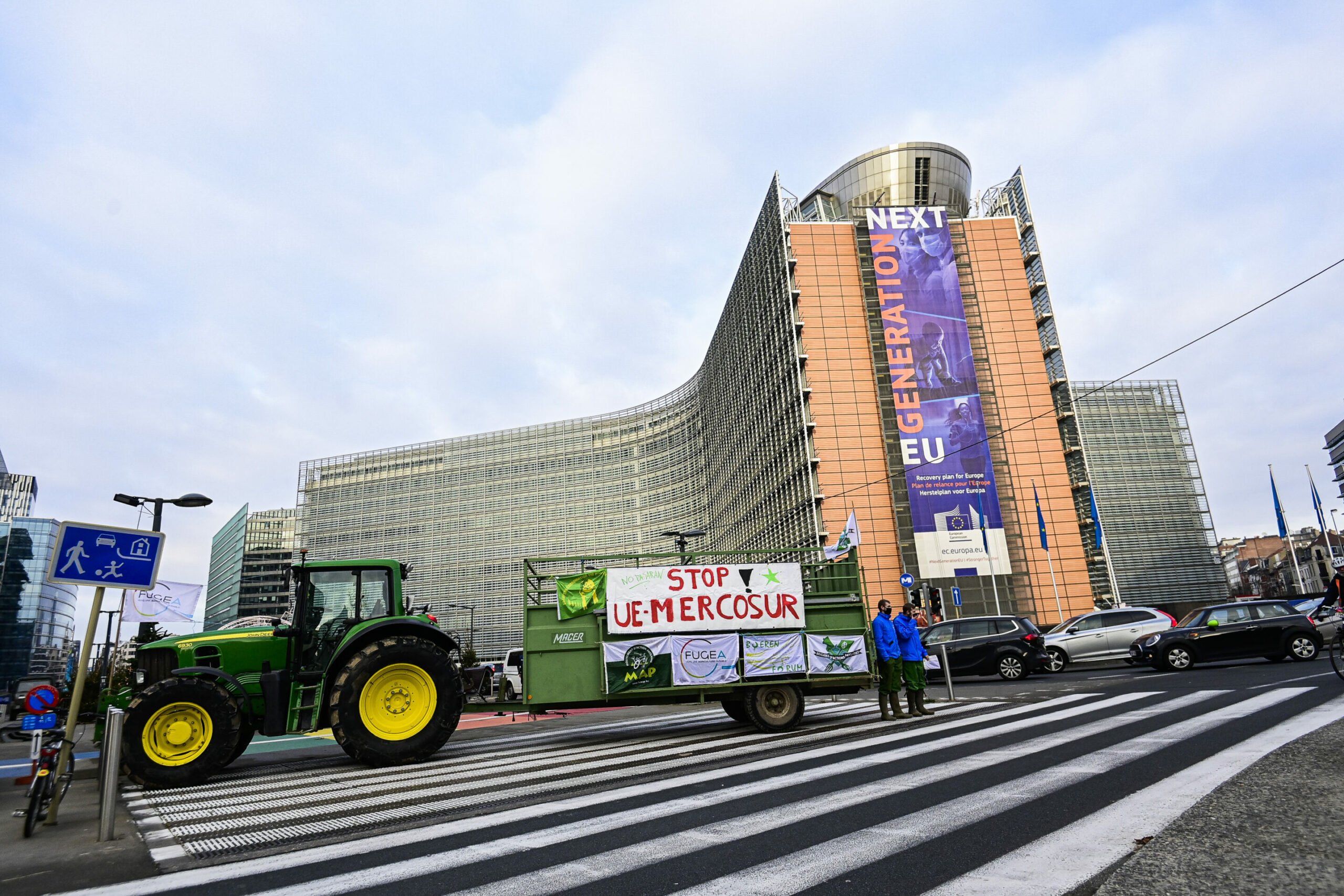
Farmers protest in November 2024. Credit: Belga/Laurie Diefembacq
The safety zone can only be entered by people who live and/or work in the safety zone and carry a digital or printed pass (apply for one here) and proof of identity.
The only vehicles allowed to enter the zone are emergency and police services, official delegations accredited by the Council and police-accredited vehicles (access only via the Avenue d'Auderghem).
In addition to the perimeter, certain streets will only be accessible for local traffic (above ground, there will be a parking ban):
- Rue Archimède between Rue Stevin and the Schuman roundabout
- Avenue de Cortenbergh, between Rue Stevin and the Schuman roundabout (limited access during escorts)
- Rue de la Loi, between Avenue de la Joyeuse Entrée and the Schuman roundabout
- Avenue de la Joyeuse Entrée
- Avenue d'Auderghem, between Rue de la Loi and the Schuman roundabout
- Rue Breydel
- Rue Froissart, between Rue Juste Lipse and Rue Belliard
- Rue Juste Lipse
This means that deliveries will not be possible in these areas. Garbage bags, bicycles and terraces are not allowed within the safety zone either, and all windows of the buildings must be closed for security reasons.
More real-time information on the days of the summit can be found on the website and social media channels of the Brussels-Capital/Ixelles police zone.
