
Every year, a new list of names for upcoming storms is announced – a practice that is crucial for public safety, according to the Royal Meteorological Institute (RMI).
Belgium has been systematically naming storms in collaboration with neighbouring countries since 2017, just two years after the system became routine in the United Kingdom and Ireland.
While it is practical to label such significant weather events, naming storms is primarily a way to ensure the general public pays attention to them, according to RMI meteorologist Thomas Vanhamel.
"When a storm has a name, it is easier for the media and the public to talk about it, share information and prepare for it. It's a simple measure that can help citizens stay safe," said Vanhamel.
What's in a name?
Naming storms in Europe is a collaborative effort between different national meteorological institutes. There are a total of six groups, each representing a different zone.
Each zone comes up with its own annual list of storm names. Belgium is part of the south-west group, which includes France, Luxembourg, Spain, Portugal and Andorra.
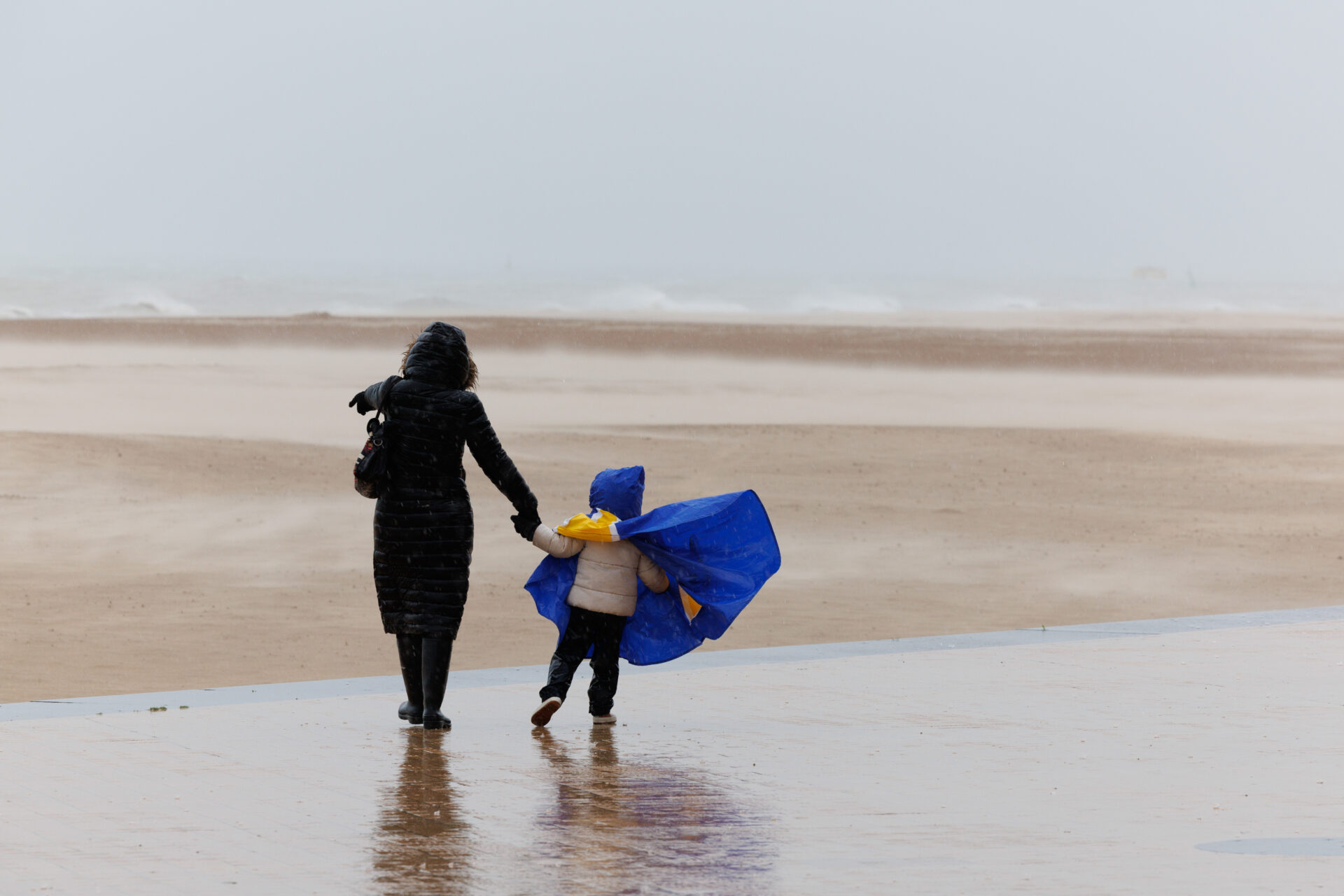
A woman and a child walking in Ostende. Credit: Belga
The list of names for storms is revealed around autumn every year. The names are assigned in alphabetical order, alternating between male and female names.
The list of storm names for the 2025-2026 season is:
Alice, Benjamin, Claudia, Davide, Emilia, Francis, Goretti, Harry, Ingrid, Joseph, Kristin, Leonardo, Marta, Nils, Oriana, Pedro, Regina, Samuel, Therese, Vitor, Wilma.
According to RIM, the name ‘Ingrid’ was chosen by Belgium as a way to honour Ingrid Daubechies, a Belgian mathematician and physicist, known for her contribution to the fundamental mathematical tool 'wavelets'.
What is actually considered a storm?
A storm typically refers to when the wind force hits a 9 on the Beaufort scale (Bft).
According to RMI, this means that the wind has reached an average speed of at least 75 km/h over a period of 10 minutes at a height of 10 metres above the weather measuring station.
In Belgium, a storm is officially declared if at least 9 Bft is recorded by at least one of the weather stations in the country.
Credit: Belga
In general, storms are named when a meteorological service issues an orange or red wind alert for them in a large area.
However, storms may still be named even without such a high warning for wind if they are expected to have a considerable impact.
“A recent example is the storm of 2021, which was named Darcy by the Dutch meteorological service (KNMI) and for which a weather warning for the risk of ice (and not for wind) was issued,” the RIM noted in a statement.
