
Belgium ended 2025 on a relative high. This time last year there was no Federal Government, no budget agreement, no strategy to deal with necessary social reforms and no hint of the major role the country would play on the international stage a mere 11 months later.
Belgium's Prime Minister Bart De Wever (N-VA) starts 2026 with political capital few could have imagined this time last year. Much of it is as a result of his position, under extreme pressure and many would argue, wholly unjustified attacks, over the EU's plans for frozen Russian assets. His stance brought him credit from supporters and opponents alike, and unified a country which increasingly struggles to find common ground. It gave him a platform on the international stage too.
The question is, how far will this political capital stretch, given that Belgium still has some fundamental and serious challenges to overcome in the year ahead.
Structural reforms
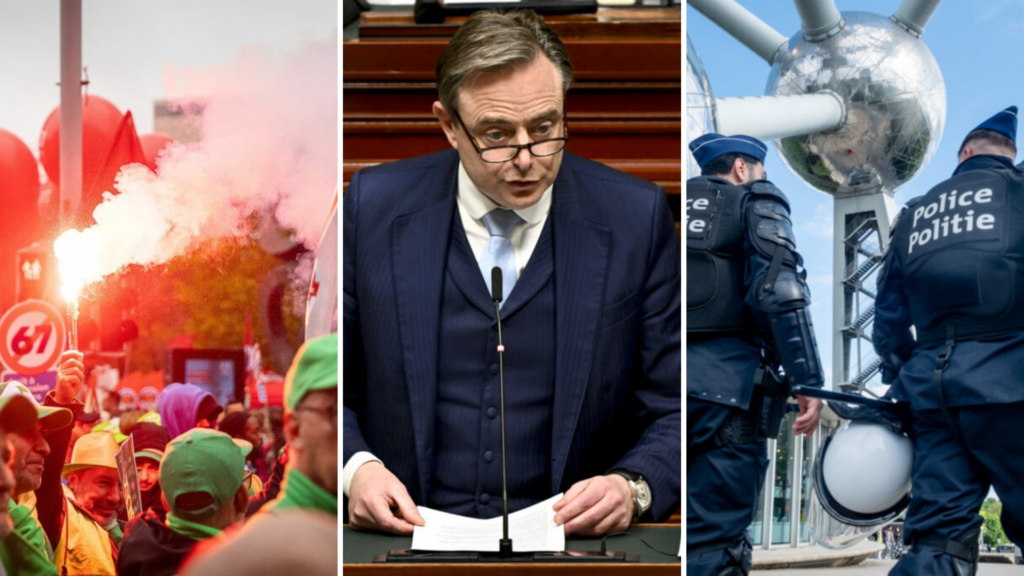
In case you had forgotten, the Federal Government is in the process of pushing through major reforms to pensions, unemployment benefits, and working practices. Some of these will take effect sooner rather than later, but this isn't stopping continuing industrial action which was the theme of last year, and will be again for the forseeable future. It's unlikely that these strikes will achieve anything however, given the resolve of De Wever and his cabinet. Anyone who watched him resist the international pressure over Russian assets will be under no illusion that he will stay the course.
Those seeking to change the government's path will need to use more sophisticated means and more convincing arguments if they are to have any hope of succeeding. Indeed most experts agree that Belgium cannot continue on the current course, so one has to ask, if these reforms are not to be implemented then where exactly does the money come from? Which leads us to Belgium's other major issue.
High public deficit and debt
Growth is stalling in Belgium. Companies and employers consistently report that the economic climate and working practices here do not encourage investment or help increase employment levels. Even more serious, is the fact that the country's national debt continues on an upward trend, and needs intervention in the opinion of the EU to avoid a crisis. This is not scaremongering as some would have it. Belgium's debt to GDP ratio is over 100%. This is not sustainable - particularly when there are increasing trade pressures in the form of tariffs, and demands on defence spending which keep rising. The solution? A bitter pill of major economic reforms and public spending cuts, which a large portion of the electorate are still not buying.
Law and order
Law and order covers many facets of society and all of them are under pressure currently in Belgium. The judicial system is outdated, buckling under the strain of underfunding and cumbersome structures and the prisons themselves are full. The sentencing and punishment codes are provoking serious questions; many sentences for serious crimes seem unbelievably lenient, and dangerous criminals are being left on the streets to offend again and again. Drug gangs are giving the country's major cities a bad image, and the resulting un violence is out of hand; let no-one tell you it isn't.
There is a real attempt to deal with the drug issue at source, with serous help from the US now, focussing on Antwerp and the supply routes. But the much vaunted police reforms need to happen quickly this year, and there needs to be a concerted, coordinated domestic strategy and task force to deal with the gangs and the violence. The perception that it's not that bad, and the view that we should learn to live with it should not be normalised. This will take political will and risk taking.
Brussels
And then there is Brussels. Still no regional government, still no accountability, and still seemingly no shame on the part of the politicians, who continue to be paid by the way. It's affecting inward investment, crime, social cohesion, the arts, housing, education and businesses. So pretty much everything. Not to mention the perception that Brussels for all its talk of being 'the capital of Europe' is not a serious international city. this needs solving, and one can but hope that 2026 is the year when a proper national conversation takes place about how to solve the 'Brussels problem'.
Spend it wisely
Perhaps the best use of the PM's political capital should be convincing the country that all these challenges mentioned need to be met head on. For too long many analysts argue, Belgium has had it too easy, spent way beyond its means, and expected everyone else to foot the bill. Those days are over, but the argument so far doesn't seem to be landing. The vested interest voices are still louder, and the economic complacency of the last few years is still regarded as right and fair. Making this case is perhaps the biggest challenge of all for the PM.
Known unknowns
These of course are the challenges we know about. But the world of international affairs and politics has a funny way of throwing curve balls at an alarming rate these days; many of them pitched by the same few teams. Bearing in mind a week is a long time in politics, charting the coming year's political map is fraught with pitfalls. Perhaps the biggest challenge for Belgium, or any country that is not a major global power for that matter, is how to read the signs, and plan accordingly.
Even domestically issues can flare up without warning. Take last years spate of drone incursions. Seemingly innocuous events can have devastating repercussions. Likewise cyber attacks - on the increase across Europe, with often the same global players behind them. These will not stop, so countries need to increase defences, and resilience, which costs money.
Indeed Belgium sits slap bang at the point where many of the potential geopolitical and economic flashpoints converge bearing in mind it is host to the EU, NATO and is a global hub of diplomacy. It will do well to navigate a course through the coming storms and avoid being buffeted by the winds of international conflict in the coming twelve months. It will need friends, and in a chaotic Europe and wider world, friends are increasingly hard to come by.
Better the devil you know
There is one more challenge for Belgium, which I am confident in predicting will unite the country more than anything else this year. The Red Devils' World Cup campaign starts on the 15th June in Seattle against Egypt. In fact, I dare say for many in this country, how the team progresses through the tournament will be the one factor that defines whether 2026 turns out to be a good year or a bad year in the end.
