
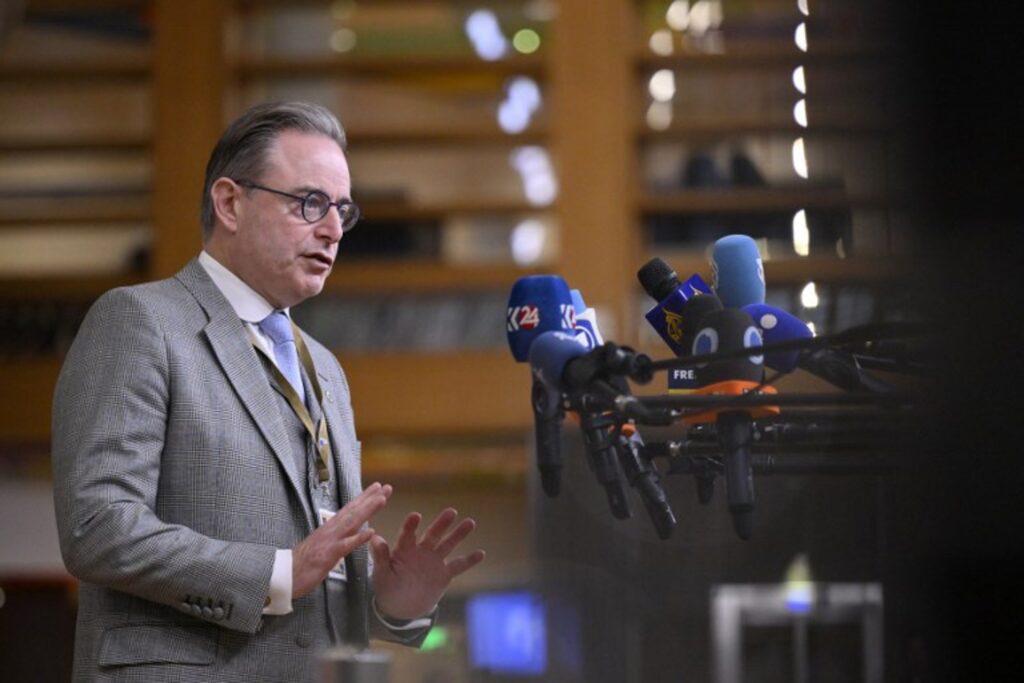
Four years after Russia’s invasion of Ukraine, Belgium remains committed to supporting Kyiv despite facing criticism over its stance on seizing frozen Russian assets.
In December, Prime Minister Bart De Wever faced widespread praise domestically for opposing demands from the European Commission and several countries, including Germany, to confiscate approximately €140 billion in Russian assets frozen in Belgium’s Euroclear accounts.
Ukraine has long urged for the seizure of these assets to fund its aid since the war began.
However, both De Wever and his predecessor Alexander De Croo have resisted, citing the financial risks such an unprecedented move could entail, which Belgium cannot shoulder alone.
Russian threats and drone incursions
In the lead-up to the European summit, Belgium faced intense diplomatic activity and mounting Russian pressure.
This even included threats from Russia’s Foreign Intelligence Service (SVR) in November last year while drone incursions forced Brussels national airport to temporarily close its airspace.
Related News
- Russia's central bank threatens to sue European banks over frozen assets
- Will Belgium budge on Russian assets at today’s crucial EU summit?
- From EU critic to European statesman? Bart De Wever's surprising 12 months as Belgium's PM
The drone incursions flying over sensitive Belgian infrastructure sparked internal debate over the country’s lack of security.
During a December conference in Brussels, De Wever made controversial remarks expressing doubts about a decisive Ukrainian victory and warning against the instability a Russian defeat could bring. Three days later he assured his parliament that Belgium’s support for Ukraine remained unwavering.
The remarks sparked backlash from European media and pro-Ukrainian advocacy groups, some labelling De Wever as overly sympathetic to Moscow. In response, the Prime Minister strongly denied any alignment with Russian interests.
Officially, Ukraine has not criticised Belgium for its stance. In February, Ukraine’s ambassador to Brussels, Yaroslav Melnyk, was invited to Belgium’s Parliament and praised the “friendship” between the nations while highlighting Belgian aid since the conflict began. He avoided any mention of the frozen Russian assets.
F-16s promise
During a visit to Ukraine last year, De Wever reaffirmed Belgium’s support by pledging €1 billion annually to Ukraine, funded by corporate tax revenues from Euroclear.
A large part of this money has since 2022 financed Belgium’s military assistance to Ukraine.
Belgium also committed to delivering 30 F-16 fighter jets to Ukraine, replacing them with incoming F-35s. While initial deliveries were expected by late 2023, none have arrived yet, prompting Defence Minister Theo Francken to request a revised timeline.
Belgium further joined the “coalition of volunteers,” which includes 35 countries, pledging additional military support once a peace agreement is reached. While the commitment extends to land, air, and sea capabilities, ground deployments would be limited to training Ukrainian soldiers rather than direct combat involvement.
A potential peace deal remains uncertain. European nations, despite bearing much of the cost of supporting Ukraine’s defence, are currently excluded from peace negotiations.
Belgium and Europe have reiterated their long-term commitment to Ukraine, with Foreign Affairs Minister Maxime Prévot stressing the importance of a fair and sustainable peace in which Ukraine’s sovereignty remains intact.
