
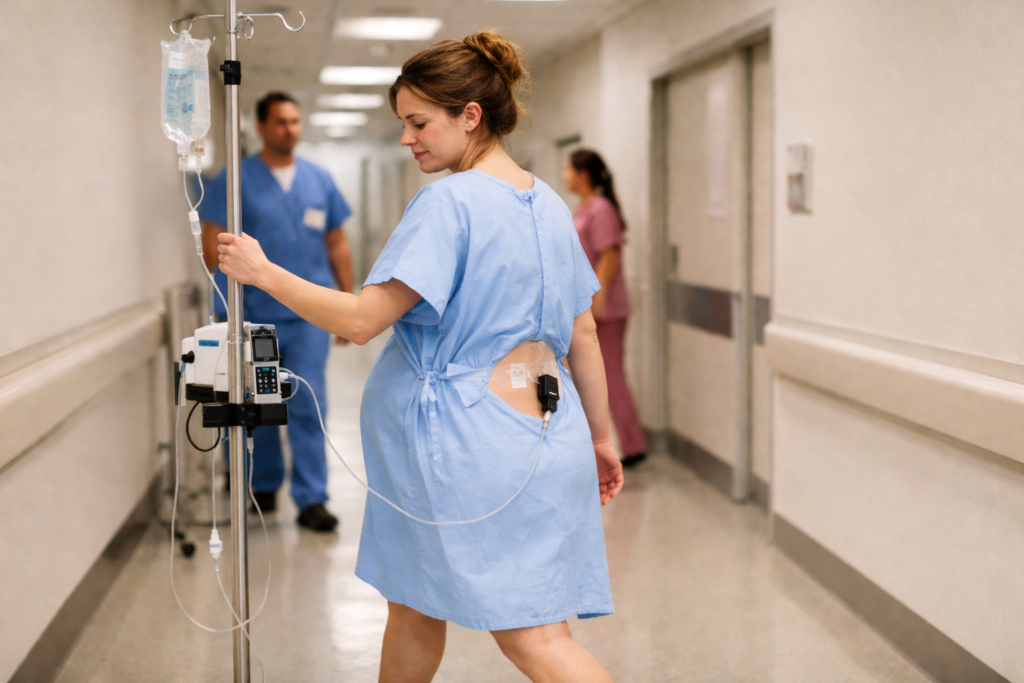
At the University Hospital of Brussels (H.U.B.), giving birth is entering a new era. For the first time in French-speaking Belgium, women can experience a vaginal delivery under an ambulatory epidural, a procedure that manages pain effectively while allowing them to move freely during labour.
Active participation in childbirth
Traditionally, epidurals required women to remain in bed, limiting mobility and the natural movements that can support the progress of labour. The new protocol, developed jointly by the hospital’s gynaecology-obstetrics and anaesthesiology teams, preserves sensations and maintains leg mobility, enabling mothers to actively participate in their childbirth.
“Movement is life,” says Dr. Clotilde Lamy, Director of the Gynaecology-Obstetrics Clinic at H.U.B. She emphasises that being able to move during labour not only improves maternal comfort but also supports the physiological process of birth, making labour smoother and more efficient for both mother and child.
Natural experience of childbirth
The approach reflects a modern vision of obstetrics that balances medical safety with respect for the natural experience of childbirth. By allowing women to walk, change positions, or sit upright, the hospital aims to enhance autonomy and reduce interventions, such as the use of forceps or vacuum extraction.
The innovation is the result of unprecedented collaboration within the hospital. Teams from gynaecology-obstetrics and anaesthesiology worked together to design a specific clinical protocol, ensuring that safety remains paramount while opening new possibilities for how labour is managed.
With this ambulatory epidural, H.U.B. offers expectant mothers a scientifically supported, innovative option. Hospital officials hope it will transform the childbirth experience in French-speaking Belgium, empowering women to remain active participants from the first contractions to delivery.
