

Belgium's Constitutional Court has temporarily suspended the country's stricter rules on family reunification introduced by the Federal Government last summer. The court has doubts about compatibility with EU law.
Under the regulations that Migration Minister Anneleen Van Bossuyt (N-VA) introduced, asylum seekers can only apply for family reunification after a waiting period of at least two years. The income threshold had also been raised significantly.
"This ruling shows that a strict migration policy is only possible with respect for and within the framework of fundamental human rights," Matthieu Lys of the Alter Egaux law firm, one of the solicitors who brought the appeal and suspension proceedings against the federal legislation, told Belga News Agency.
He called the ruling "excellent news" and said that it is "a very strong signal to the Federal Government; the Constitutional Court is letting it know that the government cannot simply do whatever it wants."
Serious harm
The first suspended measure allowed Belgium's asylum reception agency, Fedasil, to limit or withdraw the right to material assistance when a person applies for asylum in Belgium while already having been granted asylum in another EU country.
The second one concerned the abolition of the possibility, in special circumstances, of not assigning a compulsory place of registration or of lifting it – which allowed asylum seekers to receive financial assistance.
Several asylum seekers appealed to the Constitutional Court to suspend these measures. Now, the Court ruled that the refusal of material assistance to asylum seekers who have already been granted asylum in Greece could cause them "serious harm that would be difficult to repair."
As it is not certain whether EU law allows Belgium to refuse material assistance in such a situation, the Court has referred the matter to the Court of Justice of the European Union (CJEU) for a preliminary ruling.

Illustration image of a family in Brussels. Credit: Belga/ Nicolas Maeterlinck
The court added that, by abolishing any possibility of reception in the form of financial assistance, it may also cause harm to asylum seekers who have already submitted an initial application in Belgium, and are not given access to reception facilities due to the saturation of the Fedasil reception network.
The provisions in question appear to be contrary to EU law and a number of fundamental rights, the Court ruled. Therefore, it is suspending the provisions and will rule on the appeals for annulment of the provisions within three months.
Additionally, the Court is temporarily suspending the stricter rules on family reunification, whereby family members who join their relatives are subject to stricter rules.
Lys particularly emphasised the importance of the preliminary question referred by the Constitutional Court to the EUCJ, which will consider whether Belgian federal legislation is indeed compatible with European regulations. "Minister Van Bossuyt has always claimed that this was the case, but we have always disputed this. The Constitutional Court agrees with us on this by referring the question to a higher court," he said.
'Confirms what we see every day'
The Court also ruled in favour of the private prosecutors on the right to reception, Lys said. "The judgment stipulates that no significant steps may be taken backwards about the right to reception."
For Refugee Work Flanders, a Flemish civil society organisation that assists refugees and asylum seekers, the ruling "confirms what we see every day in the field."
"The Court's ruling shows that the Federal Government's policy can cause serious harm to people fleeing their countries," Thomas Willekens of Refugee Work Flanders told Belga.
Refugee Work Flanders also submitted a request for the annulment of the federal legislation at the beginning of February, together with 24 other organisations.
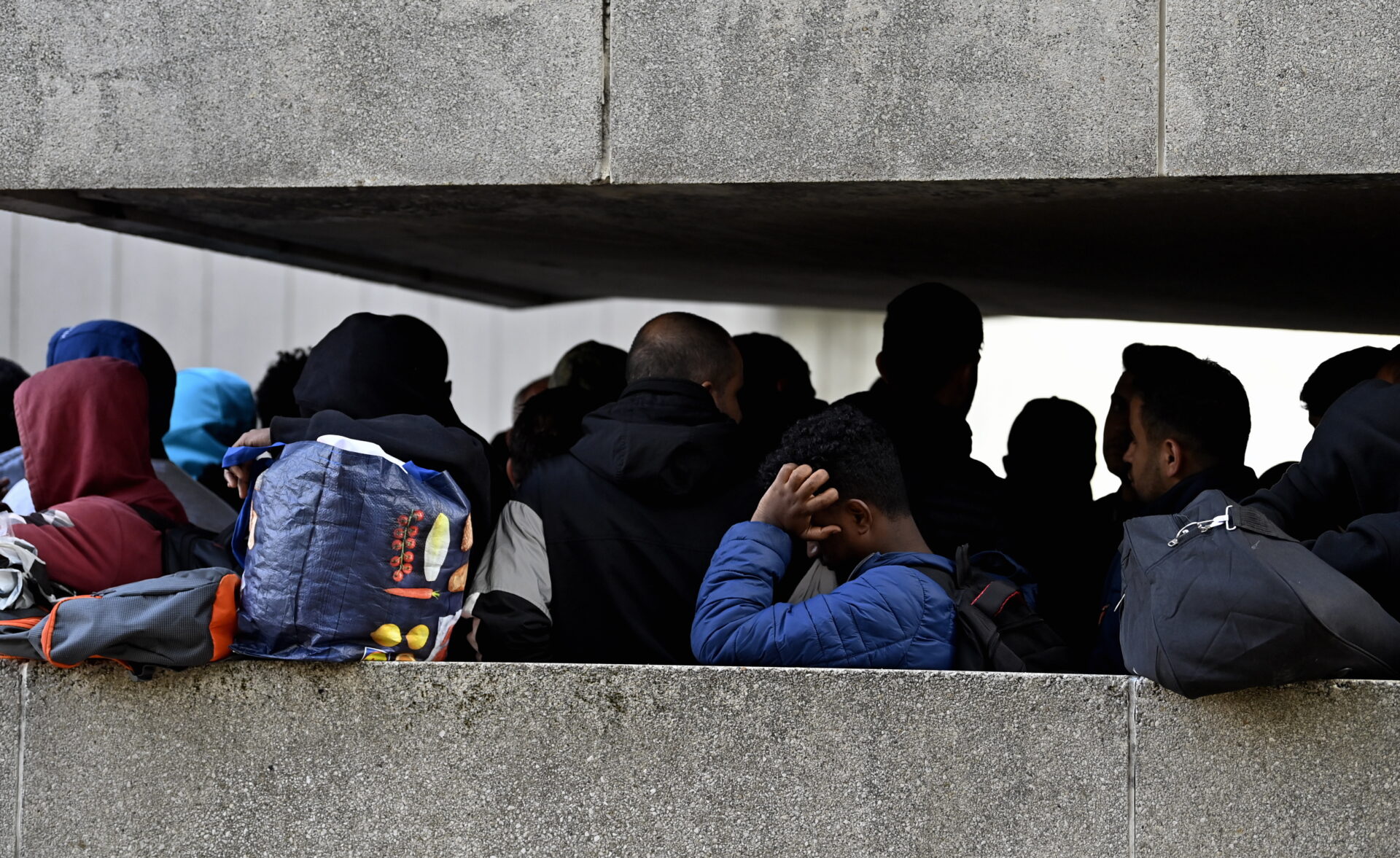
Refugees in Brussels. Credit: Belga / Eric Lalmand
According to Willekens, this first step, in which private prosecutors were upheld, and various legal provisions were suspended, shows "crystal clear" that "the strict migration policy of this Federal Government causes irreparable damage to people fleeing and to newcomers."
"This government is promoting itself with what it calls 'the strictest asylum policy ever'. The Court's ruling shows that this policy can cause serious harm to people fleeing their homes," Willekens said.
The organisation hopes that the Court will ultimately overturn the unconstitutional restrictions and that the government will work towards a humane asylum and migration policy that respects fundamental rights.
The Constitutional Court referred five specific questions on this matter to the CJEU. Only once a response has been formulated will the Constitutional Court issue a final ruling on the matter.
