
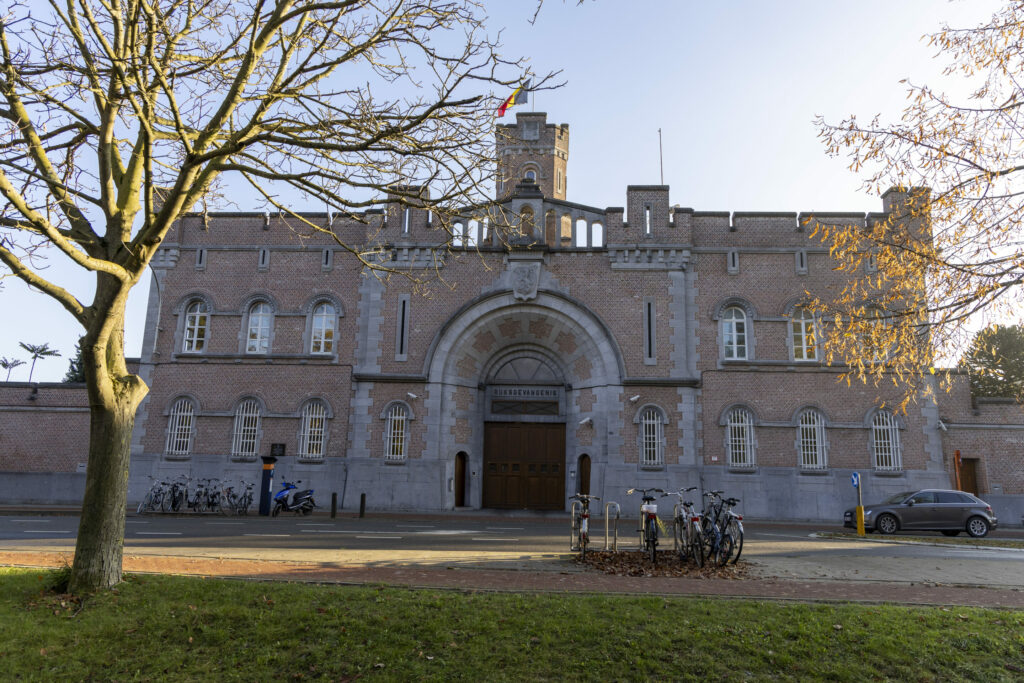
The criminal court in Ghent has acquitted the Justice Ministry in a case brought by an inmate at Ghent prison who alleged that his living conditions amounted to degrading treatment.
The detainee, identified as Nordin A., is serving a sentence for drug offences. While accepting his conviction, he argued that his detention conditions breached Article 3 of the European Convention on Human Rights, which prohibits inhuman or degrading treatment.
He claimed that for a period of 49 days he was confined to a living space of just 2.24 square metres and that, as a diabetic, he did not receive adequate insulin injections. He sought €1,000 in damages and requested the appointment of a doctor to examine him.
His lawyer, Jesse Van den Broeck, argued that Belgian prison conditions have repeatedly been criticised by the Strasbourg court and that structural reform remains lacking despite political assurances.
Counsel for the state, Kris Luyckx, acknowledged systemic challenges within Belgian prisons but argued that the court had to assess the individual case rather than general conditions.
No intent proven
In its judgment, the court found that the inmate had been subjected to "a hardship exceeding the inevitable level of suffering inherent in detention" and that the material element of humiliating treatment was established.
However, it ruled that the moral element required to constitute a violation was lacking. The court examined whether the Belgian state had deliberately subjected the detainee to degrading treatment between 17 June and 5 August 2025 or had failed to implement its policy of respecting human dignity.
It concluded that there was no evidence of a deliberate decision to impose such treatment.
The judgment states that the Belgian state, represented by the Minister of Justice, is pursuing a policy aimed at preserving humane detention conditions and prioritising prisoners' dignity.
It also noted that the state faces structural constraints beyond its sole control, including permit procedures, forensic psychiatric capacity and bilateral agreements concerning detainees without residence status.
On that basis, the court ruled that the charge of inhuman treatment was not proven and granted absolution to the Belgian state. As a result, it did not rule on the prisoner's compensation claim.
