
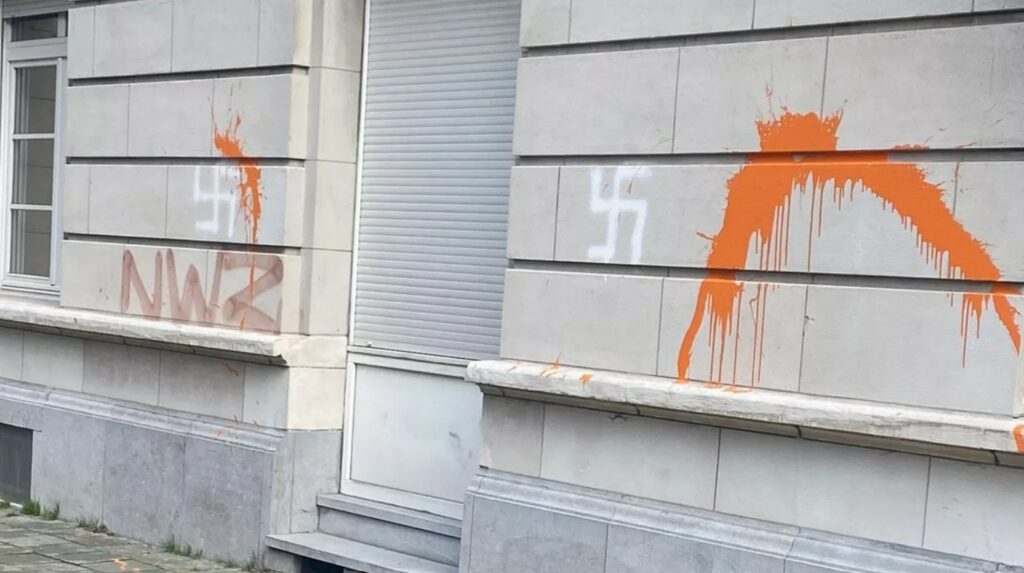
Antisemitic prejudices are widespread in Brussels, according to new research by the Jonathas Institute, a centre for studies and actions against antisemitism in Belgium.
At the request of the Jonathas Institute, research agency Ipsos presented a whole series of antisemitic prejudices to 600 Brussels residents between 2 and 6 July last summer. While strict criteria were met in terms of gender and age, the sample was not strictly representative in terms of ethnic and religious diversity, particularly due to the relative under-representation of Muslim Brussels residents.
"The results are clear: the study highlights that the population of Brussels continues to hold many antisemitic stereotypes 'inherited from the past' of a religious or political nature," the institute said.
It added that these stereotypes are "sometimes expressed as 'obvious truths' without apparent animosity," adding that that makes them "all the more likely to be trivialised, particularly in digital spaces."
Earlier this week, explosions were heard near the synagogue in the city of Liège, but no one was injured. Prime Minister Bart De Wever (N-VA) and Interior Minister Bernard Quintin (MR) immediately condemned the attack as an antisemitic act, but Joshua Nejman, the rabbi of the synagogue, warned against jumping to conclusions.
'Unassimilable race'
The survey found that 40% of Brussels respondents agreed with the statement that Jews control the financial and banking sectors, and one in four even held them responsible for various economic crises.
Over one in five (22%) of respondents agreed with the statement that Jews are "not Belgians like the others," while 21% consider Jews to be an "unassimilable race."
"The attack on the synagogue in Liège confirms that it is no longer just antisemitic speech that has been unleashed, but antisemitic acts as well. This aggressive antisemitism continues to rise," the institute added.
The prejudice that "Jews form a close-knit or closed community" was shared by 70% of respondents, while 39% believe that "Jews are doing to Palestinians what the Nazis did to them."
These prejudices against Jewish people are sometimes linked to the Israeli-Palestinian conflict, but the institute believes that they are not limited to it, and are part of "a more comprehensive view of otherness."
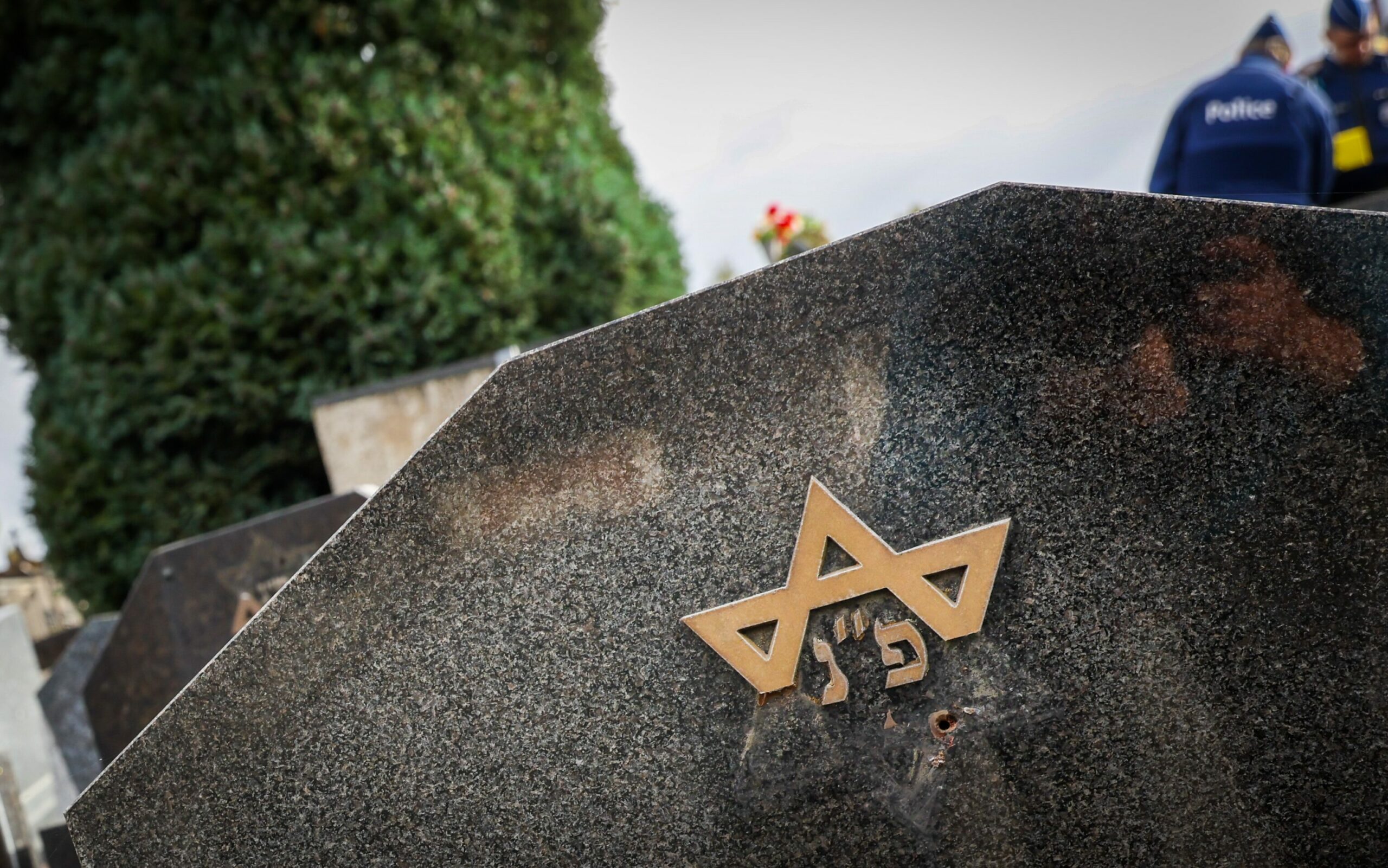
At least 85 Jewish graves were desecrated at the Jewish part of the cemetery in Charleroi, Friday 24 November 2023. Credit: Belga/Virginie Lefour
While the study confirms that antisemitic views are present across all social and political groups, the researchers found that these views are significantly more intense among people voting for political extremes, the younger generations, and certain groups defined by ethno-religious factors (particularly Muslims in Brussels, but to a lesser extent, also practising Catholics).
Importantly, the study emphasised the need to avoid generalisations about any of these groups. For example, they stressed that Belgian Islam, in particular, is "pluralistic and heterogeneous."
Additionally, nearly 40% of 18 to 35-year-old respondents compared Israel's behaviour to that of the Nazis – something that the institute called "a sign of the trivialisation of extreme historical parallels."
Among far-right supporters, 69% believe that Jews exploit the Holocaust, and 72% believe they exploit antisemitism for their own interests.
However, certain representations of antisemitism are also present among those on the far-left on the political spectrum, stressed the researchers: 33% consider Jews to be an "unassimilable race," and less than one in two consider spraying graffiti on a Jewish site in protest against Israel to be antisemitic.
Key recommendations
Based on its own research, the Jonathas Institute has two key recommendations. Firstly, it recommends strengthening historical education, digital literacy, and vigilance against discourse that justifies symbolic or physical attacks.
Secondly, the institute also advocates for the formalisation of the International Holocaust Remembrance Alliance's (IHRA) working definition of antisemitism to better distinguish "legitimate criticism of Israel" from "forms of anti-Zionism that revive antisemitic patterns."
However, the IHRA's definition is highly controversial: in April 2023, more than 100 Israeli and international civil society groups warned UN Secretary-General António Guterres against adopting it, saying that it is being "misused" to protect Israel from legitimate criticism.
The IHRA's definition has been adopted by almost all EU Member States, including Belgium.
In an open letter, the groups said that the adoption of the definition is usually framed as an essential step in efforts to combat antisemitism, but that in practice, "it has often been used to wrongly label criticism of Israel as antisemitic, and thus chill and sometimes suppress, non-violent protest, activism and speech critical of Israel and/or Zionism, including in the US and Europe."
United Nations (UN) flag. Credit: Belga/Nicolas Maeterlinck
In response to the IHRA definition, more than 350 scholars of antisemitism, Holocaust studies and Jewish studies drew up an alternative: the Jerusalem Declaration on Antisemitism.
On the website, its signatories said the IHRA definition was "unclear in key respects and widely open to different interpretations." As a result, they said it "caused confusion and generated controversy, hence weakening the fight against antisemitism."
Created in March 2024 following the 7 October attacks in Israel and their repercussions in Europe, the Jonathas Institute is a centre for study and action against antisemitism and everything that promotes it in Belgium.
