
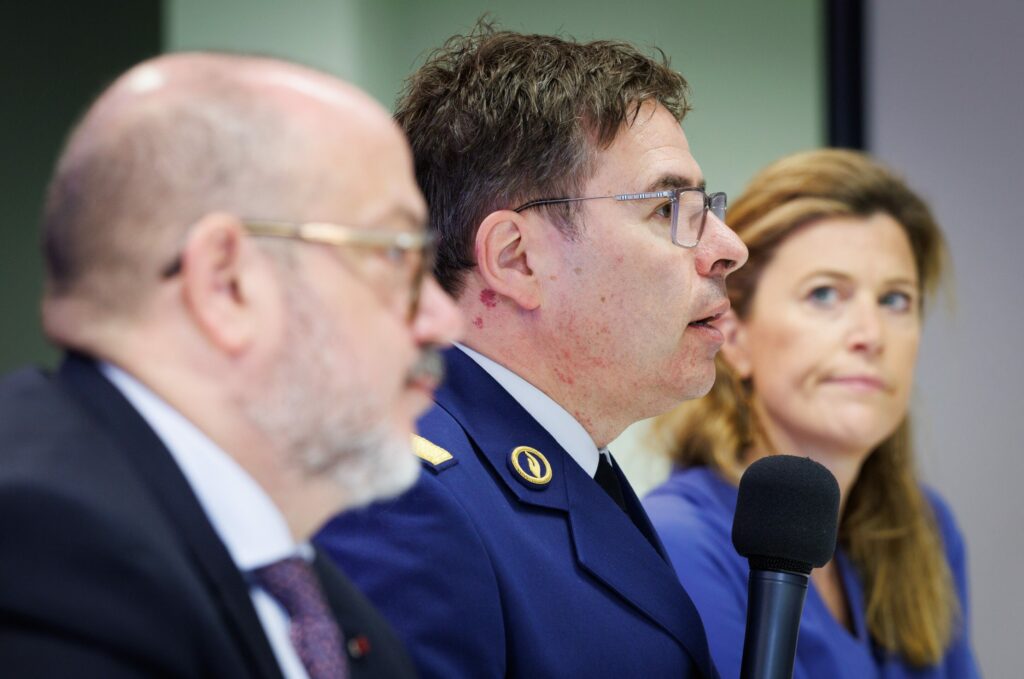
Federal police seized €195,031,046 of criminal assets in 2025, according to the annual report presented this week by Commissioner-General Eric Snoeck, in the presence of Interior Minister Bernard Quintin and Justice Minister Annelies Verlinden.
This result, slightly lower than in 2024, represents only a portion of the actual volume of seizures, the report explains. Amounts recovered through plea bargains, the market value of seized illegal assets, and recoveries made by other authorities, including inspection services and the Federal Public Service Finance, are not included in this figure.
According to Snoeck, the year 2025 thus confirms “the relevance and robustness” of the approach aimed at dismantling the criminal economy.
The Commissioner-General presented the five key areas on which the police services are working, with the fight against organised and complex crime at the forefront.
A total of 4,011 new investigations were opened, more than 10 per day: 804 concerned money laundering, 693 narcotics, 600 violent offences, 342 theft, and 252 economic and financial crime. These five criminal phenomena account for more than two-thirds of open investigations.
Organised crime in Belgium
In the fight against organised crime, 58,937 suspects have been identified in ongoing cases (including 11,210 for drug trafficking, 8,317 for money laundering, and 5,427 for violence), and 1,521 convictions were handed down in 2025, representing a total of 4,756.5 years of imprisonment.
The Federal Judicial Police (PJF) has, in fact, dedicated the majority of its investigative capacity to drug-related crime (20%).
The Commissioner-General emphasised the preventative aspect of this fight. For example, 18,175 security screenings were carried out in seaports, including Antwerp, and 310 negative security clearances were issued.
Belgium is not just a transit point for drugs; it is also a production site, Snoeck emphasised. As such, 41 clandestine drug production laboratories were dismantled in 2025. While Limburg is home to one in three laboratories, there is an increasingly widespread presence across the country.
Cyber-crime and radicalisation
Other areas of focus in 2025 included cybercrime, the fight against radicalisation, violent extremism and terrorism, border management, and specialised and/or supra-local operational support.
The Federal Computer Crime Unit (FCCU) opened 143 cybercrime investigations in 2025, and 73 cybercriminals were convicted.
As part of the fight against radicalisation, the Federal Judicial Police (PJF) opened 159 new investigations. “This does not mean 159 attacks were thwarted,” clarified Snoeck, praising this police activity, which is “often largely invisible” to the general public.
The Commissioner-General emphasised that all the recommendations of the Parliamentary Commission of Inquiry into the March 22, 2016 attacks were “implemented or in the process of being implemented.”
The Federal Police also checked 14.2 million passengers entering the country via airports, Brussels-Midi station, and seaports.
Regarding operational support, the Missing Persons Unit recorded 1,532 worrying disappearances in 2025; in 94% of cases, the person was found alive.
One of the challenges for the coming years will be recruitment, indicated Snoeck. The Federal Police is focusing on specialised IT and Finance profiles. In 2025, 2,976 candidates passed the selection tests for an operational function, an increase of 20% compared to 2024. Among these, 1,790 successful candidates were destined for the position of police inspector.
