
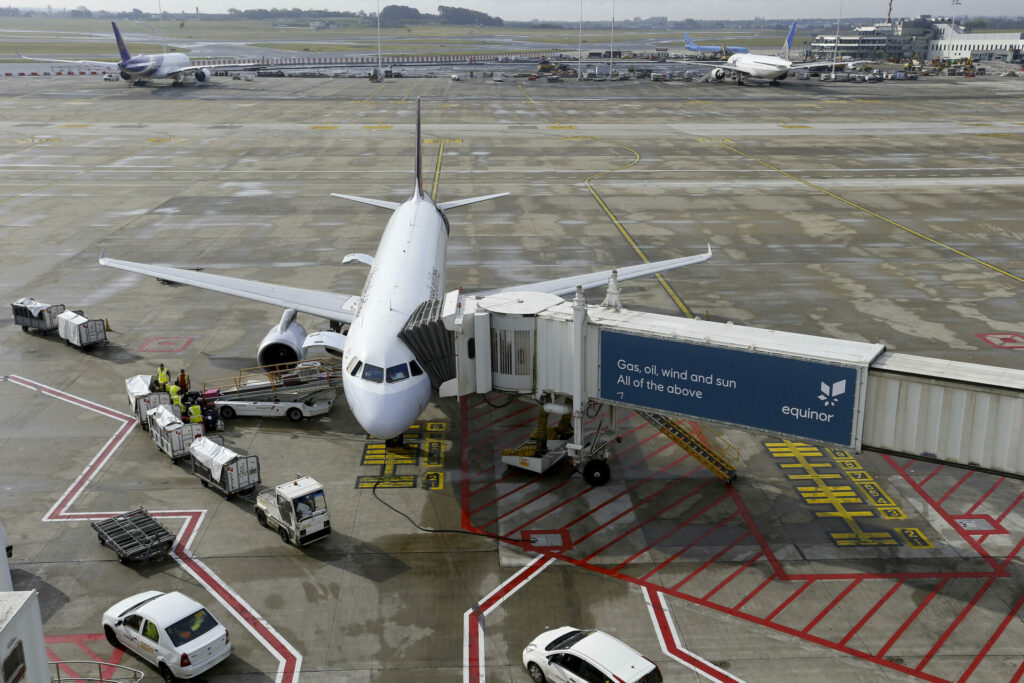
The European Commission on Wednesday called on Member States to coordinate closely to prevent a potential kerosene shortage in the run-up to summer.
The Commission will set up an observatory designed to enable the European Union to respond swiftly.
The observatory is to monitor the production, imports, exports and stocks of kerosene and other transport fuels in the EU. This should make it possible to identify any shortages quickly and take targeted measures to ensure "balanced fuel distribution" should emergency stocks be released.
The International Energy Agency (IEA) estimates that a genuine kerosene supply problem could arise within five to six weeks as a result of the war in the Middle East and the ongoing closure of the Strait of Hormuz.
"We are not there yet, but we could end up in a situation where this could cause real problems," said European Commissioner for Energy Dan Jorgensen. "Our economy depends on the ability to fly. People want to go on holiday; many regions and cities depend on tourism and are very concerned."
Stocking up
The EU imports around 40% of its kerosene. About half of that passes through the Strait. The Commission will therefore work on measures to ensure that European refineries operate at full capacity during the crisis. They have the capacity to cover around 70% of kerosene consumption.
The Commission emphasises that Member States must, in any event, closely coordinate national measures regarding the availability of kerosene and diesel. This is to prevent Member States from competing against one another and driving prices up even further.
According to the Commission, this close coordination is also necessary with a view to the possible release of strategic oil reserves and the replenishment of gas stocks for the coming winter.
In principle, Member States must have their storage facilities 90% full, but this may be reduced to 80% under certain circumstances. The Commission is prepared to lower that threshold by a further 5% if necessary.
The measures form part of a toolbox of recommendations and new initiatives presented by the Commission on Wednesday to tackle the energy crisis.
As is well known, it advises Member States to take "temporary and targeted measures" to support vulnerable consumers, for example, through targeted income support, energy vouchers or a reduction in excise duties on electricity.
Illustration picture shows an airplane flying. Credit: Belga
The Commission will also approve a temporary state aid framework later this month, which will give governments extra scope to take emergency measures to benefit the sectors most exposed to high energy prices, primarily energy-intensive industry.
Since the crisis began, the EU has already had to spend an additional €24 billion on fossil fuel imports. According to the Commission, this demonstrates once again how important it is to make the transition to sustainable fuels produced in Europe.
By the summer, the Commission will draw up an action plan setting out targets and measures to electrify industry, transport and the heating of buildings.
The Commission also hopes that the Member States and the European Parliament will be able to reach an agreement by the summer on the development of infrastructure and networks to enable electrification.
In the meantime, it is itself preparing a proposal to ensure that electricity is taxed at a lower rate than fossil fuels.
Windfall tax?
The communication makes no mention of a European framework for a windfall tax on companies reaping unexpected profits from the current situation.
Germany, Italy, Spain, Portugal and Austria had advocated for this, and on Tuesday evening, Belgium's Federal Government decided that Prime Minister Bart De Wever (N-VA) would also champion a European initiative.
Vice-President Teresa Ribera made no secret of her support for the proposal, but pointed out that such a joint tax would require unanimity among the Member States. "At present, we see no possibility of reaching a joint decision on the introduction of a common tax across the European Union."
An earlier version of the communication also mentioned measures to reduce demand for fossil fuels, such as mandatory remote working or restrictions on car traffic, but those IAE-inspired recommendations for consumption cuts were ultimately dropped.
"We naturally still encourage Member States to do everything they can to reduce demand," Jorgensen responded. "It offers a solution to the current price crisis and can also help prevent supply security issues in the future. But we believe that Member States are best placed to decide for themselves which specific measures to take."
