
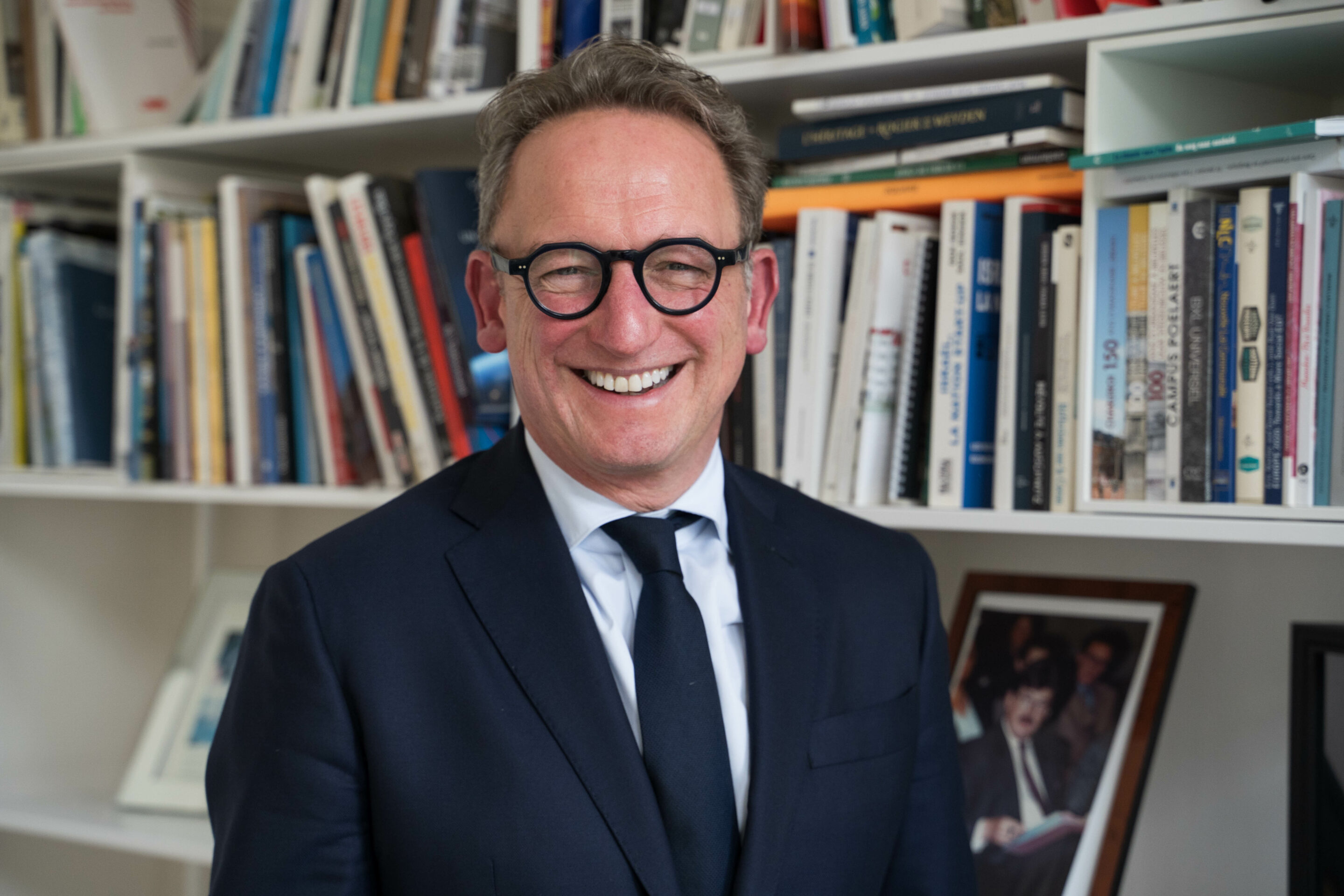
Two months after Boris Dilliès (MR) accepted a surprise phone call at 07:00 on Valentine's Day that turned him into the leader of the new Brussels Government, he sat down with The Brussels Times to talk about his vision for the city.
Overlooking the beech trees of Brussels' Parc Royal, Dilliès and several new members of his cabinet are gathered to meet us in his office. It wouldn't be Brussels if our conversation weren't preceded by the Belgian capital's awkward language shuffle: "bienvenue, uhh, goeiedag, hello. Donc, en français, ou..?"
There has been much ado about the minister-president's lack of Dutch skills (his new Dutch-speaking spokesperson reassures me they are "working on it"). His English is great, though – thanks to him spending time as an au pair in London as a young man, Dilliès explains.
Still, we settle on French as the language for our conversation. "It is easier for me, especially if we are going to talk in-depth about technical topics that require some nuance," he says.
And they certainly do require nuance. From the European institutions' place in Brussels to the city's security and cleanliness issues, and the "wall" between the so-called expat community and the capital's locals – nothing is simple in Brussels.
For someone with an unenviable in-tray, Dilliès seems very upbeat. Often described as a bon vivant, he is quick to smile and clearly feels at ease when laying out his vision. In fact, his eyes light up when he sees that one of his frequent metaphors or comparisons lands well.
The choice for Dilliès as the leader of the new government came as a surprise to pretty much everyone, including himself. He was not involved in the 613 days of difficult negotiations – something he considers an advantage.
"My working relationship with each minister is frank, but calm," he says. "I tip my hat at them, for having achieved something people did not believe was possible."
First things first
Having settled into the new job quickly, Dilliès is unafraid to speak his mind. Priority number one is getting Brussels' budget in order – something he stresses at the start and end of our conversation. It is a subject he repeatedly circles back to.
"The financial situation is truly appalling. It's catastrophic. So the first thing we need to do is get the budget back on track. I am well aware that this isn't popular. But it is the foundation of any policy," he says, adding, "it's not very sexy, I know."
The Brussels-Capital Region ended 2025 with a budget deficit of €1 billion – money that will have to be found by the end of this government's term in 2029.
According to the most recent budget resolution (adopted in March), this entails budgetary savings of €238 million in 2027, €303 million in 2028 and €415 million in 2029.
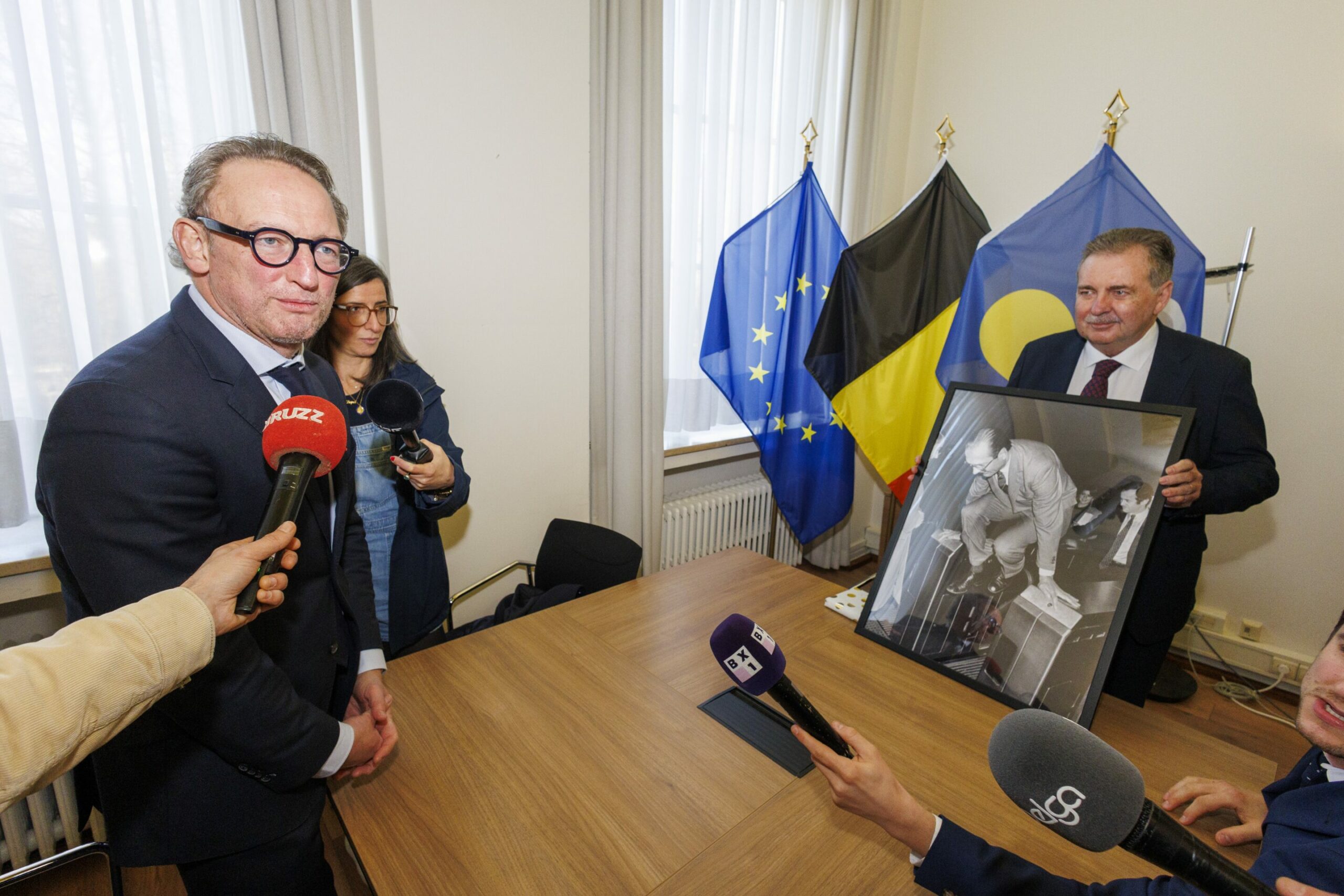
New Brussels Minister-President Boris Dillies (left) and former Brussels Minister-President Rudi Vervoort during the handover of the keys, Saturday 14 February 2026. Credit: Belga
While the government is counting on certain revenue policies, the bulk of the effort – 80% – will come through cuts and savings: a drastic overhaul of the public sector and civil services (merging services, a recruitment freeze, lower consultancy costs), savings in social housing and subsidies (especially for the housing and homelessness sectors) and the halting of grants.
"We are not doing this with a hatchet or a chainsaw," he says. "The distribution of these funds, grants and subsidies was sometimes very scattered, so there was a clean-up job to be done. It is quite normal to ask ourselves what we are doing with taxpayers’ money."
Being the face of a savings government will not make him popular, but he is "not here to whine", he says. He needs to get Brussels back on its feet – for the good of the people living in the city, but also the rest of the world.
"There is the policy we want to pursue. But first, we must be able to provide the resources for it," he says.
He believes getting the city out of the red is the only way to create better capability to act and respond to the problems facing the region, particularly in terms of cleanliness, safety and mobility.
Tackling Midi's bad reputation
Dilliès's first public appearance as minister-president was at the Brussels-Midi railway station – a rather symbolic choice. With the Eurostar and several other international trains arriving there, the station is a gateway to the city.
However, the station and its surroundings frequently make headlines for all the wrong reasons: poverty, homelessness, rising drug use, crime and feelings of insecurity – anyone arriving in Brussels via the Midi station will not get a great first impression.
"As a Brussels resident and a citizen, I have always been shocked and embarrassed to see certain aspects that the map of the city centre might present to a foreign visitor," Dilliès says. He sometimes gets the impression that "we have simply accepted it", he says.
Many people are "doing everything they can" to improve the area, but Dilliès sees a coordination issue. "Beyond the symbolism, that is why I wanted to visit the Midi station as the first thing that I did."
The government is allocating €28 million for its 'station plan' this legislature, of which €3 million is to be used this year. The plan addresses not just Midi but also the Brussels-North station.
The money will be used at multiple levels of government and in various areas, such as cleanliness, safety and urban planning.
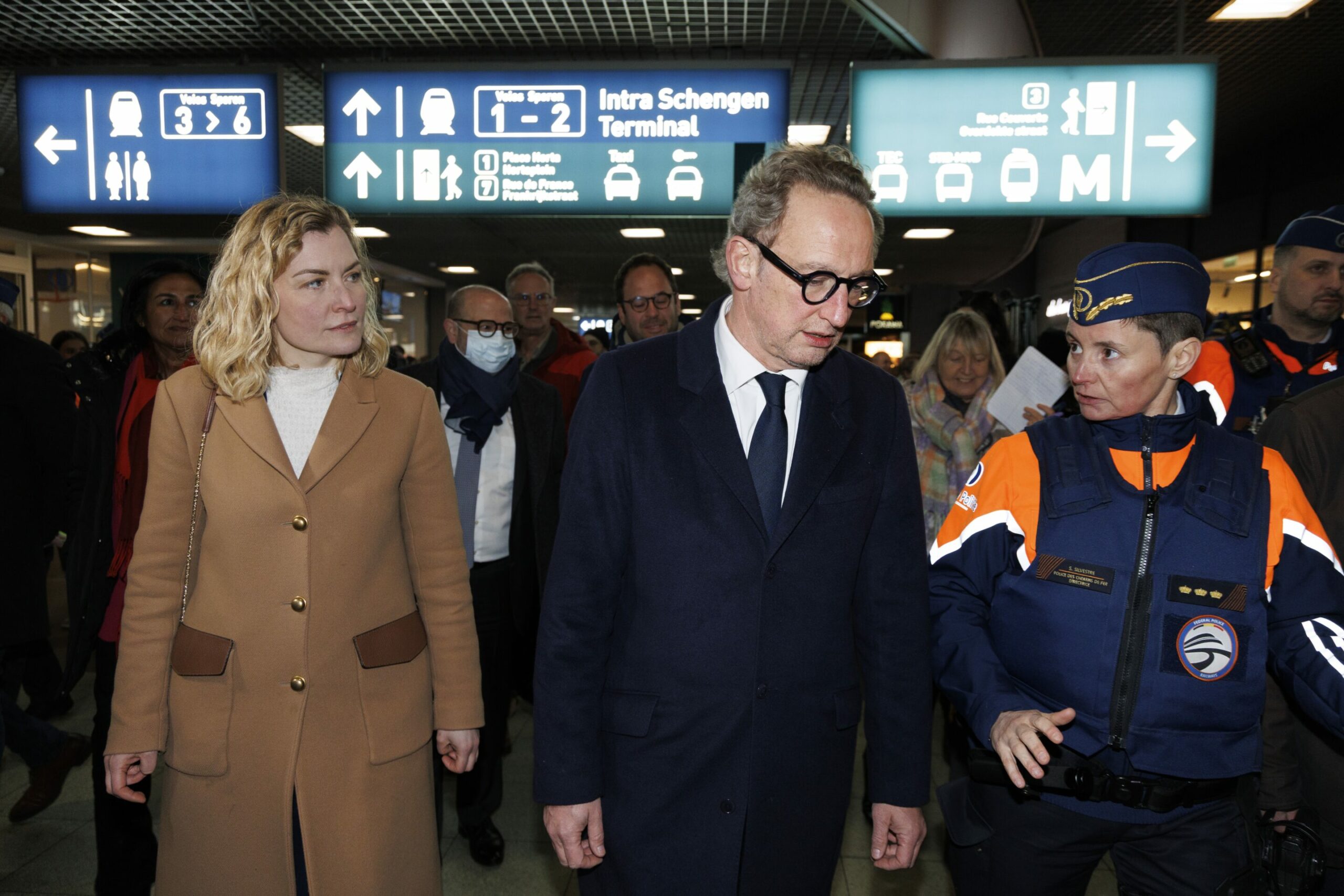
Brussels region State Secretary Audrey Henry (left), Brussels Minister-President Boris Dillies (middle) and a railways federal police officer pictured during a visit to the Brussels Midi station, on Monday 16 February 2026. Credit: Belga/Nicolas Maeterlinck
Cleaning up
Recalling his experience in the local council in Uccle, Dilliès is quick to stress that cleanliness goes beyond containers and rubbish bins: "Cleaning up is never the whole story. If you clean up but do not tackle the root causes of your problems, you can come back every week or every day, but it will not fix anything."
Therefore, this government will also address the issue of the people who are causing these issues. "Sanctions won't help, let’s not kid ourselves," he says. "Fining a homeless person or someone without papers makes no sense. These are just slogans, and they don’t solve anything."
Neither would creating a scheme that hides the poverty and precariousness, but does not fix anything. "That is not serious, and not responsible," he believes. Instead, the government will focus on combating problems of dependency and drug addiction, and on helping people in a socially vulnerable situation.
"Unfortunately, that is more complicated and takes more time," he says.
In addition to security, cleanliness, drug addiction and social distress, the station plan also highlights urban planning. "This must act as a lever within the plan's framework to ensure the regeneration of the surrounding area," he says.
From Beverly Hills to Disneyland
A combination of all those factors is needed to make a real change, Dilliès argues. "I recognise the difficulty of the task, but it will ultimately be a positive thing for the people of Brussels," he says.
Going from being the mayor of a wealthy municipality like Uccle to dealing with issues of the entire Brussels-Capital Region must be quite the change, I ask. Is he up to the task?
Immediately, he underlines that Uccle is "not the Beverly Hills of Brussels", no matter what anyone says. "When people talk about Uccle, they make a caricature of it," he claims.
There are, of course, very affluent neighbourhoods in "his" municipality, he says. "But other neighbourhoods have very diverse demographics – the same ones as in municipalities in the north of Brussels. Exactly the same."
Where, then, does this image come from? What's the secret to Uccle's success? Dilliès and his colleagues always paid close attention to cleanliness in all neighbourhoods, he says. "But also to schools, sports facilities, solidarity and social action. These are super important for quality of life."
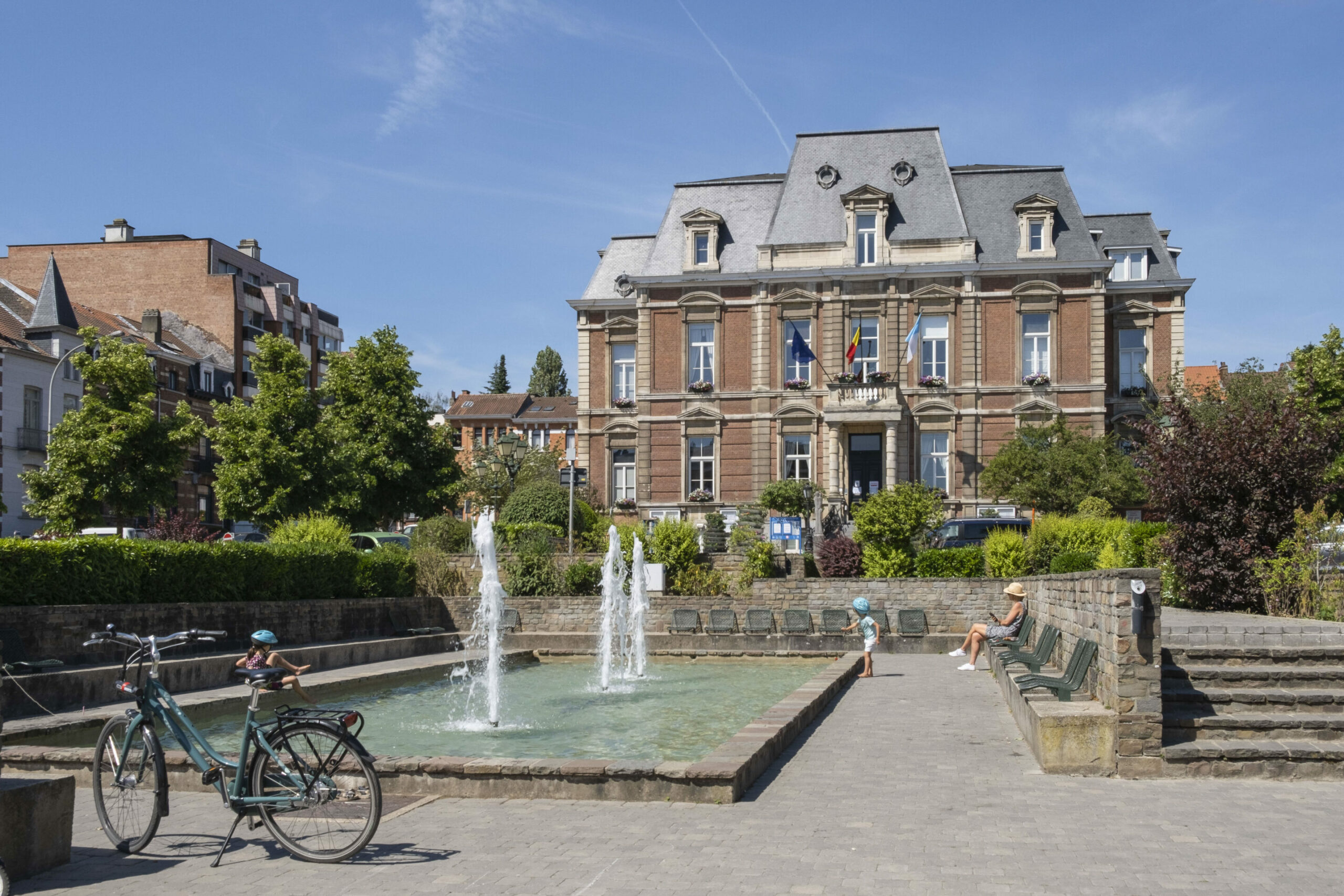
Uccle centre. Credit: Belga Photo/Paul-Henri Verlooy
He's "not a know-it-all", he says, and he admits it's not as simple as that. "But quite frankly, would it not be positive to say that in Brussels, whatever the neighbourhood, whatever the type of person, our primary objective is quality of life?"
While calling the caricature of Uccle "unfair" and "false", he is clearly still amused by its implications. "If, in a few years, there is an image of Brussels as a capital with carpet on the pavements everywhere and the sun shining every day... A bit like Disneyland, let's say, that is absolutely fine by me."
In all seriousness, he stresses that the people of Brussels, "whether they are in a three-piece suit or a djellaba", are looking for a good quality of life: they want good infrastructure for their children, they want safety, they want it to be clean, they want infrastructure that meets their expectations.
"Regardless of where we live, what we do or the colour of our skin, we all want the same thing, really."
Caught in the middle
The son of a French father, Dilliès is a dual citizen of France and Belgium. He was born in Brussels, but spent his early childhood in the south of France before returning to Uccle at the age of 10.
Asked if he considers himself somewhat of an expat too, he laughs a little. "The south of France is not exactly New York or London, but I indeed spent a large part of my childhood outside of Belgium." He pauses to reflect. "But no, I'd be lying if I said I consider myself an expat," he adds.
He sees himself as a Brussels resident and a Belgian, but also as a Frenchman. "Above all, I see myself as a European."
In fact, he says that his dual nationality was not always a bonus as a child. "In France, my classmates told me I was Belgian. But when I arrived in Belgium, people told me I was French."
From a young age, he says, this gave him an awareness of what it feels like to be considered different from those around you. "As a child, these things can hurt you. In a way, it made me aware of how victims of racism must feel."
While he acknowledges that his experiences "might seem trivial" in comparison to racism, he stresses that the effect is similar. "Even as a child, it wears you down to be categorised like that, to be considered less. It is unpleasant, it is tiring. It made me very sensitive to the importance of fighting against racism and antisemitism."
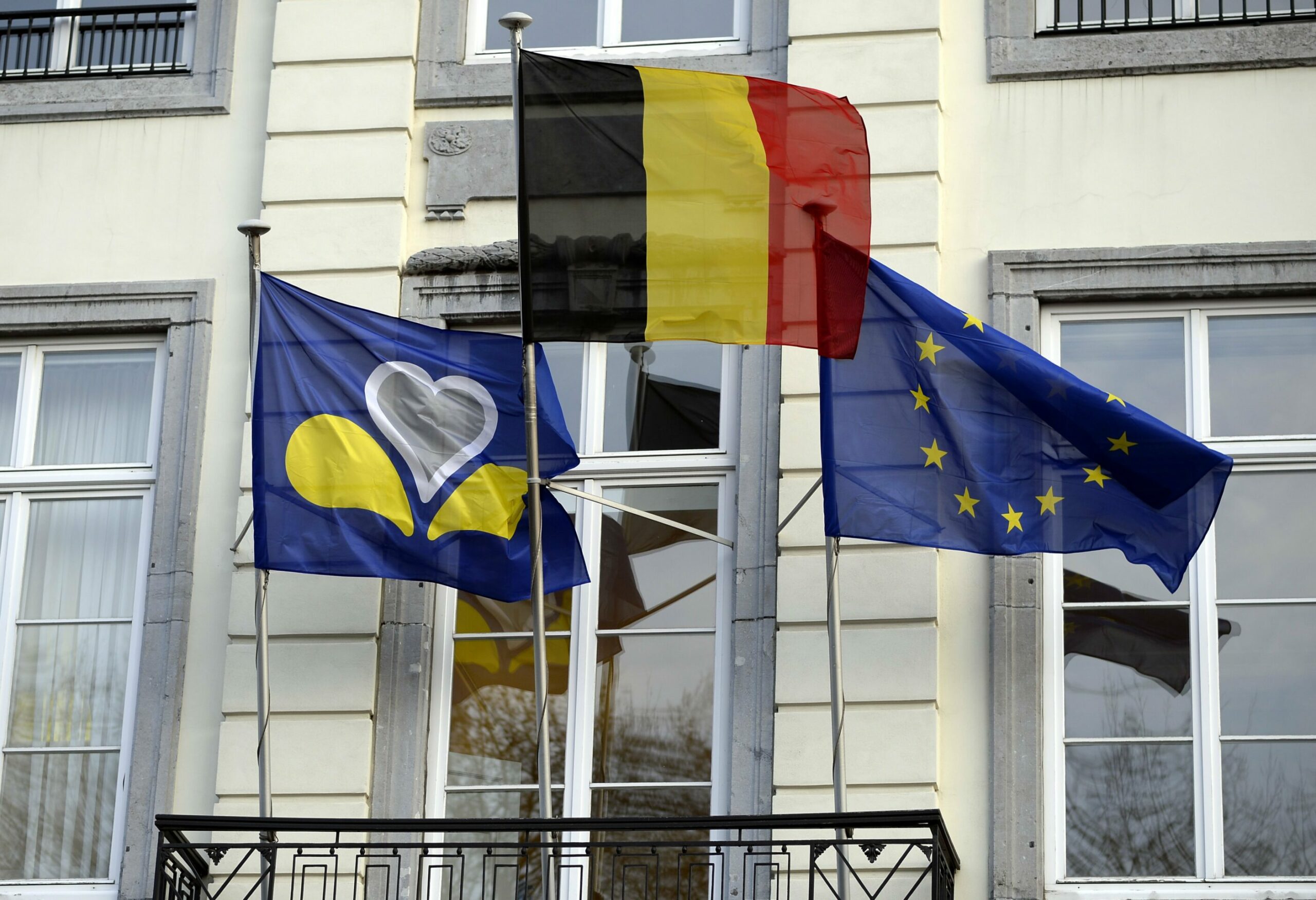
The flags of Brussels Region, Belgium and the European union pictured outside the cabinet of Brussels Region Minister-President. Credit: Belga
Speaking about feeling European, Dilliès feels that Brussels is not capitalising enough on its status as the unofficial capital of Europe. "When it comes to decision-making, Brussels is the centre of the world at certain times, if you look at the calendar of events taking place there."
Yet Brussels locals see the international sphere and the European institutions as "something separate" from the city – something "intruding" even, he believes. "There is a boundary, not to say a wall, between the international community and the people of Brussels. There are, in a way, two Brussels," he muses. "And that is truly regrettable."
If you go to Strasbourg, EU flags are everywhere. But if you come into Brussels via the Midi station, you will not see a single one. "Why not? It's quite surreal, really. Why aren't we seizing this opportunity?"
He assures us that the European institutions are "just as keen" as him to forge closer ties; this summer, he has a meeting with Roberta Metsola, the President of the European Parliament, and he wants to speak with European Commission President Ursula von der Leyen as well.
"It is not my job to stay here in my office, gazing from afar at the EU buildings, waving at each other from a distance," he adds. "We need to work together."
From surrealism to contemporary art
When we ask if his main aim is to make Brussels more attractive to the international community, Dilliès is quick to say yes. "But not just for them. They are not different from the locals. In my eyes, expats are Brussels residents, and I want to make Brussels more attractive for everyone."
Already, there are plenty of positives to highlight in the city, he stresses, including its cultural life, impressive heritage and high-quality cuisine. "There are some truly beautiful things in Brussels, and luckily, expats recognise that too. It's not all negative," he says.
Soon, the much-anticipated contemporary art museum Kanal-Centre Pompidou will be added to that list of attributes.
Set to open towards the end of the year, Kanal is poised to become one of Europe's largest museums, with a surface area of 40,000 m².
"It is probably one of the most ambitious ideas Brussels has had in the last 20 years," Dilliès says.
He admits he is "no expert" on contemporary art. "In fact, I know absolutely nothing about it. Nevertheless, I went to visit the Guggenheim, I went to visit the MoMA. Why? Because I knew there was something quite exceptional to see. And I don’t regret it."
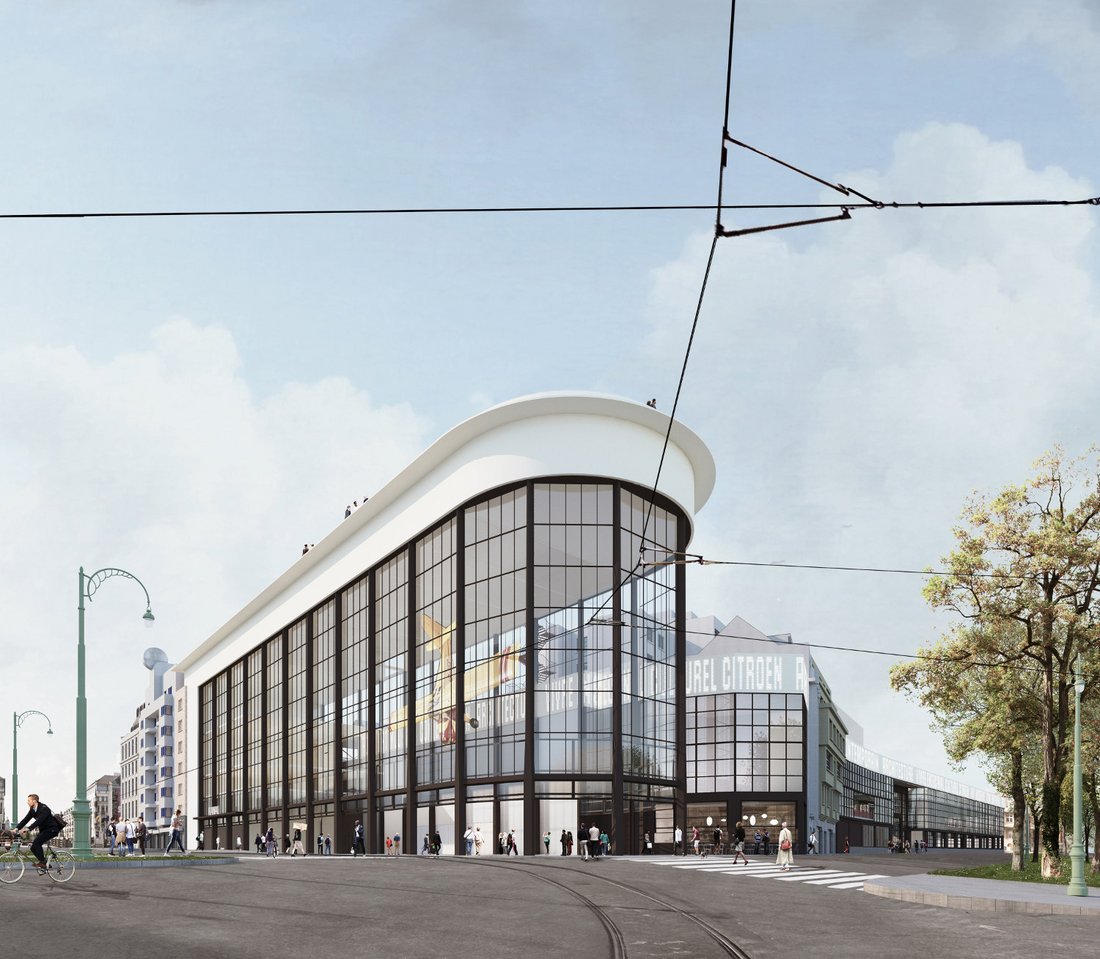
Kanal-Centre Pompidou graphic. Credit: centrepompidou.fr
This is exactly what Kanal should become for Brussels, he argues: a flagship.
The museum was due to be completed three years ago, but was hit by a series of financial and political problems. The final bill is expected to reach some €230 million.
With roughly €185 million already paid, the new government still needs to cough up nearly €60 million. "We decided to continue to invest in it. The worst thing would be to stop now. That would have been incredibly stupid."
He understands the concerns, but believes the investment will ultimately be worth it for Brussels.
"I am convinced that Brussels is destined to be part of the world’s capital. It has all the assets, it has all the potential," he says. But three years is not enough to realise that potential, he says. "Maybe more like 10 years."
Does that mean he's aiming for a second term? He assures us that he is not thinking about the 2029 elections at all.
"I have just been here for two months, but it feels like much longer because the days and weeks are very, very busy. So, I’m focused on the task at hand. And trust me, there is more than enough work to do."
Related News
- 'We must thank cyclists,' says new Brussels leader as he backpedals on Good Move
- Dilliès wants more money to boost security in Brussels - with an important caveat
- 'Disgraceful situation': New Brussels Government urged to tackle safety and cleanliness
- 'We are fully aware of the budgetary crisis': Dilliès outlines new budget strategy for Brussels
- A true gentleman with bad Dutch: Who is Boris Dilliès, Brussels' surprise new Minister-President?
- Brussels' Kanal-Centre Pompidou shares first exhibitions as anticipation grows
