
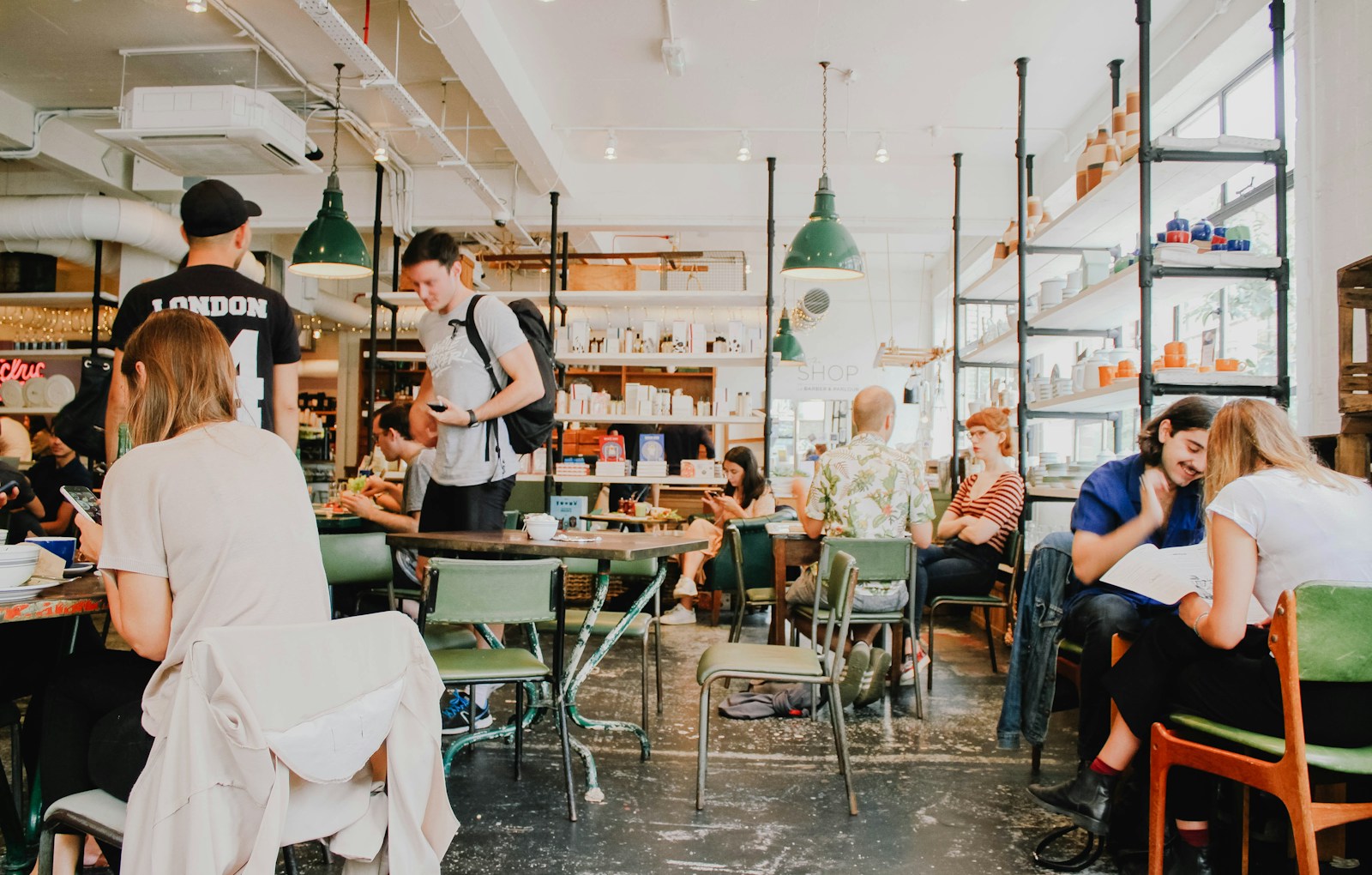
Kristina Chetcuti, a registered health coach (UKIHCA) specialising in behaviour change and lifestyle medicine (ELMO), answers your lifestyle dilemmas.
Q. I work in an international office in Brussels and am noticing a generational divide around lunch. Up until a few years ago, colleagues ate together most days – in twos or in small groups, we’d informally wander off to a café. It was unremarkable but it helped create a sense of camaraderie.
Now, many of my younger colleagues seem to prefer eating alone. They are perfectly polite and friendly, but there is much less spontaneous socialising around meals. I’m not sure if this is just a new lunchtime etiquette thing (and I’m being a bit nostalgic), or whether there’s still something valuable about eating together.
A. What you are describing is a significant shift happening in many offices across Europe. Certainly up until 10 years ago, lunchtime for office workers was a communal affair. Around 13:00, someone would push their chair back and say, “Fancy lunch?” and some people would nod and reply: “Hmm, yes actually I’m quite hungry” and together they’d head out for sandwiches or salad.
There was no loaded meaning behind the question and nobody thought too much about it: sometimes you joined, sometimes you did not. However, since Covid lunch seems to have taken another shape.
While those in their mid-30s and above seamlessly drifted back to old convivial lunchtimes post-Covid, younger colleagues have generally taken a slightly different approach. Although otherwise sociable, they seem to prefer eating alone. Sometimes they just make a disappearing act at around noon and pop back an hour later, or sometimes they eat at their desks, with headphones on or scrolling through their phones.
Possibly related to this, many of them bring lunch from home, either because they are more conscious about what they eat, or because they save eating out for friends rather than colleagues. Nobody is being rude exactly, but I get you – the atmosphere is different.
I don’t think this is a matter of changing etiquette, as such. It feels more like a deeper shift in how we now work and socialise. Many of us now spend hours in Zoom meetings, Teams calls, group chats, email threads and constant notifications. There is a subtle sense of being ‘on’ all the time, something that seems to have intensified since Covid.
I suspect, and confirmed with a quick straw poll among people in their twenties in my network, that younger workers are quite aware/wary of this ‘on’ switch and are more protective of their mental energy and work-life balance. Guarding lunchtime may be their way of creating a short break from yet more interaction.
This is my stepson’s take: “I don’t go out for lunch with colleagues,” he told me. “Why? We can talk to each other all day in an open-plan office.” Like many of his twenty-something colleagues in international companies, he always eats lunch at his desk, works through his lunch hour and leaves earlier. Work is work, life is life.
Should this, therefore, be the new office norm? I am not so sure, because I think there may be something in your nostalgia worth paying attention to. Both lifestyle medicine and positive psychology increasingly emphasise the importance of small social rituals.
We’re not talking about forced bonding at official team-building activities where you have to construct something dramatic like a spaceship out of cardboard, but ordinary moments of low-pressure human contact: chatting while making coffee or sharing a spontaneous lunch without an agenda. These moments may not seem particularly significant on their own – to moan about the latest general strike or to share that you are secretly a Eurovision fanatic – mundane stuff that creates familiarity and ease.
Over time, that can accumulate into trust, camaraderie and sometimes friendships that last long after you have moved on to other workplaces. (A handful of my closest friends can be traced back to various workplaces – I’m not sure I’d be able to build similar relationships today.)
Science backs up the benefits of eating communally. A study published only a few weeks ago in Nature found that people who regularly share meals – across different countries and cultures – report higher levels of wellbeing and lower levels of loneliness and stress. Which perhaps suggests that eating together is not merely an old office habit, but something innate in human nature.
Mediterranean cultures have long treated meals as moments of rhythm, companionship and pause. And around the world in the so-called Blue Zones (regions associated with exceptionally fit longevity) eating together is still part of daily life. 'Positive Psychology' researchers make similar observations. Barbara Fredrickson, known for her broaden-and-build theory argues that not every meaningful human interaction has to be deep or emotionally intense – water cooler ‘micro-moments’ of connection matter too.
Therefore, while it’s clear that as humans we flourish through moments of connection and conviviality, modern work culture often leaves younger people drawing boundaries around their time spent at work. This is almost biological evolutionary tension. The disappearance of communal lunches may sound trivial, but is this the unravelling of small rituals of coexistence that we’ve known since the dawn of time? Should we be okay with future in which everybody routinely eats alone? And most importantly, can we recreate an old social ease in a culture that no longer produces it naturally?
The answer is not straightforward. Because with that ‘fancy lunch?’ question, the younger colleagues are not thinking, “Hmm, yes actually I’m quite hungry.” They’re thinking: “If I say yes, will it become a daily expectation? If I don’t, does that signal something? Do I have enough energy for more interaction? I’d rather work my break so I can leave work earlier and meet my friends.”
What used to be, as you said, "unremarkable" has now become a more loaded social decision, with almost a strain on their resilience. So, how do we make lunchtime light and uncomplicated again?
I guess it has to start with accepting that office culture has changed, not for better or worse, just differently. Accepting that the working day now is more fragmented, with hybrid schedules, constant messages and crowded calendars, and that many people simply need more quiet time to offset this. Accepting that work lunch, once built naturally into the rhythm of office life, no longer plays quite the same role. And accepting that perhaps the only thing we can do is openly talk about it across the generational divide.
Possibly, sharing an article like this can lead to a surprisingly honest conversation, and perhaps create a bit more space for new, different small office rituals to evolve. Rituals that align more with modern office life but which also give us that sense of connection that we innately need.
Got a lifestyle health question you’ve been turning over in your mind? Send your dilemmas to k.westwood@brusselstimes.com, and we'll tackle them confidentially right here.
