
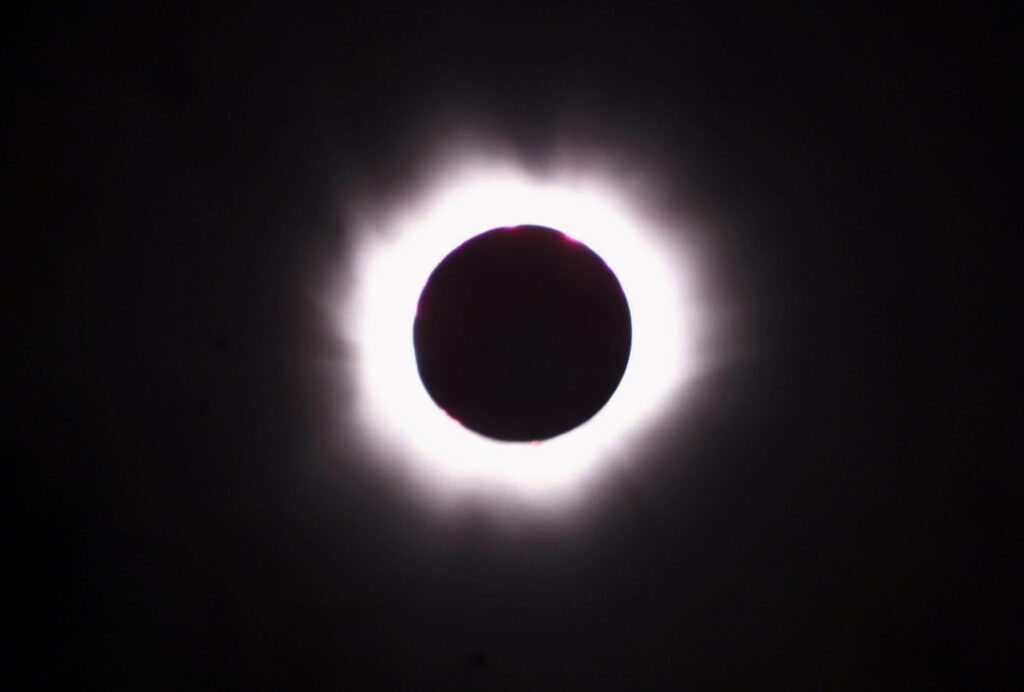
People across Belgium will have a chance to witness a partial solar eclipse in August.
On Wednesday, 12 August, the eclipse will be visible in Belgium, making it the largest seen in the country since 1999.
The Flemish public observatories are launching a brochure to inform young people about this exceptional phenomenon, the Urania public observatory reported on Thursday.
The solar eclipse of 12 August starts north of Russia and then moves via Greenland over Iceland towards Western Europe.
It is the first time since the solar eclipse of 11 August 1999 that the Moon's umbra strikes mainland Europe. It passes over northern Spain, grazing northeastern Portugal, before ending over the Balearic Islands at sunset.
The sun will be approximately 90% covered. The first contact between the Moon and the Sun will be visible at 19:18.
As the Sun rises lower in the sky, the degree of coverage increases. The maximum eclipse will finally be visible at 20:13, during which, as seen from Brussels, about 91% of the Sun's diameter will be covered.
Subsequently, the Moon will gradually disappear in front of the Sun until the final moment of contact around 21:05.
The last total eclipse in Belgium was on 11 August, 1999. The next one is not until 25 May, 2142. Partial eclipses occur more frequently. The next eclipses in Belgium are in 2027, 2028, and 2030.
The Flemish public observatories have advised people never to look directly at the sun and to protect their eyes with eclipse glasses or a solar filter. The full brochure is available via the website www.eclips2026.be.
